

Dear New World Investor:
“We can now say for the first time that the disinflationary process has started.” – Fed Chairman Powell, who used the word “disinflation” 12 times in yesterday’s press conference
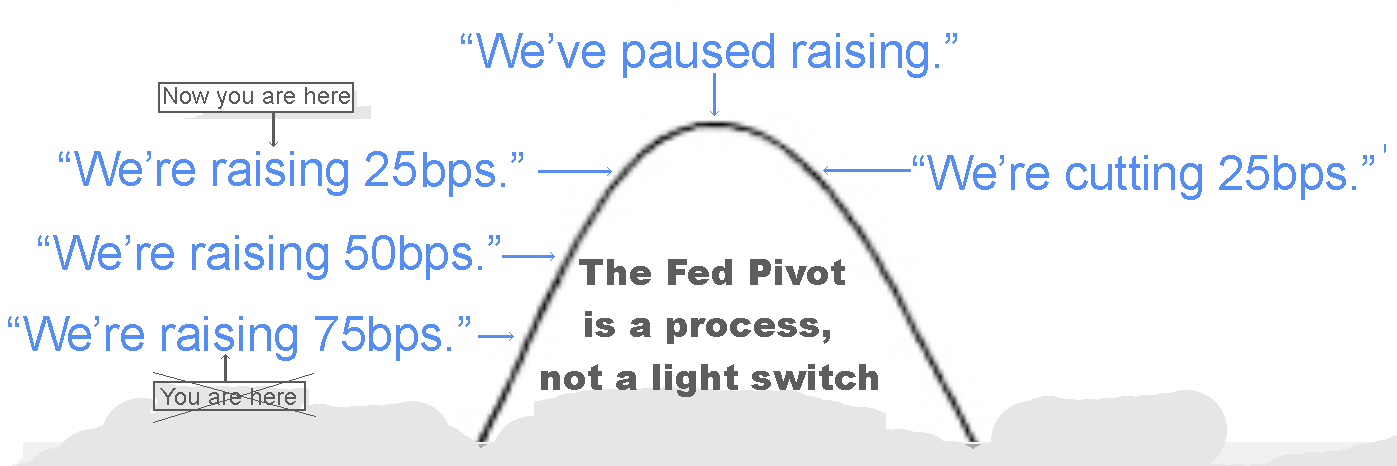
The Fed increased the funds rate a quarter-point yesterday to a new range of 4.50% to 4.75%, the highest level since October 2007. This was right in line with my Fed pivot graphic. Most investors don’t understand that the pivot is a process, not a light switch.
 Click for larger graphic
There was a big change in tone from the Fed. Powell not only said we’re in the early stages of disinflation, he specifically noted that it’s not showing up in housing yet, but that’s coming. He also said the central bank doesn’t want to over-tighten and that they’re close to pausing hikes. Stocks, bitcoin, and gold shot up while the US dollar and 10-year Treasury yields fell.
To some extent, the Fed uses their dot plot of expected future rate increases to talk tough and keep people scared. They believe that helps slow inflation by reducing expectations. But the bond market has been betting against the dot plot because it sees the weakness in the economy, housing, and employment.
 Click for larger graphic
Powell suggested two more increases might be enough. That’s likely because they are not going to slow down Quantitative Tightening and will continue to sell bonds to shrink their balance sheet, The drop in real M2 is the deepest since 1980.
 Click for larger graphic
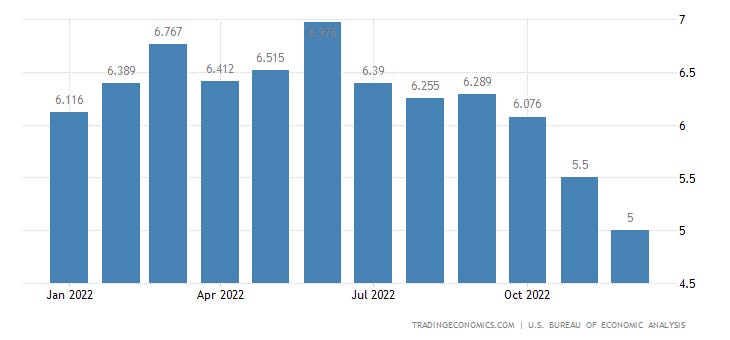
There seem to be two measures of inflation that the Fed cares most about. The first is the Personal Consumption Expenditures Index that they’ve always preferred. Last week’s report showed it is falling steadily. It was 5.0% year-over-year, the lowest since September 2021. It was only 0.1% month-over-month.
 Click for larger graphic
The Fed’s focus measure, Core PCE excluding food and energy, was 4.4% year-over-year, down from 4.7% in December and below the Fed’s December 2022 forecast for 4.8%.
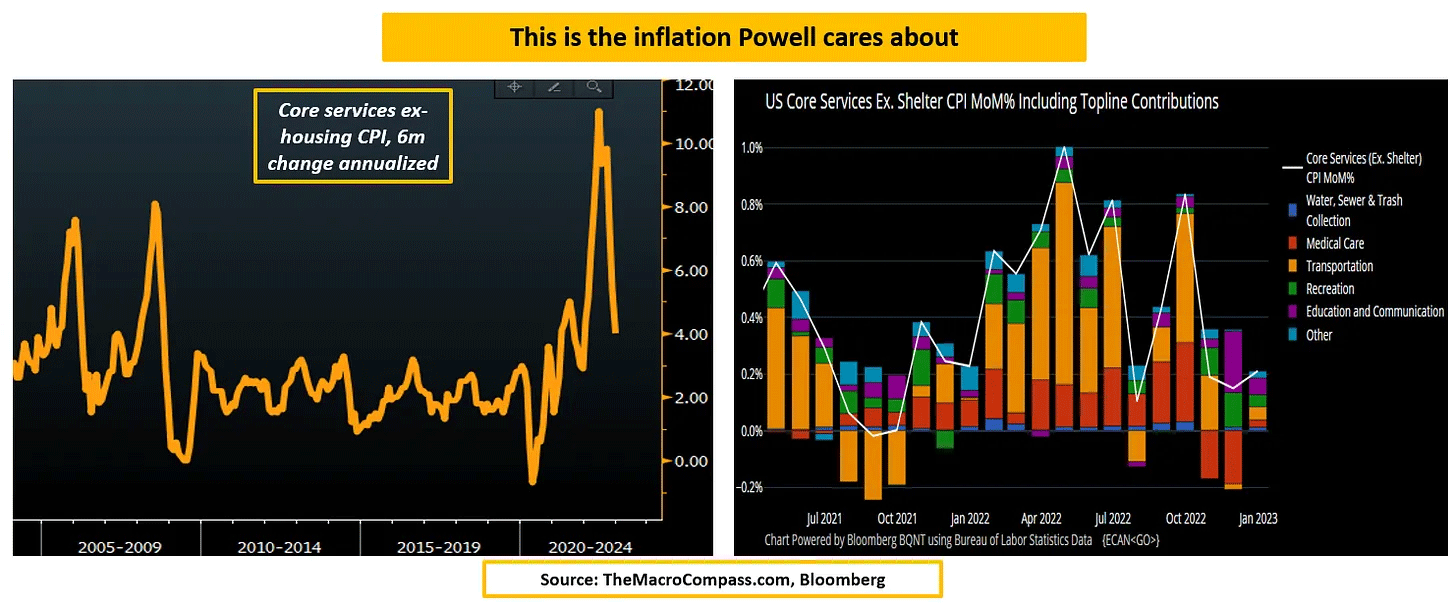
The new key inflation metric for the Powell Fed is Personal Consumption Expenditures on services, excluding housing. Powell believes this is a good measure of wage inflation. The six-month rate of change has plunged to 4%, but Powell wants to see it at 2%:
 Click for larger graphic
The three-month annualized core PCE is down to 2.9%, similar to the three-month annualized core Consumer Price Index at 3.1%.
In spite of the strong GDP number for the December quarter – +2.9% – the economy actually is quite weak. Much of the strength was driven by inventory growth of over $130 billion, which contributed 1.5 percentage points to the 2.9%. About $70 billion of it came from the manufacturing sector, which has seen a considerable decline in New Orders over the last two months. Inventory is a volatile component and levels will normalize, pulling down GDP growth in the March quarter. The Atlanta Fed’s GDPNow model is forecasting only +0.7% for the current quarter.
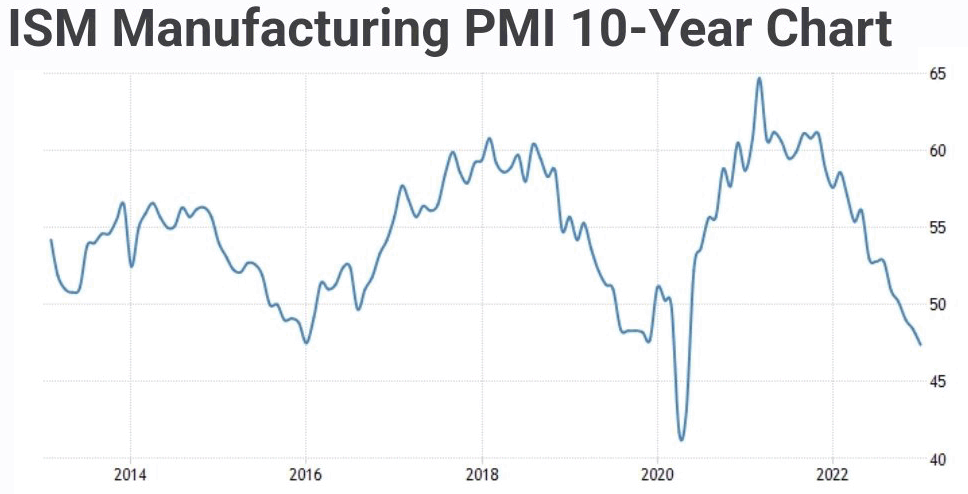
The Institute for Supply Management’s Purchasing Managers Index fell for the fifth month in a row to its lowest level since May 2020. The index fell from 48.4 in December to 47.4 in January, just below the 48.0 expectation. Their measure of prices paid for materials increased for the first time in nearly a year, to 44.5, but anything under 50 still suggests easing inflationary pressures. Manufacturing is in free fall, and manufacturing prices paid remain in contraction. Manufacturing employment at 50.6 is not in contraction quite yet, but that’s next.
 Click for larger graphic
Market Outlook
The S&P 500 added 2.9% since last Thursday as it booked its best January since 2019. The Index is up 6.1% year-to-date. The Nasdaq Composite jumped 6.0% and was up 10.7% in January, the most since 2001. It was down 33.1% in 2022, including an 8.7% drop in December. Since 1971, there have been 16 months that the Naz was up at least 10% in a month following a 12-month stretch in which it was down. It did quite well after that on average, up 73% of the time a year later with a median return of +24.7%.
 Click for larger graphic
It is up 16.6% for the year. The small-cap Russell 2000 gained 5.2% and is up 13.6% in 2023.
These “this market is tracking that older market” charts are usually meaningless hooey, but the S&P 500 is tracking the 1946-49 cycle in remarkable fashion. (See how the black and pink lines mirror one another.) There were similar fiscal/monetary and post-war inflation influences then and now.
 Click for larger graphic
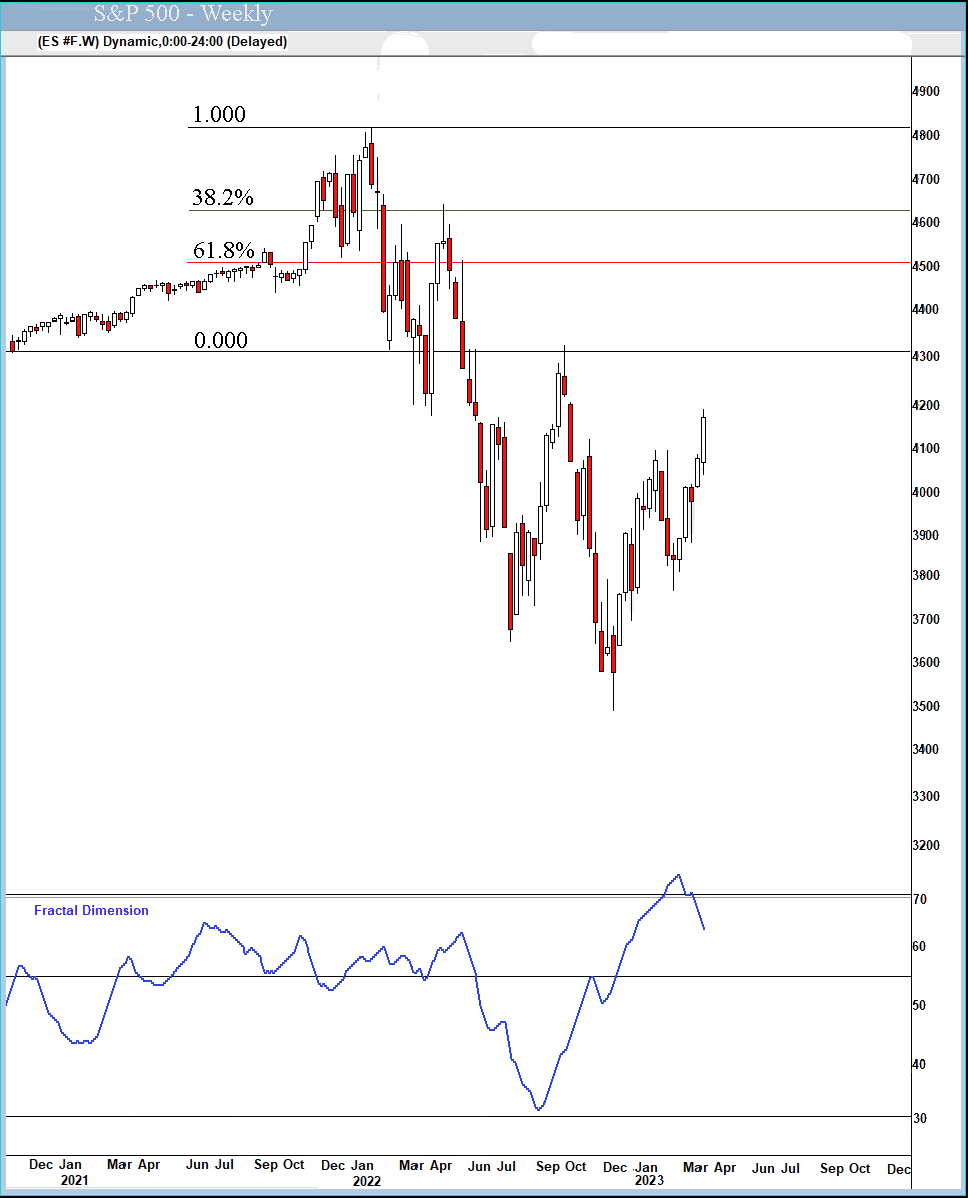
The fractal dimension is dropping quickly towards the 55 level that will signal this upmove is a real trend and not just part of the consolidation of the drop to the October low. I think it will get there and may get the S&P to a new all-time high, but I am beginning to worry that too many are turning too bullish too quickly. I am watching that closely.
Top 5
Changes this week: Removed META from near-term – got the “Bounce from overdone selloff”
Near-Term – chronological order
INO Inovio – VGX-3100 HPV Phase 3 results any day
EQT EQT – cold February coming
OIL iPath Pure Beta Crude Oil Exchange-Traded Note – crude should rise quickly
GBTC Grayscale Bitcoin Trust – Bitcoin is coming out of one of its periodic sharp drops
VLD Velo3D – Rapid revenue growth; low market cap
Long-Term – alphabetical order
EQT EQT – largest US natural gas company
NVTA Invitae – the winner-take-most of genetic testing
META Meta – a (the?) leader in the metaverse
RKLB Rocket Lab – #2 to SpaceX in space
VLD Velo3D – Return manufacturing to the US
Coming Events
All times below are ET, and most presentations and slides are archived on the companies’ websites so you can listen to them.
Friday, February 3
January Payrolls – 8:30am – +185,000 expected; December was +223,000
Tuesday, February 7
SFTBY – Softbank – 2:30am – Earnings conference call
MDNA – Medicenna – 8:30am – Earnings conference call
Thursday, February 9
MDNA – Medicenna – 3:55pm – Guggenheim Oncology Conference
Short Interest – After the close
The $20-For-$1 Stocks
Say you put $2,000 into a stock that goes from 50¢ a share to $10. The $2,000 turns into $40,000. Then you put the $40,000 into another stock that goes from 50¢ to $10. That turns the $40,000 into $800,000. You did it with two stocks, and never risked going negative more than $2,000. (Not that you won’t be mad at me if the first one works and then the second one doesn’t, taking your $40,000 to Money Heaven.)
If you can afford it – and it would not be too big a position in your portfolio – putting $2,000 into each of these speculative biotechs might be a good way to start. Buying these out-of-favor, fallen, or forgotten companies that can get important products through the FDA at very low market capitalizations seems like a good strategy to me.
Risks
Development-stage biotechs are subject to investor sentiment swings from wildly optimistic to excessively pessimistic – mostly the latter recently. After the Primary Risk for each company, I’ve added the clinical stage of their lead product, the probable time of their first FDA approval, and the probable time of their next financing.
As always, you need to think about an appropriate position size. You could buy a full position upfront and then just hold on, or buy some upfront and leave room to add more on the inevitable financings, transient clinical trial setbacks, and the like.
* * * * *
A member of the FDA Oncologic Drugs Advisory Committee summarizes their observations of sponsors’ transgressions when presenting trial data. It includes Spin, Sloth, Wrath, Gluttony, and Blaming.
 Click for larger graphic
* * * * *
Aptose Biosciences (APTO – $0.74) started dosing 120 milligrams of tuspetinib in their Phase 1/2 expansion trial in acute myeloid leukemia. They also had another clinical response in a patient receiving 40 milligrams in the original dose exploration trial, the second response at the recently launched low-dose 40-milligram cohort.
Management said: “Importantly, Aptose has elucidated a rationale for the superior safety profile of tuspetinib. While several kinase inhibitors require high exposures that exert near complete suppression of a single target to elicit responses, those agents often cause additional toxicity because they also cause extensive inhibition of that target in normal cells. In contrast, tuspetinib simultaneously suppresses a small suite of kinase-driven pathways critical for leukemogenesis. Consequently, tuspetinib achieves clinical responses at lower exposures with less overall suppression of each pathway, thereby avoiding many of the toxicities observed with competing agents.” APTO is a Buy under $2.50 for a $30 target in a buyout.
Primary Risk: Either drug fails in clinical trials.
Clinical stage of lead product: Phase 1a
Probable time of first FDA approval: 2025
Probable time of next financing: Mid- to late-2023
Inovio (INO – $1.79) will layoff 11% of their workforce to save about $4.3 million a year, although there will be a one-time $1.1 million severance charge in the March quarter. They said data readouts for both the Phase 3 REVEAL2 trial for VGX-3100 and the second cohort from the Phase 1/2 trial for INO-3107 will be announced in the March quarter.
Today, they reported positive Phase 1b results for INO4201 as an Ebola booster for Ervebo, an FDA-approved Ebola vaccine. INO-4201 was well-tolerated and boosted humoral responses in 100% (36 of 36) of treated participants, all vaccinated three to seven years ago. This trial was spearheaded by Global Urgent and Advanced Research and Development (GuardRX), sponsored by Geneva University Hospitals, and funded by the US Defense Advanced Research Projects Agency (DARPA).
Dr. Gary Kobinger, microbiologist, GuardRX ex-President, and Board Member and Director of the Galveston National Laboratory at the University of Texas Medical Branch, said: “We are particularly pleased with INO-4201’s boost effect on neutralizing titers. To our knowledge, this is one of the highest responses we have ever seen across multiple vaccine platforms. Indeed, our results showed that the neutralizing titers were significantly higher in the individuals who received the INO-4201 boost compared to the placebo and the response was maintained even 24 weeks later.”
INO is a Buy under $7 for a very long-term hold.
Primary Risk: Their drugs fail in the clinic.
Clinical stage of lead product: Phase 3
Probable time of first FDA approval: 2023
Probable time of next financing: Mid-2024
Invitae (NVTA – $2.69) dropped 4.8% on Tuesday after Goldman Sachs cut the stock to a Sell because “we see NVTA emerging as a lower growth company engaged in competitive end markets with a long and uncertain path towards profitability.”
The worry is that management can’t keep up the growth rate while moving toward profitability. I think they can because genetic testing is growing faster than people expected. My worry is that they can’t grow fast enough to become the Amazon of genetic testing – but so far, so good. Buy NVTA under $10 for a first target of $50 and eventually $100+ when they become the Amazon of genetic testing.
Primary Risk: A competitor starts taking significant market share.
Clinical stage of lead product: NM
Probable time of first FDA approval: NM
Probable time of next financing: Not needed
Biotech MegaShift
Akebia Therapeutics (AKBA- $0.89) competitor Glaxo SmithKline got approval for Jesduvroq, the first oral treatment for anemia caused by chronic kidney disease for adults on dialysis. The non-dialysis, much bigger market still does not have an approved drug, but Akebia’s trial showed safety signals there that will block approval. Still, if they can get the FDA to approve vadadustat for dialysis, the stock can move much higher. AKBA is a Hold for the results of the FDA meeting on vadadustat.
Primary Risk: Vadadustat not approved.
Clinical stage of lead product: Vadadustat NDA filed
Probable time of next FDA approval: Unknown
Probable time of next financing: Unknown
Biotech & Digital Dominators MegaShift
There are at least four ways to make money in the stocks of these large, growing, dominant companies. You can:
* * Buy a stock and hold it
* * Buy a stock and write a call option against it
* * With a Level IV options account, write an out-of-the-money put option
* * With a Level IV options account, write an out-of-the-money put option and use part of the premium to buy an out-of-the-money call option
Apple (AAPL – $150.82) reported a disappointing December quarter, with revenues down 5.5% from last year’s period to $117.15 billion. That fell short of the $121.6 billion consensus estimate. They earned $1.88 a share, under the $1.95 consensus.
iPhone revenue was $65.78 billion, down from $71.63 billion year-over-year. Mac revenue was $7.74 billion versus $10.85 billion. iPad revenue grew 29.5% from $7.25 billion to $9.39 billion. Wearables, home, and accessories slipped from $14.7 billion in 2021 to $13.48 billion. Service revenue showed only a small 6.2% increase from $19.52 billion to $20.76 billion.
Management blamed “significant supply constraints” in part for the shortfall, and we know that Foxconn did not make enough iPhone 14s for the strong demand. That’s behind us now, and the March quarter should benefit from some catch-up sales.
Some more good news: The installed base crossed two billion active devices and hit an all-time high for all major product categories.
The Silicon Valley buzz is that Apple is about to enter the metaverse and is in talks with about six media partners, including Walt Disney, to develop virtual reality (VR) content for its mixed-reality headset. The headset – see below – will be launched at this year’s spring event, and will cost around $3,000 – twice as much as Meta’s Quest Pro
AAPL is a Buy under $150 for new iPhone rollouts and augmented/virtual reality products.
Corning (GLW – $36.29) announced December fourth quarter revenues of $3.63 billion, down 2.2% from last year but just above the consensus estimate for $3.54 billion. Pro forma earnings of 47¢ per share also were just above the 44¢ estimate.
During the September quarter conference call, management guided for a disappointing December quarter, so Wall Street was not surprised. But during this call (INFOGRAPHIC HERE and TRANSCRIPT HERE), they again guided below the consensus estimates. They expect March quarter revenues of $3.2 billion to $3.4 billion with pro forma earnings of 35¢ to 42¢. The consensus was expecting $3.57 billion and 46¢.
The weakness is in TV display screens, autos, and smartphone screens – all consumer products hit by the recession. Management said they are seeing “essentially recession-level demand in markets that constitute about half of our sales. Cars, televisions, smartphones, laptops, and tablets are all well below what we estimate as the normal range.” Optical fiber and solar are doing well. They had $1.24 billion in free cash flow in 2022, more than enough to cover the 3.1% dividend.
Corning is a carefully-managed company that can grow your investment for years to come while paying an increasing dividend. They’ve grown the dividend 35% since 2019, and have increased it for 12 consecutive years. They are going to raise the annual rate again, from $1.08 to $1.12 per share.
Their current average debt maturity is 25 years, with only $1 billion in debt coming due in the next five years and no significant debt coming due in any given year. Their interest rate exposure is very low because essentially all of their debt instruments are fixed rate. The stock fell 4.9% on Tuesday after the conference call and gained almost all of it back by today’s close. GLW is a Buy under $33 for the 5G cellular buildout, followed by the smartphone upgrade to use 5G services. My target is $60 in 2023 .
Gilead Sciences (GILD – $81.39) reported December quarter revenues up 2.1% from last year to $7.39 billion, ahead of the $6.63 billion estimate. Pro forma earnings of $1.67 beat the estimate for $1.51.
Total product sales excluding Veklury (remdesivir) increased 9% year-over-year to $6.3 billion primarily due to increased sales in HIV and Oncology, as well as contributions from HCV products. HIV product sales increased 5% from last year to $4.8 billion due to both higher demand and higher prices.
Veklury sales dropped 26% to $1.0 billion due to lower rates of COVID-19 related hospitalizations.
For 2023, management guided for total product sales between $26.0 billion and $26.5 billion, well above the $25.67 billion consensus that includes royalty, contract, and other non-product revenues. They expect GAAP earnings per share between $5.30 and $5.70, and pro forma earnings of $6.60 to $7.00 versus the $6.71 consensus.
They raised the quarterly dividend from 73¢ to 75¢, giving us a forward yield of 3.69%. Gilead is well on their way to becoming an oncology company, and they’re going to be one of the best. They have the cash, talent, and stock-market-driven motivation to get there. GILD is a Long-Term Buy under $70 for a first target of $100.
Meta Platforms (META – $188.77) shot up 23.3% today after reporting a mediocre December quarter. Revenues fell 4.5% from last year to $32.17 billion, although that was ahead of the $31.65 billion consensus estimate. But earnings of $1.76 per share fell way short of the $2.24 estimate.
Facebook daily active users (DAUs) averaged 2.00 billion, an increase of 4% year-over-year. Monthly active users (MAUs) – were 2.96 billion, up 2% year-over-year.
They guided March quarter revenues to $26.0 billion to $28.5 million, pretty much on the consensus for $27,25 billion. So why did the stock shoot up? Two reasons.
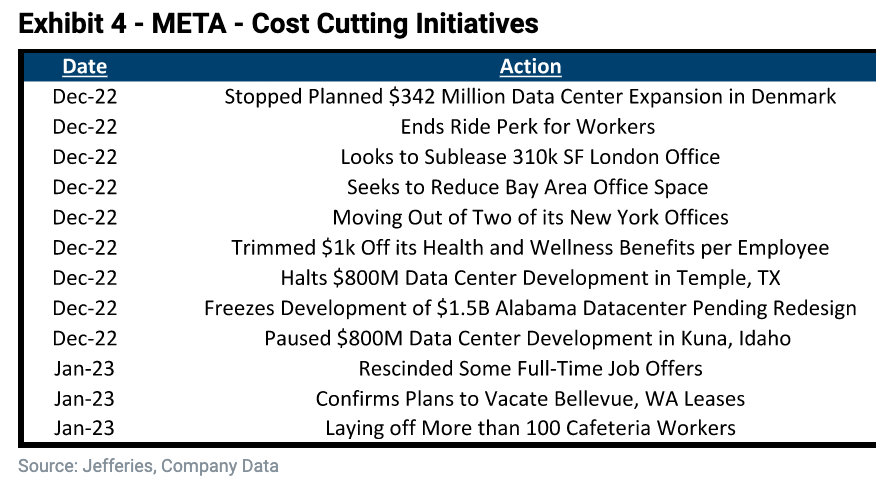
First, Wall Street really wanted to see expense control. On the conference call (SLIDES HERE and TRANSCRIPT HERE and FOLLOW-UP TRANSCRIPT HERE), Zuckerberg said they expect full-year 2023 total expenses will be in the range of $89 billion to $95 billion, lowered from their prior outlook of $94 billion to $100 billion due to slower anticipated growth in payroll expenses and cost of revenue.
After firing 11,000 employees last November – 13% of the workforce – Zuck said: “We closed last year with some difficult layoffs and restructuring some teams and when we did this, I said clearly that this was the beginning of our focus on efficiency and not the end.” Just to show you how serious he is, “More than 100 Cafeteria Workers” have been RIF’d.
 Click for larger graphic
He added that “efficiency” is one of his key themes for 2023. They also cut their capital expenditures guidance for this year to a range of $30 billion to $33 billion, lowered from their prior estimate of $34 billion to $37 billion. Wall Street loved it.
But that’s not all! The second reason the stock jumped to a $485 billion market capitalization today was they added $40 billion to their stock buyback program, on top of the $10 billion left on its existing plan.
From my point of view, META’s headwinds are fading. We’ll be comparing to the post-Apple IDFA results in the March quarter. Meta’s AI investments in fixing attribution and sharpening targeting post-AAPL are working. Advertisers are getting 20% better conversions year-over-year. The foreign exchange headwinds from the strong dollar are easing. Reels monetization doubled from last year and is on pace to be revenue neutral by 2024.
Rosenblatt Securities upgraded Meta from neutral to buy and raised the price target from $104 to $220. Bank of America boosted their rating from neutral to buy and raised their target from $160 to $220. J.P. Morgan reiterated their overweight rating and raised their target to $225 a share. Piper Sandler upgraded from neutral to overweight and raised their target to $215. META is a Buy under $150 for a $400 target in 2024.
Other Tech
Rocket Lab USA (RKLB – $5.24) CEO Peter Beck was interviewed on CNBC’sManifest Space. RKLB is a Buy up to $13 for my $30+ target as low earth orbit satellites and space exploration grow.
Primary Risk: A new competitor emerges.
Probable time of next financing: None needed
Inflation MegaShift
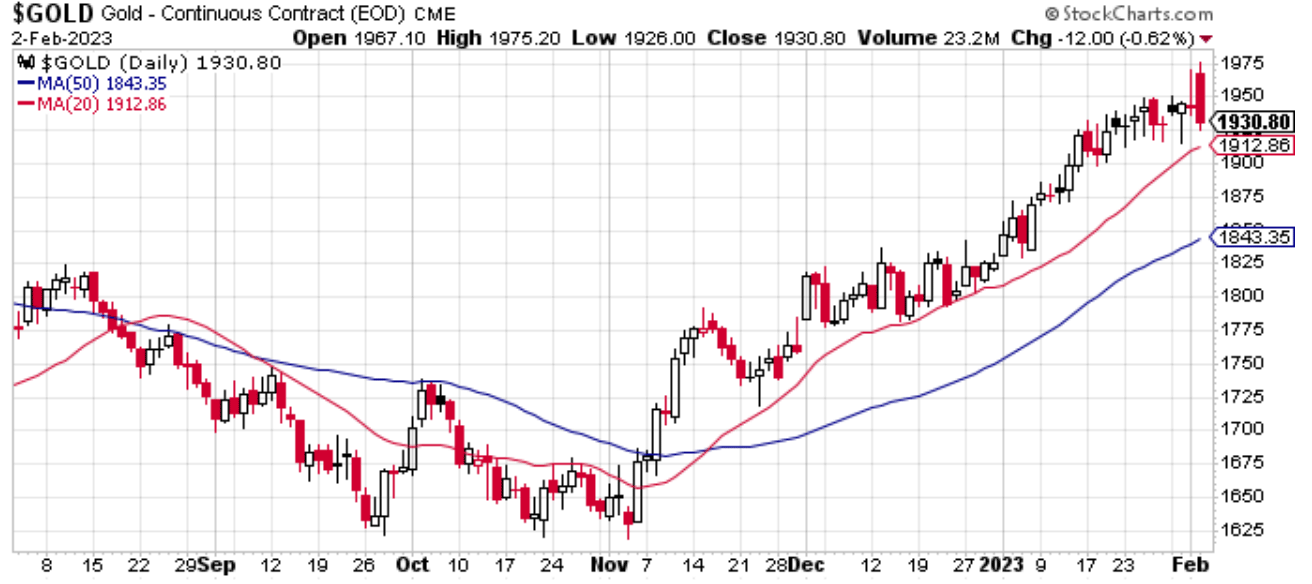
Gold ($1,926.40) hit $1,975 this morning after the Fed news, but gave back $49 by the close. If it slips below its 20-day moving average at $1912.86 we have to be ready for a trip down to the 50-day at $1,843.35 to shake out weak hands.
 Click for larger graphic
According to the World Gold Council, gold demand grew by 18% to 4,741 tons in 2022, the highest demand in 11 years. The massive central bank purchases I’ve written about coupled with strong retail investor buying and slowing outflows from ETFs drove overall demand higher.
 Click for larger graphic
The fractal dimension stalled out as the rally stalled out for the last two weeks. There still is plenty of energy to move higher, but we need another spark.

Miners & Related
Sprott Inc. (SII – $40.01) launched four new exchange-traded funds focused on “energy transition” metals. They are the Sprott Energy Transition Materials ETF (SETM), Sprott Lithium Miners ETF (LITP), Sprott Junior Uranium Miners ETF (URNJ), and Sprott Junior Copper Miners ETF (COPJ). Sprott has built a big business with the Sprott Physical Uranium Trust (U-U.TO and SRUUF) and I expect these funds to be a big success. Buy SII under $40 for a $70 target price.
Primary Risk: Prices of precious metals fall due to US dollar strength.
Cryptocurrencies
Cryptocurrencies are a diversifying asset that offer a unique opportunity to make (or lose!) a lot of money quickly. You can easily buy Bitcoin and other cryptocurrencies at Coinbase, Block, or Robinhood.
Bitcoin (BTC-USD on Yahoo – $23,520.00) is holding strong above $23,000. It’s up 70% from the November lows and clearly is a risk-on asset.
 Click for larger graphic
Institutional demand for bitcoin reached a six-month record high and dominates the entire crypto asset industry.
 Click for larger graphic
BTC-USD, ETH-USD, GBTC, and ETHE are Strong Buys.
Primary Risk: Bitcoin falls due to over-regulation or is surpassed by another cryptocurrency.
International & Other Recommendations
It is important to hold some non-US assets, especially in China. The first week-long holiday in the Chinese Lunar New Year after China opened up from its insane COVID restrictions saw tourist numbers rebound to 88.6% of the pre-COVID 2019 level and tourism spending rebound to 73.1% of 2019, the Ministry of Culture and Tourism estimates.
EMQQ Emerging Markets Internet & Ecommerce ETF (EMQQ – $34.84) is a Buy under $38 for a $66 target in 12 to 18 months.
KraneShares Bosera MSCI China A Share Fund (KBA – $28.52) is a Buy under $40 for a three- to five-year hold.
Morgan Stanley China A-Share Closed-End Fund (CAF – $16.43) is a Buy under $18 for a three- to five-year hold.
KraneShares CSI China Internet Exchange-Traded Fund (KWEB – $34.45) is a Buy under $40 for a double over the next three years.
Primary Risk of all four: China falls into a recession.
Acreage Holdings (ACRDF – $1.23) introduced “Fast-Acting Gummies” or “TiME Gummies” in Illinois, Maine, Massachusetts, and Ohio. Whereas traditional edibles may take one to four hours to take effect, the Fast-Acting Gummies deliver potential effects in 5 to 15 minutes. They use a unique individual molecule encapsulation method that delivers fast-acting THC with fruit flavors, Sparkling Orange (Sativa) and Sparkling Strawberry (Indica). They contain either 5 milligrams or 10 milligrams of THC per dose in 10-packs or 20-packs. Each offering incorporates the flavor of real white wine grapes along with the added qualities of cannabis terpenes. ACRDF is a buy under $2 for a hold for the Canopy Growth merger and beyond.
Primary Risk: Canopy Growth does not acquire the company.
Oil – $75.83
Oil is down $2 this week after the fifth straight week of crude builds, especially at the Cushing terminal. This week saw 4.140 million barrels in storage, the highest since June 2021, including 2.315 million barrels at Cushing. Although some refineries still are closed or only partly open, gasoline stocks rose to 2.576 million barrels and distillates were up to 2.320 million.
Even so, East Coast gasoline prices are likely headed higher due to low imports caused by the EU’s Russia ban. Seasonal gasoline stockpiles in the East are at the lowest in a decade, and heavy winter maintenance at refineries may further trim inventories before the summer driving season.
Unfortunately, hedge funds and other money managers have piled into petroleum futures and options at the fastest rate since the first successful coronavirus vaccines were announced in late 2020. China’s exit from a zero-COVID strategy, along with hopes the global economy can avoid a recession and low oil inventories, have contributed to an extraordinary wave of buying across the petroleum complex.
Investors bought the equivalent of 232 million barrels in the six most important futures and options contracts over the six weeks ended January 24.
The July 2026 Crude Oil Futures (CLN26.NYM – $64.70) are a Buy under $55 for a $200+ target.
The iPath Pure Beta Crude Oil Exchange-Traded Note (OIL – $28.85) is a Buy under $36 for an $80+ target.
* * * * *
11 tech trends to watch in 2023
 Click for larger graphic
* * * * *
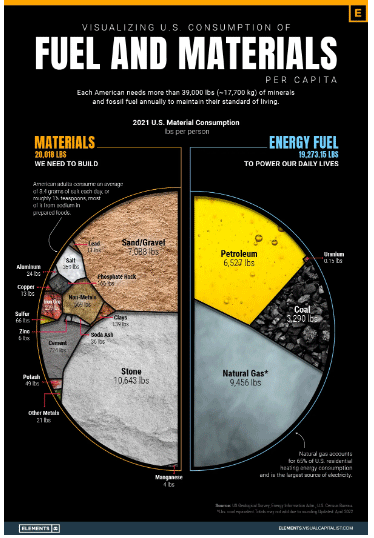
Each American needs more than 39,000 lbs of minerals and fossil fuels annually
to maintain their standard of living.
 Click for larger graphic
Look at that cute little 0.15 lbs of uranium per capita powering about 20% of the US grid! (h/t Liberty Labs)
* * * * *
Your using 12 free resources to be a better investor Editor,

Michael Murphy CFA
Founding Editor
New World Investor
All Recommendations
Check out the complete Portfolio page HERE.
Buys
These are the stocks everyone needs to own because transformative events are happening over the next year or two, and I expect to hold them long-term.
$20-for-$1
Aptose Biosciences (APTO – $0.74) – Buy under $2.50, ultimate target $30
Bellerophon Therapeutics (BLPH – $1.89) – Buy under $5, first target $30, then $100
Compass Pathways (CMPS – $10.85) – Buy under $20, hold a long time for a 10x return
Inovio (INO – $1.79) – Buy under $7, hold a long time
Invitae (NVTA – $2.69) – Buy under $10, first target $50, then $100+
Medicenna (MDNA – $0.78) – Buy under $3, first target $20, then maybe $40
ScyNexis (SCYX – $1.74) – Buy under $3, target price $20, then $50
Other Biotech
TG Therapeutics (TGTX – $17.97) – Buy under $7, target price $25+
Tech Dominators
Apple Computer (AAPL – $150.82) – Buy under $150 for new iPhones
Corning (GLW – $36.29) – Buy under $33, target price $60
Gilead Sciences (GILD – $81.39) – Buy under $70, target price $100
Meta (META – $188.77) – Buy under $250, target price $400
SoftBank (SFTBY – $24.70) – Buy under $25, target price $50
Other Tech
First Trust NASDAQ Cybersecurity ETF (CIBR – $42.50) – Buy under $40; 3- to 5-year hold
Fastly (FSLY – $11.90) – Buy under $20; 2- to 5-year hold to $80+
PagerDuty (PD – $32.11) – Buy under $30; 2- to 5-year hold
QuickLogic (QUIK – $6.12) – Buy under $10, target price $40
Rocket Lab (RKLB – $5.24) – Buy under $13, target price $30+
Velo3D (VLD – $2.77) – Buy under $6, target price $50
Inflation
A Short-Sale or REO House – ($447,000) – Hold
Bag of Junk Silver – ($23.54) – hold through silver bull market
Sprott Gold Miners ETF (SGDM – $27.43) – Buy under $28, target price $50
Sprott Junior Gold Miners ETF (SGDJ – $31.69) – Buy under $39, target price $100
Sprott Physical Gold and Silver Trust (CEF – $18.30) – Buy under $18, target price $30
Global X Silver Miners ETF (SIL – $30.19) – Buy under $30, target price $50
Coeur Mining (CDE – $3.90) – Buy under $5, target price $20
First Majestic Mining (AG – $8.03) – Buy under $11, next target price $23
Paramount Gold Nevada (PZG – $0.36) – Buy under $1, first target price $10
Sandstorm Gold (SAND – $5.66) – Buy under $10, target price $25
Sprott Inc. (SII – $40.01) – Buy under $40, target price $70
Cryptocurrencies
Bitcoin (BTC-USD – $23,520.00) – Buy
Grayscale Bitcoin Trust (GBTC – $12.93) – Buy
Ethereum (ETH-USD – $1,647.81) – Buy
Grayscale Ethereum Trust (ETHE – $7.95) – Buy
International & Other Recommendations
EMQQ Emerging Markets Internet & Ecommerce ETF (EMQQ – $34.84) – Buy under $38 for a $66 target in 12 to 18 months
KraneShares Bosera MSCI China A Share Fund (KBA – $28.52) – Buy under $40 for a three- to five-year hold
Morgan Stanley China A-Shares Fund (CAF – $16.43) – Buy under $18 for a three- to five-year hold
KraneShares CSI China Internet ETF (KWEB – $34.45) – Buy under $40 for a double over the next three years
Acreage Holdings (ACRDF – $1.23) – Buy under $2 for the Canopy Growth merger
Mongolia Growth Group (MNGGF – $1.15) – Buy under $1.30; long-term hold
Energy
Crude Oil Futures – July 2026 (CLN26.NYM – $65.59) – Buy under $55; $200+ target
iPath Pure Beta Crude Oil Exchange-Traded Note (OIL – $28.85) – Buy under $36; $80+ target
EQT (EQT – $31.84) – Buy under $35; $70 first target
Energy Fuels (UUUU – $7.68) – Buy under $8; $30 target
Holds
These are holds but not sells – yet. They could get moved back to one of the buy categories if their prices drop or outlook improves, or they could become sell recommendations in the future.
Algernon Pharmaceuticals (AGNPF – $1.58) – Hold for IPF/chronic cough trial
Akebia Biotherapeutics (AKBA – $0.89) – Hold for FDA meeting
Arch Therapeutics (ARTHD – $5.76) – Hold for buyout
Graphite Bio (GRPH – $2.18) – Hold until they resolve the clinical hold
Publisher: GwynRose LLC, 5348 Vegas Drive, Suite 868, Las Vegas, NV 89108
New World Investor does not act as a personal investment adviser or advocate the purchase or sale of any security or investment for any specific individual. The recommendations and analysis presented to members are for the exclusive use of members. Members should be aware that investment markets have inherent risks and there can be no guarantee of future profits. Likewise, past performance does not assure future results. Recommendations are subject to change at any time. Nothing in this presentation should be considered personalized investment advice. No communication to you by Michael Murphy or any of our employees or contractors should be deemed as personalized investment advice.
Copyright ©GwynRoseLLC 2023
New World Investor Mastermind Group
1. Post unto others as you would have them post unto you.
2. Keep it clean, like a 1950s family television show. Your alter ego can run free on Twitter.
3. NO PERSONAL ATTACKS! If you don’t like the stock, don’t trash the person. Everyone is responsible for their own due diligence and investments.
4. Don’t post here about politics or religion – you aren’t going to change anyone’s mind. Again, NO PERSONAL ATTACKS!
5. The investment implications of something going on in politics or religion is OK.
6. Of course, there’s never a reason to slur someone based on race, religion, gender, sexual orientation, or country of national origin.
7. Please, no snark!
 Print This Post


1st
crazy that we can use that amt. of materials,per person each year.!
I wonder if the gravel and stone is for the highways and concrete ?
Thanks Michael I am amazed at your knowledge of all these graphs etc.
When its all said and done Is market going down in your opinion with all the info you presented ?
I received an email from MM about his new service: Biotech Moonshots. I am assuming the 8 biotechs he is touting as part of that subscription are included in the biotechs he is touting here. According to the description he gives, I am sure NVTA, INO, and ARCH are part of the 8. I am not sure about others.
MM – please comment on this Silvergate bailout news and its relationship or impact on DCG, ultimately how this impacts GBTC
If the results of Phase 3 REVEAL2 trial for VGX-3100 with INO come out postiive will they be able to file immediately for FDA approval ?
why are so many peole selling their shares of INO Do they know something we dont ?
AKBA doubled in the last month, given the safety failures noted by MM, can anyone advise why it moved up aggressively? Is this a worthy hold or should I bail out while its up?
There is optimism that the FDA will rule in AKBA’s favor. I think that the FDA willfully and corruptly ignored AKBA’s good data for dialysis patients. The FDA decision comes at the end of Feb. I am holding, but won’t be surprised if the political corruption continues and AKBA goes kaput.
MM and Michael,
What do you think of ENVX and DFLI in the areas of battery storage? Yahoo Finance reported that Musk sees batteries and recharging as the costly and time wasting problems for EV’s, just as combustion car owners see high oil prices as a negative.
The new Radar Report for 2.9.23 is posted.