

Dear New World Investor:
As I expected, the June Consumer Price Index fell 0.4% from May, thanks to falling gasoline prices (in turn, thanks to falling oil prices). That was the largest single-month decline since April 2020. The CPI was up 3.5% year-over-year, the lowest yearly reading since March. Inflation is dea…not so fast. The core rate increased 0.0% month-over-month but 2.8% year-ever-year, well above the Fed’s 2.0% target.
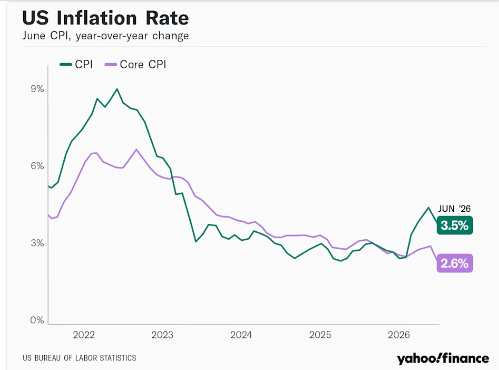 Click for larger graphic h/t Yahoo Finance
Rent of Shelter was up only 0.13% month-over-month, although still up 3.24% year-over-year. It may have begun its deceleration to 2%. The so-called Super Core (non-housing services) fell -0.09% month-over-month (year-over-year +2.67%). Seasonality is likely to push this idiosyncratic series lower through the summer. The tariff impact is over and core goods are headed back to zero. It is possible that a return to disinflation is coming.
I expect the June 30 core Personal Consumption Expenditures (PCE) Index – the Fed’s favorite inflation indicator – to be a mild +0.2% month-over-month and +3.3% year-over-year. That would be the lowest monthly print since November. The headline PCE should decline 0.07% for June, lowering the year-over-year rate to +3.7%. Still a long way from the +2.0% target, but making enough progress to keep the Fed from raising the funds rate.
The bond market disagrees. The US 30-year bond yield has traded above 5% for 27 days, or about 19% of all sessions. That is the longest stretch since the 50-day stretch in 2007, the beginning of the Great Financial Crisis. Unlike 2007, the Federal Reserve’s benchmark is currently 150 basis points lower than the 30-year. The bond vigilantes are demanding even more compensation for holding the longest maturity sold by Treasury than at the start of the subprime debt woes! They are worried about the growing debt pile and sticky inflation. They are right about the debt but wrong about inflation. I expect the 30-year to go back under 5%.
Since 2007, the Treasury market has ballooned from $4.5 trillion to $31 trillion. Debt as a percentage of US gross domestic product has doubled to over 100%. Years of excessive spending have propelled annual interest cost above $1 trillion.
Debt concerns prompted Lacy Hunt of Hoisington Investment Management, a renowned and probably the last bull on the US long bond for decades, to throw in the towel earlier this month, citing a “broader structural backdrop” of larger fiscal deficits and higher capital demand that could keep inflation and long-end yields higher.
With no bond bulls left, the sellers are out of ammo. In every one of the instances that we saw 5% 30-year Treasurys in the last few years, it was quickly bought by pensions and insurers. One of the tells that we can expect that to happen again is that the two to 10-year Treasury notes have increased much less, only back toward levels last seen in early 2025.
So who is buying stocks in this environment? Well, there is record high foreign demand for US equities, probably to participate in the AI boom their countries are missing:
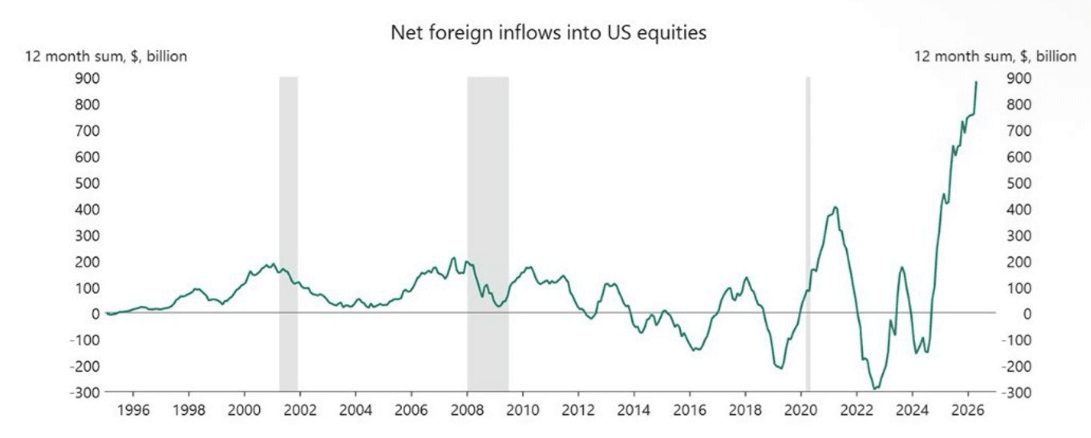
Click for larger graphic h/t @rev_cap via Jared Dillian
And options traders are their most bullish on stocks since December 2020, after the total put/call ratio plunged to 0.61:
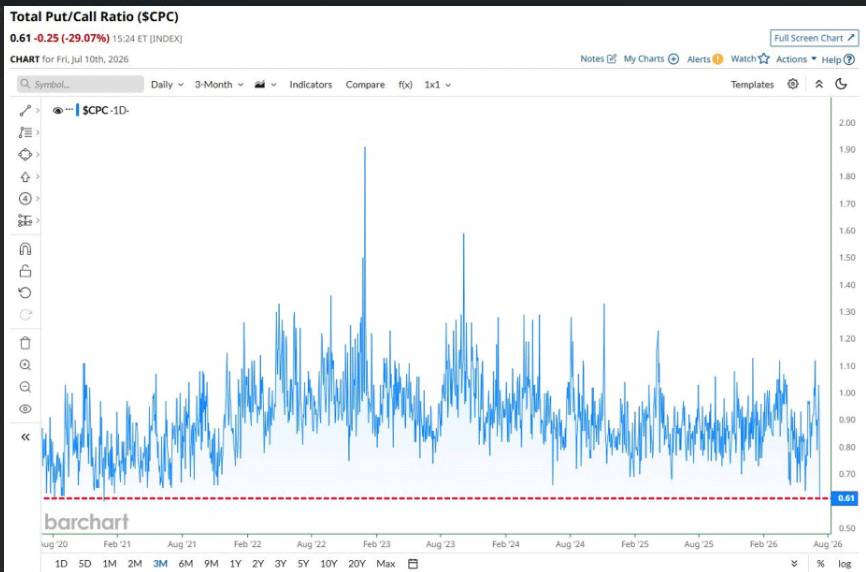 Click for larger graphic h/t @Barchart via Jared Dillian
But people are not running wild on margin debt:
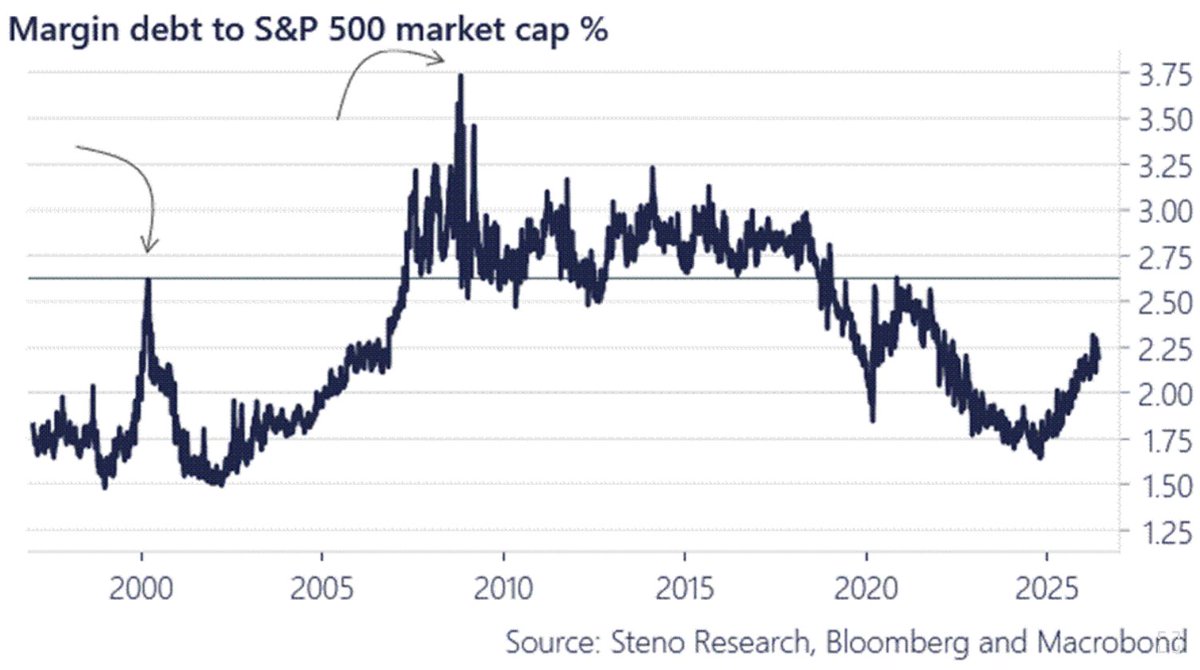
Click for larger graphic h/t @AndreasSteno
Plus, tech insiders are buying into the summer weakness in their stock prices at a robust pace: 28 executives at companies within the State Street Technology Select Sector SPDR ETF (XLK) have purchased their own stock on the open market over the past six months. That’s the highest count on record, according to an analysis by SentimenTrader, and a double since the start of 2026.
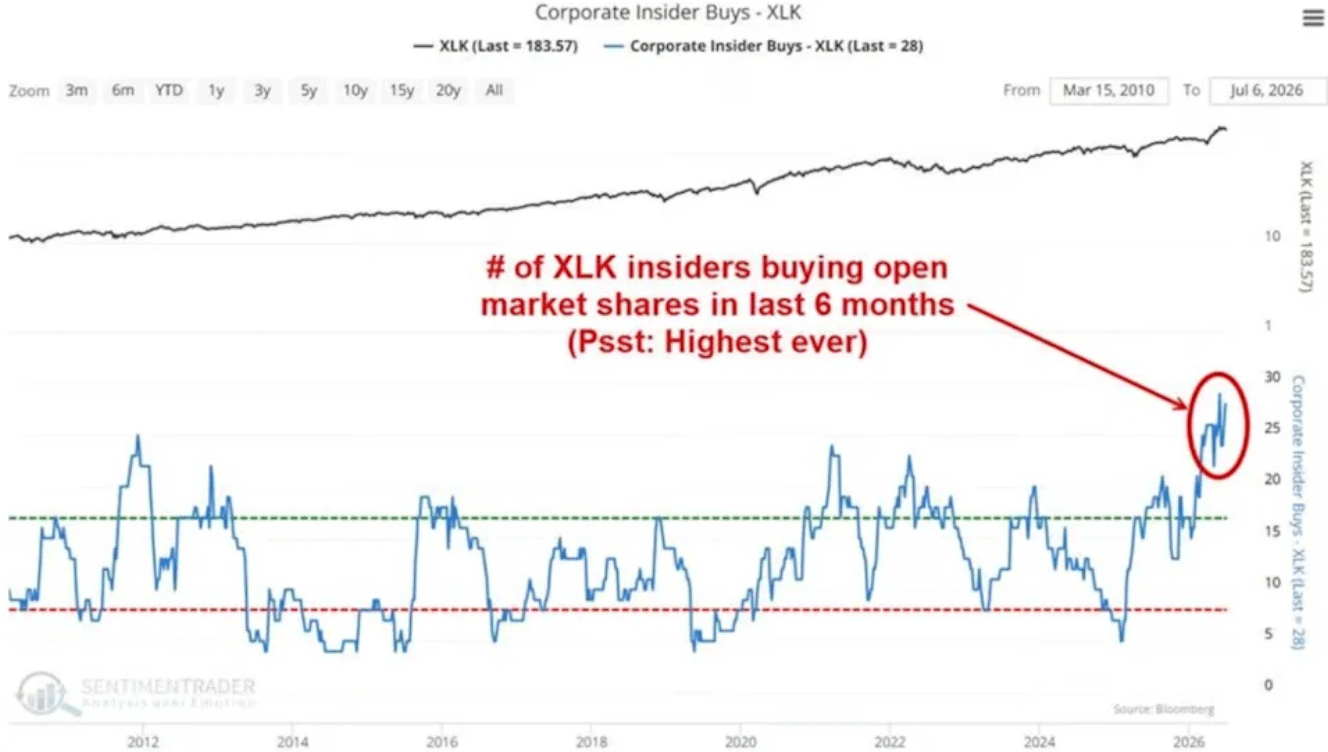
Click for larger graphic h/t @SentimenTrader
Money is coming off the sidelines at a rapid clip, which usually means a correction happens soon. It’s a good time to let cash build up, take some profits like my recent recommendation to sell Apple, and get your buy list ready for some low-ball bids.
Market Outlook
The S&P 500 lost 1.8% over the last two weeks, even though the year-over-year index earnings growth rate is tracking at 24.7%. This will mark the second straight quarter of earnings growth above 20%, and the seventh straight quarter of double-digit earnings growth. The Index is up 8.2% year-to-date. The Nasdaq Composite lost 4.1% as Wall Street bailed on AI stocks. It is also up 8.2% for the year. The SPDR S&P Biotech Exchange-Traded Fund (XBI) fell 7.1% as hedge funds took profits. It is still leading the performance derby, up 24.9% year-to-date. The small-cap Russell 2000, like the 500, dropped 1.8%. It is up 18.5% in 2026.
Top 5
Changes this week: None
Near-Term – chronological order
INO Inovio – bounce back from equity offering + FDA allows 6-month review of INO-3107
AKBA Akebia Therapeutics – Vafseo launch
BTC-USD Bitcoin – rebound from sell-off
ETH-USD Ethereum – rebound from sell-off
EQT EQT – natural gas price rebound
USL United States 12 Month Oil Fund, LP – crude should rise quickly
Long-Term – alphabetical order
ABCL AbCelllera – Will become a huge pharma royalty company
UUUU Energy Focus – Domestic uranium supplier
EQT EQT – largest US natural gas company
IBIT iShares Bitcoin Trust – Bitcoin is headed for $150,000
META Meta – a (the?) leader in the metaverse
PLTR Palantir – a (the?) leader in AI applications software
SCYX ScyNexis –First new antifungal in 20 years
Economy
The Atlanta Fed’s GDPNow model estimate for June quarter real GDP ticked up a bit to +1.7%, but it’s still under the Blue Chip economist average of +2.1%. We’ll see the number on July 30.
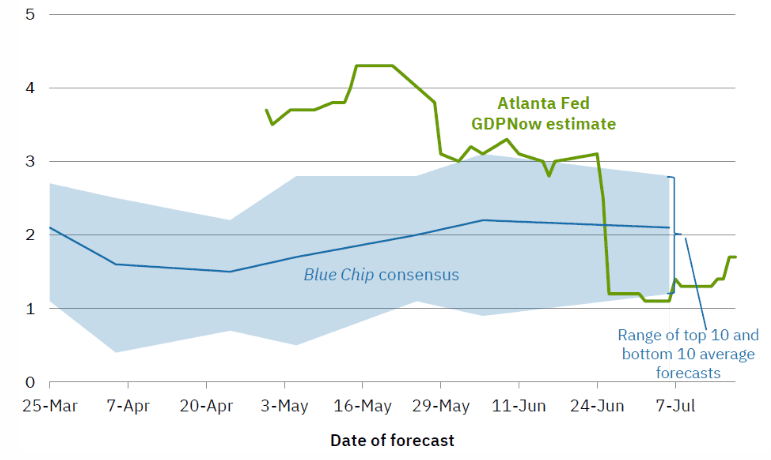 Click for larger graphic
Coming Events
All times below are ET, and most presentations and slides are archived on the companies’ websites so you can listen to them.
Friday, July 24
Short Interest – After the close
Monday, July 27
GILD – Gilead Sciences – Through 7/21 – 26th International AIDS Conference
Tuesday, July 28
PYPL- PayPal – 8:00am – Earnings conference call
Wednesday, July 29
Business Employment Dynamics – 10:00am – December quarter revisions
VET – Vermilion Energy – After the close – Earnings release; call tomorrow
Fed Meeting – 2:00pm press release; 2:30pm press conference
META – Meta Platforms – 4:30pm – Earnings conference call
Thursday, July 30
June quarter GDP – 8:30am – First estimate
Personal consumption Expenditures (PCE) Index – 8:30am
VET – Vermilion Energy – 10:00am – Earnings conference call
AG – First Majestic – 11:30am – Earnings conference call
SNAP – Snap – 5:00pm – Annual meeting
Monday, August 3
ON – Onsemi – 5:00pm – Earnings conference call
PLTR – Palantir – 5:00pm – Earnings conference call
SNAP – Snap – 5:00pm – Earnings conference call
Tuesday, August 4
Job Openings and Labor Turnover Survey (JOLTS) – 10:00am
GILD – Gilead Sciences – 4:30pm – Earnings conference call
Wednesday, August 5
CDE – Coeur Mining – After the close – Earnings release; call tomorrow
RGLD – Royal Gold – After the close – Earnings release; call tomorrow
FSLY – Fastly – 4:30pm – Earnings conference call
ABCL – AbCellera – 5:00pm – Earnings conference call
Thursday, August 6
CDE – Coeur Mining – 11:00am – Earnings conference call
RGLD – Royal Gold – 12:00pm – Earnings conference call
Friday, August 7
July payrolls – 8:30am
Big Tech: The Biotech & Digital Dominators MegaShift
There are at least four ways to make money in the stocks of these large, growing, dominant companies. You can:
* * Buy a stock and hold it
* * Buy a stock and write a call option against it
* * With a Level IV options account, write an out-of-the-money put option
* * With a Level IV options account, write an out-of-the-money put option and use part of the premium to buy an out-of-the-money call option
Gilead Sciences (GILD – $130.86) is expected to report June quarter revenues up 4.57% to $7.41 billion with a loss of $7.29 per share due to one-time acquisition writeoffs. They should report about $1.90 before the writeoffs.
They will present the detailed outcomes from the Phase 3 ISLEND-1 and ISLEND-2 trials at the 26th International AIDS Conference on July 29. The primary endpoint results at Week 48 showed that the investigational once-weekly oral single-tablet HIV treatment regimen of islatravir 2 mg/lenacapavir 300 mg (ISL/LEN) was effective in adults living with HIV who were virologically suppressed and switched from Gilead’s global guideline-recommended Biktarvy (ISLEND-1) or other standard of care oral daily antiretroviral regimens (ISLEND-2).
I expect the ISL/LEN combination of Merck’s islatravir and Gilead’s lenacapavir to be approved by the FDA as the first and only once-weekly oral HIV treatment option for adults with virologic suppression on a stable antiretroviral regimen.
Leerink Partners downgraded Gilead from outperform to market perform and cut its target price from $146 to $127. It sees headwinds in the growth of the HIV prophylaxis (PrEP) market and reduced their 2031 estimates for annual US sales of Gilead’s PrEP portfolio from $6 billion to $4 billion. That’s about in the middle of the consensus for $3.1 billion to $5.3 billion, so they were just too enthusiastic and this cut is no big deal. GILD is a Long-Term Buy under $115 for a first target of $150.
Meta Platforms (META – $606.10) is expected to report June quarter revenues up 26.82% to $60.26 billion with earnings of $7.39 per share. But the two things that will move the stock are (1) any update to their capital spending guidance (already doubled once for 2026 to $125-$145 billion), and (2) Meta’s ability to monetize their AI infrastructure investments. Meta’s recent pivot toward becoming a neocloud provider and compute lessor (Meta Compute), including a potential $10 billion, two year Anthropic deal, could reduce its persistent valuation discount by providing a path to such monetization.
Of course, analysts will also be looking at the integration of AI models within Meta’s social ecosystem and the scaling of Meta Glasses, both key forward catalysts. I think their AI-driven ad improvements could add $7–$12 billion in annual revenue, and Meta Glasses has a huge cost advantage over Apple and Snap’s AR glasses. A team of Jefferies analysts put Meta’s AI glasses through their paces and came away impressed with their functionality, performance, and design that represents a “long-dated growth vector for Meta not yet priced in,” and separates Meta AI glasses from its competitors.
The team was impressed overall with the quality of the glasses, their functionality, and monetization potential for Meta, with additional long-term upside from premium subscriptions, advertising, and commerce, along with the multi-billion dollar hardware revenue opportunity. They wrote: “We believe Meta has the first-mover advantage as the only player shipping AI glasses at scale today versus peer products still underway.”
Meta’s manufacturing partner, EssilorLuxottica plans to double production capacity to 20 million glasses this year.
BofA reiterated their Buy rating and $835 price target, saying an internal Meta memo reviewed by Reuters suggests the company could expand computing capacity more efficiently than previously estimated. Meta expects to deploy about 6.5 gigawatts of AI compute capacity during 2026, including 5.5 gigawatts in the second half of the year. Meta’s projected capital spending of roughly $145 billion implies construction costs near $22 billion per gigawatt, compared with BofA’s earlier estimate of about $45 billion per gigawatt.
The stock was added as a new long idea at Hedgeye, with the potential upside to $1,200+ over the next 12-18 months. They wrote: “We have been saying that 2H26 into 2027 is the highest-probability period of outperformance for Meta, based on our expectation for when the company would release a frontier model, when its AI capacity would begin coming online, and the base effects related to expense growth. And here we are: Muse Spark 1.1 shipped on July 9, the capacity Meta began building in late 2022 starts coming online in the back half of this year, and the labor-to-capital shift is comping against last year’s expense base – while the stock still trades at a discount, with zero revenue modeled for Meta Compute.” META is a Buy under $705 for a long-term hold.
Nvidia (NVDA – $208.76) won’t report their July quarter earnings until August 26, but you can be sure they’ll be another blowout.
I have a couple of problems with Nvidia and the whole AI trade in general. Preamble: I think AI is the Fourth Industrial Revolution that will dramatically increase the standard of living. That’s why I’m going to restart the California Technology Stock Letter.
But…
First, I suspect about half of all the Nvidia GPUs that have been shipped are in warehouses, unused. It turns out that building a data center – land, concrete, plumbing, wiring, getting enough water, getting enough power – is really hard. Even if that should happen. Perhaps, as Mark Cuban said, most of them will wind up being used as pickleball courts.
Second, the interlocking investments and revenues, plus all the off-balance sheet debt, is beginning to look like the 2008 subprime real estate crisis. The subprime entity at the center of all this is OpenAI. I’ve said before that I expect them to go bankrupt in 2027, and that shock will be transmitted through all the interlocking circular financings through the whole sector. There are some great companies that will come out of this, including Nvidia, Palantir, and Meta. But as we know, when the paddy wagon comes they take everyone, and sort it out later. The dotcom crash bankrupted Pets.com and gave you a chance to buy Amazon at $9 a share.
I’m thinking out loud here, and I’m not quite ready to say this is the hill I will die on, but I’m getting close. AI can do most of the left-brain work in the world much faster and better than humans. It can do none of the right brain work, which is a major reason Artificial General Intelligence (AGI) is horse manure whose real use is raising money.
For now, Nvidia is the top beneficiary of the AI infrastructure buildout. Its CUDA software and proprietary foundational AI models, such as Nemotron and Cosmos, strengthen its GPU business and ecosystem lock-in. They are early to some of the next huge markets: quantum computing, physical AI, and digital biology, leveraging their software platforms and direct investments. I don’t think the cheaper Chinese AI models or the hyperscalers’ custom silicon will slow them down.
And, as CEO Jensen Huang says, the much-feared AI apocalypse is complete nonsense:
NVDA’s Vera CPU + Rubin GPU architecture enables 35x lower compute costs, accelerating agentic AI adoption and expanding their total addressable market. Jensen recently directly refuted the recent rumors of Vera Rubin and Kyber production delays. The Kyber rack innovations are set to double GPU density and drive the next phase of their AI revenue expansion. An on-track Kyber roadmap would mean the company will beat Wall Street’s second-half data center revenue expectations by 20% or more.
Yet the stock is trading at a forward P/E multiple near its five-year lows, despite expectations for 88% forward EPS and 82% revenue growth. At around 16x 2028 earnings, NVDA is a Buy for a $225 first target.
Onsemi (ON – $90.13) is expected to report June quarter revenues up 8.19% to $1.59 billion with earnings of 72¢ per share. We bought ON right – it is one of a select group of 25 US large-cap stocks, all with market capitalizations exceeding $10 billion, that have emerged as clear favorites, earning unanimous Buy or Strong Buy ratings from Wall Street analysts. It is up +73.2% year to date.
The $7 billion Synaptics acquisition will increase product competitiveness and expand its portfolio. ON’s total product count will rise by 23.5%, with CPUs and DSPs from Synaptics driving an 8.45% increase in addressable market size by 2030. After the acquisition, I expect ON’s 4-year forward average growth rate to improve by 5.23% to 16.68%, mainly through enhanced product offerings rather than revenue synergies. ON is a Buy under $60 for a $130 first target.
Palantir (PLTR – $123.37) is expected to report June quarter revenues up 80.41% to $1.81 billion with earnings of 35¢ per share. In the March quarter, Palantir generated 85% revenue growth while operating expenses rose only 32%, driving 60% adjusted operating margins and 57% free cash flow margins. Stable stock-based compensation alongside rapidly growing revenue is allowing earnings and free cash flow to compound much faster than sales.
Two of the key metrics I’ll be looking for are Remaining Performance Obligations – future revenues – and Net Dollar Retention, which compares how much a customer spends this year to what they spent last year. In the March quarter, Remaining Performance Obligations surged 134% to $4.5 billion. while the 150% Net Dollar Retention showed expanding customer spending after deployment.
Citi raised their earnings estimates today, citing a potential boost in Palantir’s commercial segment’s growth, and reiterated their Buy recommendation, but lowered their target price from $225 to $200. They said: “We expect US Commercial to rebound after an unexpected deceleration in Q1, driven by improved resource prioritization and AIP proliferation across new industries and geographies. PLTR’s post-Q underperformance (-8% vs. IGV +6%) makes the risk/reward more attractive. Intra-Q checks were positive across both commercial and federal, alongside encouraging feedback from CFO Glazer, which gives us more confidence in USC RDV QoQ net adds rebounding to the $800M+ seen in 2H25, driving further upward revisions into FY27.”
Citi now expects 53% revenue growth in fiscal 2027, compared to Wall Street’s estimates of around 45%, with Commercial seeing 67% year-over-year growth. They said intra-quarter checks with partners and management were “largely positive,” citing continued momentum from global systems integrators and independent software vendors partners. They added: “Expanding customer use cases and geographies continue to underscore PLTR’s products and GTM differentiation, which is resonating with enterprise C-suites. In our meeting with CFO Glazer, we discussed notable customer wins from AIPCon 10, particularly in the Legal and Neoclouds verticals. International commercial momentum remains strong, highlighted by a large insurance win in Mexico and deepening relationship with NVDA in Sovereign. On federal, we observed expanding use cases within the DoW at the AWS Summit, and the USDA contract could provide continued tailwinds into 2H. While competitive displacements have increased, we believe the growing set of reference customers will serve as a catalyst for sustained momentum.”
PLTR is a Buy under $160 for a $200 first target.
PayPal Holdings (PYPL – $56.00) is expected to report June quarter revenues up 2.26% to $8.48 billion with earnings of $1.28 per share. The Board said the $60.50 per share ($53 billion) takeover bid by rival Stripe and private equity firm Advent International undervalues the company, and they are right. I expect the company’s $6 billion in free cash flow and $9.34 billion cash balance will attract either a competing bidder or, more likely, a dramatic increase in Stripe’s offer closer to $80–$100 a share.
PayPal’s 440 million active accounts, dominant Venmo presence, and strategic positioning in stablecoins and AI-driven payments make it a potential winner in the digital finance transformation. The branded checkout still faces structural pressure from frictionless card-linked wallets, which drives up customer acquisition costs and compresses margins – just as it did when I recommended this turnaround. Those are solvable problems, as Stripe and Advent know. There is a risk the stock falls back if Stripe pulls their offer, but that would just be another chance to buy under my limit. For now, Hold for a higher offer or PYPL is a Buy under $50 for a triple in three years.
Snap (SNAP – $4.41) is expected to report June quarter revenues up 13.85% to $1.53 billion with earnings of 6¢ per share. In the March quarter, revenue grew 12% year-over-year, driven by increases in Average Revenue Per User (ARPU). Their aggressive cost-cutting, targeting $500 million in annualized savings, positions the company for profit margin expansion and GAAP breakeven. It is selling for only 1.2x sales and 8x pro forma earnings – very cheap if margin expansion materializes, even with modest growth. SNAP is a Buy under $11 for a $17+ target.
SoftBank (SFTBY – $17.64) CEO Masayoshi Son said that AI will need about $5 trillion in annual investment by 2040, called AI bubble concerns “absurd” and predicted the technology will transform the global economy. Speaking at SoftBank World 2026 in Tokyo, he said, “Every year $5 trillion, or 800 trillion yen, you might think that’s a lie, but I am confident that’s what it will cost.”
He dismissed AI critics, comparing them to people who once rejected automobiles and airplanes. “Those who dislike AI have essentially refused their own evolution,” he said, adding that those who condemn AI are “spitting upwards.”
He predicted AI would account for 20% of global GDP by 2040, generating about $46 trillion in annual revenue and around $23 trillion in profits, which he said would justify the massive investment required to build AI infrastructure. Looking further ahead, Masa said AI data centers will require about 3 terawatts of power generation by 2040—roughly 1.8 times current global electricity consumption. He said natural gas would initially be the primary energy source before nuclear fusion eventually takes over.
Masa is all-in on AI, including AGI, which I think is not going to happen this century. He said: “We will go from a human-centric world to an agent-centric world. The age when humans are the highest life form on earth will end. For better or for worse, it will happen and it can’t be stopped.”
That is BS. SoftBank’s cumulative investment in ChatGPT maker OpenAI is expected to exceed $60 billion before the end of 2026. Keep your sneakers laced for now, but expect to exit soon. Hold SFTBY for a first target of $50 and then higher as the discount to hard book value disappears.
Small Tech
Enovix (ENVX – $4.34) has a unique, patented 3D stacked silicon-anode battery architecture that delivers higher energy density and dramatically reduces fire risk versus conventional lithium-ion batteries. The company has a fortress balance sheet, ramping production, and imminent commercial milestones in smart eyewear and smartphone batteries. After smartphone commercialization, there is licensing potential for their architecture that would drive high-margin, recurring revenues and significantly expand earnings beyond current manufacturing capacity.
To get everything over the finish line, they hired former Apple executive Michael Vyvoda as Chief Operating Officer, effective July 29. ENVX is a Buy up to $20 for a 4-year hold to $100+ as their BrakeFlow lithium-ion battery takes market share.
Primary Risk: A new competitor invents a better battery.
Fastly (FSLY – $19.43) is expected to report June quarter revenues up 16.95% to $173.92 million with earnings of 7¢ per share. Their revenues are driven by diversified demand across AI, cybersecurity, and IoT, not just AI hype. Their programmable edge computing and consumption-based model appeal to AI developers.
The company’s17.90% levered free cash flow margin and attractive price/sales ratio offset concerns about negative net income due to stock-based compensation. FSLY is a Buy under $10 for a 3- to 5-year hold to $50+.
Primary Risk:Content and applications delivery networks are a competitive area.
QuickLogic (QUIK – $13.35) has suffered a 50% selloff, yet they have several revenue growth drivers: Intel 18A contracts, RadPro defense programs, and a growing storefront product model that promises higher, more predictable margins. They need to convert delayed contracts to revenue, continue the stellar gross profit margin recovery, and close more commercial Intel 18A contracts – and CEO Brian Faith knows it. QUIK is a Buy up to $10 for my $40 target as their earnings repeatedly surprise Wall Street.
Primary Risk: Customers’ product introductions and associated royalties are unpredictable.
ARK Venture Fund (ARKVX – $54.99) is up since the SpaceX IPO, even though SPCX is below the IPO price. That’s because the current price of SpaceX is far above the last venture round.
The good news here is that 4.59% of the fund is in Anthropic, which should be the next big IPO, probably in October. Anthropic raised $30 billion in a Series G in February 2026 at a $380 billion valuation. Forge Global places the current secondary valuation at $1 trillion. Hiive, a separate regulated US secondary market for accredited investors, comes in at $851 billion, within 18% of that number. Jupiter’s Prestocks market confirms $1 trillion. Three independent pricing mechanisms pointing at the same number is not noise. That is the market arriving at a consensus.
Amazon committed $25 billion to Anthropic on April 20, and Google committed $40 billion on April 24. Anthropic’s revenue went from a $9 billion annual run rate at the end of 2025 to $30 billion by early April 2026 – one of the fastest revenue ramps in enterprise software history.
The bad news here is that an even larger 6.33% of the fund is in OpenAI, so we will have to exit ARK Venture Fund after the Anthropic IPO. ARKVX is a Buy for the Anthropic IPO.
Primary Risk: Cathie sells the stock before the IPOs.
Biotech MegaShift
Biotechnology market expansions historically trail technology sector surges by about 24 months. As successive advancements in computing infrastructure permeate the market and generate substantial capital, these resources and technological capabilities systematically transition into the life sciences sector. Operational tools originally developed to revolutionize information systems are invariably adapted for biological applications.
This cyclical pattern is evidenced by historical precedents: the proliferation of personal computing preceded the emergence of Genentech and Amgen, while the Internet expansion laid the groundwork for Regeneron and Illumina. Currently, the artificial intelligence paradigm shift transforming the broader economy is in the initial phases of integration within the biological sciences. Over the next decade, AI is projected to significantly accelerate drug discovery timelines, optimize the utility of legacy compounds, and generate substantial enterprise value across the pharmaceutical industry.
If you can afford it – and it would not be too big a position in your portfolio – putting $2,000 into each of these speculative biotechs might be a good way to start. Buying these out-of-favor, fallen, or forgotten companies that can get important products through the FDA at very low market capitalizations seems like a good strategy to me.
Risks
Development-stage biotechs are subject to investor sentiment swings from wildly optimistic to excessively pessimistic – mostly the latter recently. After the Primary Risk for each company, I’ve added the clinical stage of their lead product, the probable time of their first FDA approval, and the probable time of their next financing.
As always, you need to think about an appropriate position size. You could buy a full position upfront and then just hold on, or buy some upfront and leave room to add more on the inevitable financings, transient clinical trial setbacks, and the like
AbCellera Biologics (ABCL- $5.67) is expected to report June quarter revenues down 54.44% to $7.78 million with a loss of 12¢ per share. As always, it will be news about clinical progress or partnerships that move the stock.Buy ABCL up to $6 for a long-term hold to $30 or more.
Primary Risk: Partnered and owned drugs fail in the clinic.
Clinical stage of lead product: Partnered: Various Owned: Preclinical
Probable time of next FDA approval: 2027-2028
Probable time of next financing: 2026-2027 or never
Akebia Therapeutics (AKBA- $1.22) next quarterly report will show Vafseo adoption accelerating. The new dosing regimen of three-times-a-week in the dialysis center is driving strong patient and prescriber growth, with 60% sequential patient expansion and adherence rates at 86%. An announcement that DaVita will offer Vafseo could come anytime, as could an announcement that the FDA has agreed to a much less burdensome trial in non-dialysis patients with chronic kidney disease. Buy AKBA up to $4 for the Vafseo launches in the EU, UK, and US. I think GSK and/or Amgen will make a bid for the company.
Primary Risk: Vafseo doesn’t sell in the US.
Clinical stage of lead product: Approved
Probable time of next approval: 2027
Probable time of next financing: Never
Compass Pathways (CMPS – $11.71) published an important paper in the Journal of Psychopharmacology. A post-hoc analysis of support methods used in an open-label Phase 2 COMP360 study in PTSD showed that monitoring and support provided during treatment administration sessions were (1) minimal, (2) non-directive, and (3) distinct from conventional conceptions of psychotherapy. This will tell the FDA that COMP360 is providing the benefits seen in the clinical trials, not the psychological support.
A memorandum of understanding between HHS and the Veterans Administration is good news for Compass. The MOU is intended to bolster “collaboration on the research, clinical development, and responsible deployment to veterans suffering from serious mental health conditions of potential future rapid-acting psychedelic drug products if approved by the Food & Drug Administration.”
Eli Lilly is acquiring psychedelic drug maker AtaiBeckley for $2.8 billion upfront, with up to $1 billion more tied to milestones. AtaiBeckley’s lead drug, BPL-003, is a nasal spray currently in Phase 3 trials for treatment-resistant depression. It is a synthetic form of the psychedelic compound 5-Meo-DMT, not psilocybin. CMPS is a Buy under $10 for a very long-term hold to $200.
Primary Risk: Their drugs fail in the clinic.
Clinical stage of lead product: Phase 3
Probable time of first FDA approval: 2027
Probable time of next financing: Never
Inflation MegaShift
Gold ($4,052.30) was hit today but seems to have a solid bid – possibly from one or more central banks, at $4,000.
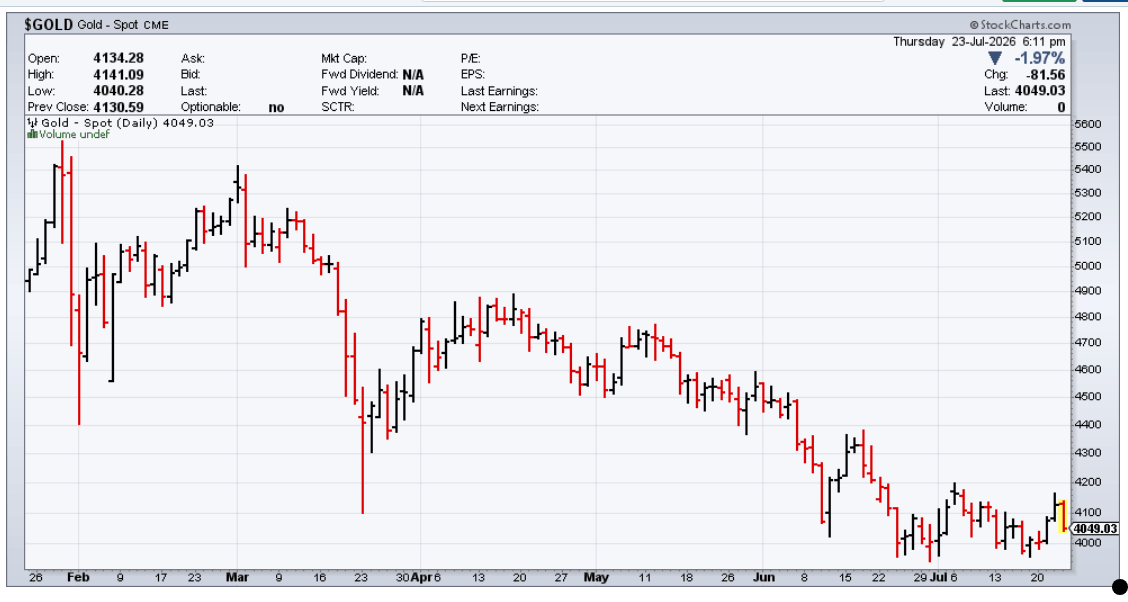 Click for larger graphic
Miners & Related
Coeur Mining (CDE – $15.24) is expected to report June quarter revenues up 158.38%(!) to $1.24 billion with earnings of 27¢ per share. The company said it is investing $158 million in exploration across its Palmarejo and Las Chispas gold-silver operations in Mexico in 2026, double the previous year’s spending and the largest program in the company’s history. The increased 2026 spending, which includes $27 million and 51.5 miles of drilling at Palmarejo and $24 million and 73.9 miles of drilling at Las Chispas, will support additional drilling at Palmarejo’s underground deposits as well as expanded testing of satellite targets and regional prospects across the company’s land package. Palmarejo produced 6.5 million ounces of silver and 101,000 ounces of gold in 2025, accounting for 36% of Coeur’s total silver production and 24% of gold output. Las Chispas produced 5.1 million ounces of silver and 55,000 ounces of gold last year.
The company has transformed itself into a diversified North American precious metals producer after acquiring New Gold, shifting away from its silver-miner legacy. With a net cash position, expanded buyback, and first-ever dividend, CDE is financially robust and trades at a significant valuation discount to peers like Hecla. CDE is a Hold as gold goes higher.
Primary Risk: Prices of precious metals fall due to US dollar strength.
Dakota Gold (DC – $4.68) was interviewed by Rick Rule (interview starts at 1:20):
DC is a Hold for a $6 target as gold goes higher.
Primary Risk: Robert Quartermain doesn’t find enough gold. Secondary risk: Prices of precious metals fall due to US dollar strength.
First Majestic (AG – $16.45) is expected to report June quarter earnings of 29¢ per share versus 4¢ last year. They reported June quarter production of 3.8 million silver ounces (+2.6% year-over-year), 34,660 gold ounces (+2.3%), 16.5 million pounds of zinc (+2.6%), 9.0 million pounds of lead (+0.1%), and 252,938 pounds of copper (+23.2%). Their 2026 guidance is for 14.6–15.5 million silver ounces and 128,000–135,000 gold ounces.
First Majestic offers high leverage to silver with improved fundamentals and a cleaner portfolio after the two non-core asset sales of San Martin for $90 million and Del Toro for up to $60 million. These sales converted idle assets into liquidity to support capital spending for growth projects like Santo Niño. CEO Keith Neumeyer was at the Rule Symposium (interview starts at 2:23):
AG is a Buy under $11 for a $23 next target price as production increases and the price of silver rises.
Primary Risk: Prices of precious metals fall due to US dollar strength.
Royal Gold (RGLD – $199.64) announced preliminary financial results for the June quarter, although they won’t announce earnings until August 5 with the conference call on August 6. Stream segment sales hit $311 million, and Royalty segment sales will be $137-$142 million.
During the quarter, they repaid another $200 million of debt, resulting in an outstanding balance on their revolving credit facility of $400 million at the end of June, leaving $1.0 billion undrawn and available. They bought back 147,205 shares at an average price of $203.80 per share, for total consideration of $30 million. RGLD is a Buy under $180.
Primary Risk: Prices of precious metals fall due to US dollar strength.
Cryptocurrencies
Cryptocurrencies are a diversifying asset that offer a unique opportunity to make (or lose!) a lot of money quickly.
Bitcoin (BTC-USD on Yahoo – $64,765.66) spent years selling a story because building a real, legal, revenue-generating token business in America was nearly impossible. So companies sold promises instead. Now the rules have changed. Wall Street came in, regulations cleared, and for the first time, the top-performing crypto companies all have one thing in common: They can make money.
I see two remaining problems for bitcoin. First, marginal liquidity would rather speculate in prediction markets and equity markets. The gamblers are gone, and I don’t really miss them. Second, the marginal energy to mine bitcoin is worth 10x-20x if reallocated to serving AI tokens. That will go away and, in the meantime, a lower supply of new tokens should mean a higher price for the existing ones.
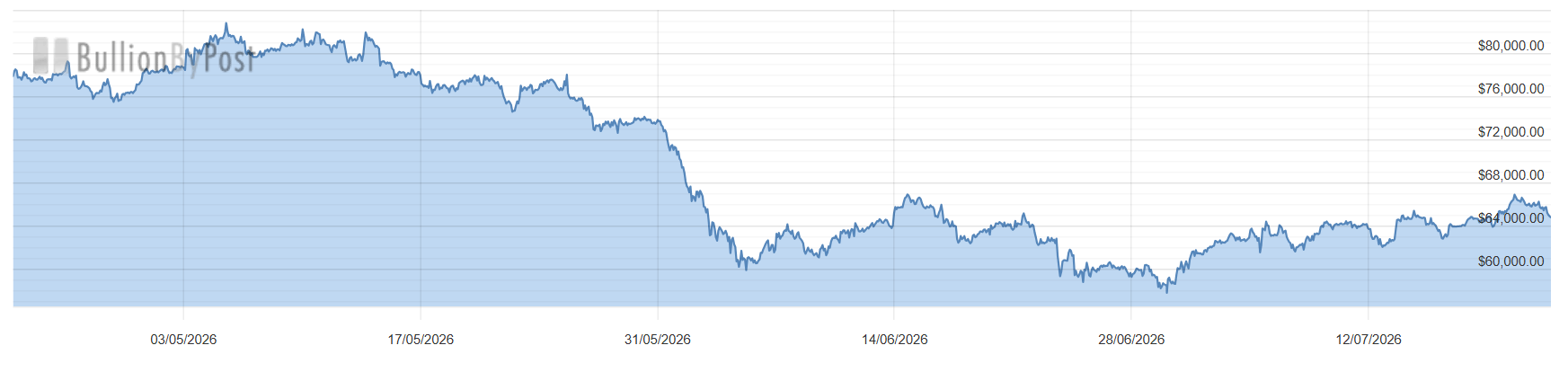 Click for larger graphic
BTC-USD, ETH-USD, IBIT, and ETHA are Strong Buys.
Primary Risk: Bitcoin falls due to over-regulation or is surpassed by another cryptocurrency.
iShares Bitcoin Trust (IBIT- $36.65) remains the cheapest and easiest way to buy bitcoin. IBIT is a Buy for the 2028, 2032, and 2036 halvings.
Primary Risk:Bitcoin falls due to over-regulation or is surpassed by another cryptocurrency.
iShares Ethereum Trust (ETHA- $14.11) remains the cheapest and easiest way to buy ethereum. ETHA is a Buy for the coming explosion in token-funded start-ups.
Primary Risk: Ethereum falls due to over-regulation or is surpassed by another cryptocurrency.
Commodities
Oil – $91.94
Well, well. It turns out that when the end user demand for oil and gasoline is growing and the supply is impaired, using oil in storage to paper over the gap doesn’t work forever. The Energy Information Agency reported oil in storage fell 1.7 million barrels and oil in the Strategic Petroleum Reserve (I hope there’s not a surprise strategic reason to need it!) fell 3.0 million barrels, for a total draw of 4.7 million barrels.
Total US stockpiles of crude oil have fallen to just 43 days worth of consumption, the lowest level in 45 years. This comes as the war in Iran re-escalates, including a recent announcement from Iran’s proxy militia – the Houthis of Yemen – of a maritime embargo against Saudi Arabia. This embargo threatens to disrupt 4.5 million barrels per day of Saudi oil exports flowing through the narrow Bab al-Mandab Strait. The risks of a significant oil supply crunch are rising.
In rapid order, multiple Russian tankers were taken out in the Black Sea, essentially showing Russian Black Sea oil loadings are finished (1 million barrels a day of exports) because Russia apparently cannot protect Black Sea ships. Then Iraq ended tanker loadings due to a drone attack at their VLCC terminal. The Houthis are making noise that they, in fact, will shut the Red Sea. Then the US put a missile into an Iranian-bound tanker, showing the blockade is once again real. And WTI is not even over $80? I cannot explain this in any way that doesn’t sound like a stupid conspiracy theory.
The latest Chinese customs data revealed that the country’s crude-oil imports dropped by a record 41% in June. The 7 million barrels per day decline in demand from the world’s largest energy importer helped balance supply disruptions from the closure of the Strait of Hormuz. But this is merely a temporary balancing act as China draws down its strategic petroleum reserves, setting up a rebound in global demand when Chinese imports come back into the market.
Crude oil prices have finally ticked up as military activity between the US and Iran reignited, yet they remain far off their wartime highs. But red flags are flashing in the refining market for critical products such as gasoline, diesel, and jet fuel. “Crack spreads,” or the price difference between crude oil and the refined product, keep growing. That means that despite the drop in oil prices, the underlying physical reality is still much tighter.
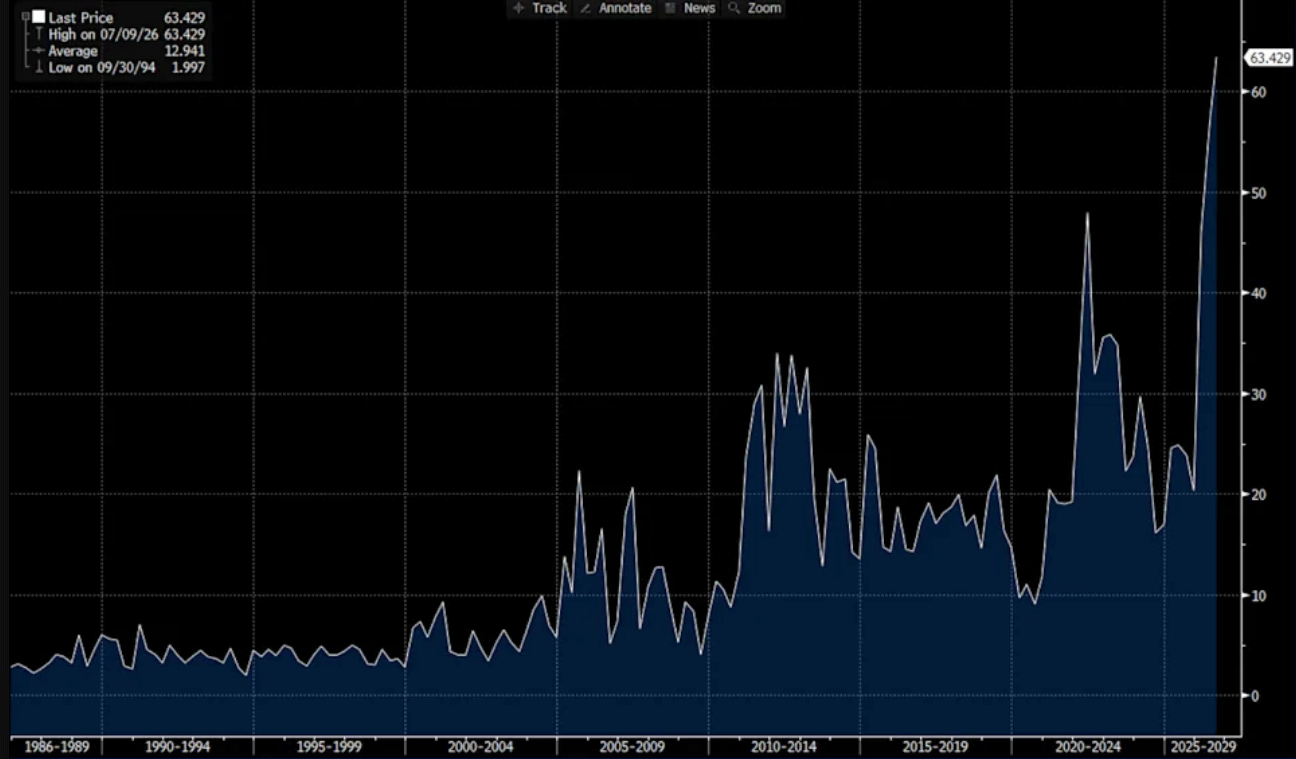 Click for larger graphic h/t Yahoo Finance
The most closely watched spread is the “3-2-1 crack,” which estimates the theoretical margin gained from turning three barrels of crude oil into two barrels of gasoline and one barrel of distillate fuel (diesel). That crucial measure pushed past $60 to reach an all-time high near $64. Refiners are earning their best margins on record, but US refiners have been running at or above the 95% utilization rate that’s widely regarded as full capacity for almost two months. In the Rocky Mountains region, fuelmakers have surpassed the 100% mark twice in the past few weeks, a pace that even the refining industry’s main lobbying group warns is untenable.
Running near max capacity is raising the likelihood that equipment failures tighten fuel supply and amplify price volatility. Several major refiners already have postponed maintenance to keep capacity online. Motiva Enterprises delayed a turnaround at the biggest crude unit at its Port Arthur refinery in Texas by a year to the fall of 2027. Any major outage could have an outsized impact because domestic fuel stockpiles are unusually low. According to Bloomberg, inventories have been strained by a drop in gasoline imports to a 29-year seasonal low and robust demand for US diesel to replace production lost to the conflicts in Russia and the Persian Gulf. Morgan Stanley says that more than half of Russian oil refinery capacity is down due to Ukrainian attacks. Typically, Russia is the world’s second-largest diesel exporter – normally around 11% of global seaborne trade.
As governments and companies drew down their jet fuel and gasoline stores during the Iran war, refineries struggled to obtain crude oil to replenish their inventories, driving prices higher. The dynamic has played out just as the US hit the summer vacation season, when demand for gasoline spikes.
The September 2027 Crude Oil Futures (CLU7.NYM – $72.82) moved up, but are still a Buy under $75 for my (lowered) $100+ target. Only buy futures for all cash; do not use margin.
The United States 12 Month Oil Fund, LP (USL – $51.94) is a Buy under $40 for a $100+ target.
Vermilion Energy (VET – $11.24) is expected to report June quarter revenues down 12.14% to $469.3 million. The company got TSX approval to repurchase up to 15.16 million shares, around 10% of its public float. Management expects to return 40% of excess free cash flow to shareholders in 2026, primarily through dividends and share repurchases.
TD Cowen upgraded VET from Hold to Buy with a C$18 price target, saying the shares are at a compelling entry point following their recent underperformance. They said Vermilion’s recent operational headwinds (presumably the falling oil price) are increasingly understood by investors, while portfolio repositioning has improved asset quality, unit costs, and financial flexibility. They see a free cash flow inflection potential in 2028 and beyond, momentum in Germany, and a valuation that offers reasonable compensation for the remaining execution and timing risks.
2026 volumes are tracking toward the high end of the company’s guidance for 118,000-122,000 barrels of oil equivalent per day. VET is a buy under $11 for a target price of $24 or more.
Primary Risk: Oil and natural gas prices fall.
Energy Fuels (UUUU – $12.01) produces both uranium and rare earths, a double win. The International Energy Agency (IEA) warned Thursday that China’s full implementation of rare earth export controls could jeopardize $6.5 trillion in global downstream production outside the country. In other news, the IEA said the sun might rise tomorrow.
The Agency said there is a strong case for policymakers to focus more attention on strategic minor minerals – those for which markets are small, but any supply disruptions could carry an outsize economic impact. Energy Focus is there. Critical minerals generally account for a small share of final product prices, suggesting that the additional cost of diversifying the supply chain could be absorbed with limited impact on consumers. For example, critical minerals account for around one-quarter of battery cell costs but only about 3% of the price of an average electric vehicle, while rare earths represent around 40% of permanent magnet costs, but less than 1% of a vehicle’s value. UUUU is a buy under $8 for a $30 target.
Primary Risk: Uranium prices fall.
EQT (EQT – $53.39) reported June quarter revenue down 29.0% from last year to $1.81 billion. The drop was expected – the consensus estimate was $1.84 billion. Total sales volume during the quarter rose 11% from last year to 634 billion cubic feet equivalent (Bcfe), but EQT’s realized price including hedges slipped 5.7% to $2.65 per million cubic feet equivalent (Mcfe) from $2.81 in the year-earlier quarter. Pro forma earnings of 39¢ a share missed by a penny.
On the conference call (WEBCAST HERE and SLIDES HERE and TRANSCRIPT HERE), CEO Toby Rice guided the September quarter to 570-620 (Bcfe) and increased the full year by about 90 Bcfe to 2,375-2,450 Bcfe, citing infrastructure investments that are boosting output. He trimmed their capital spending outlook by $25 million for the full year. He mentioned that before the Iran conflict, they saw 2028–2029 as a little bit oversupplied, but that’s gone away with Iran. He mentioned spot prices internationally are north of $17.
His two key announcements were (1) a definitive 10-year agreement to supply 325 million cubic feet per day of natural gas to Competitive Power Ventures’ Shay Energy Center in West Virginia, a new 2.1-gigawatt power generation facility expected to enter service in early 2031, with pricing linked to PJM power markets rather than a gas price index, and (2) a new LNG offtake agreement, a five-year 500,000 metric tons a year deal with a large Asian integrated energy company, starting in 2028.
Toby also said they have secured all the key regulatory approvals for the Mountain Valley Pipeline Southgate project and will accelerate $85 million in capital contributions to support completion of the pipeline by year-end 2026.
EQT had $330 million of free cash flow in the quarter, despite natural gas prices averaging just $2.89 per million British Thermal Units during the quarter. They are about to hit their long-term net debt target of $5 billion. In the near term, they intend to accumulate cash to aggressively deploy into share buybacks during the industry’s episodic down cycles.
EQT is positioned for significant upside from rising US natural gas demand, driven by LNG exports and data center power needs.
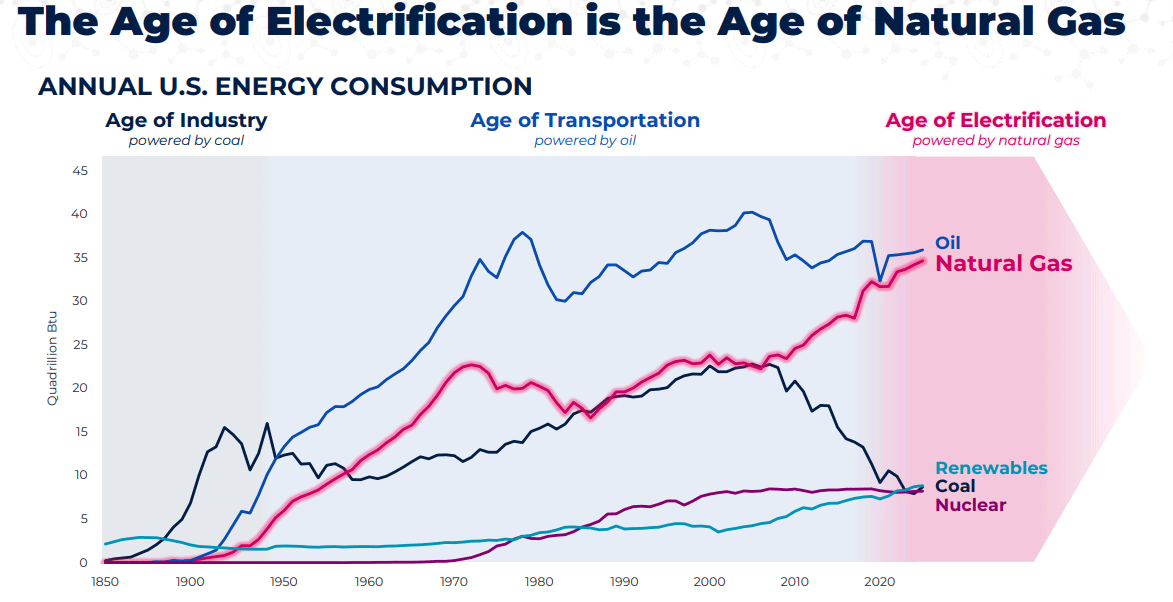 Click for larger graphic
Wall Street is underestimating the potential. If Henry Hub prices rise as projected, EQT could see earnings before interest, taxes, depreciation and amortization (EBITDA) increase by 40% or more from 2028 onward. EQT is a conservative AI-linked trade with minimal downside risk and is a Buy under $70 for a long-term hold for much higher prices.
Primary Risk:Natural gas prices fall.
Freeport McMoRan (FCX – $63.50) reported June quarter revenues down 7.3% from last year to $7.03 billion due to the Grasberg mine closure. They beat the $6.75 billion consensus. Pro forma earnings of 74¢ a share also beat the consensus for 62¢.
Consolidated production totaled 786 million pounds of copper, 192,000 ounces of gold, and 23 million pounds of molybdenum. Consolidated sales totaled 710 million pounds of copper, 123,000 ounces of gold, and 25 million pounds of molybdenum.
On the conference call (WEBCAST HERE and SLIDES HERE and TRANSCRIPT HERE), CEO Kathleen Quirk guided September quarter production to a slightly lower 750 million pounds of copper, 160,000 ounces of gold, and 22 million pounds of molybdenum. For the full year, consolidated sales are expected to approximate 3.1 billion pounds of copper, 650,000 ounces of gold, and 93 million pounds of molybdenum.
Kathleen said: “Our Grasberg ramp-up plans are on track,” adding that the company has formally applied to extend its Grasberg operating permit beyond 2041 and hopes to have a decision by the end of this year.
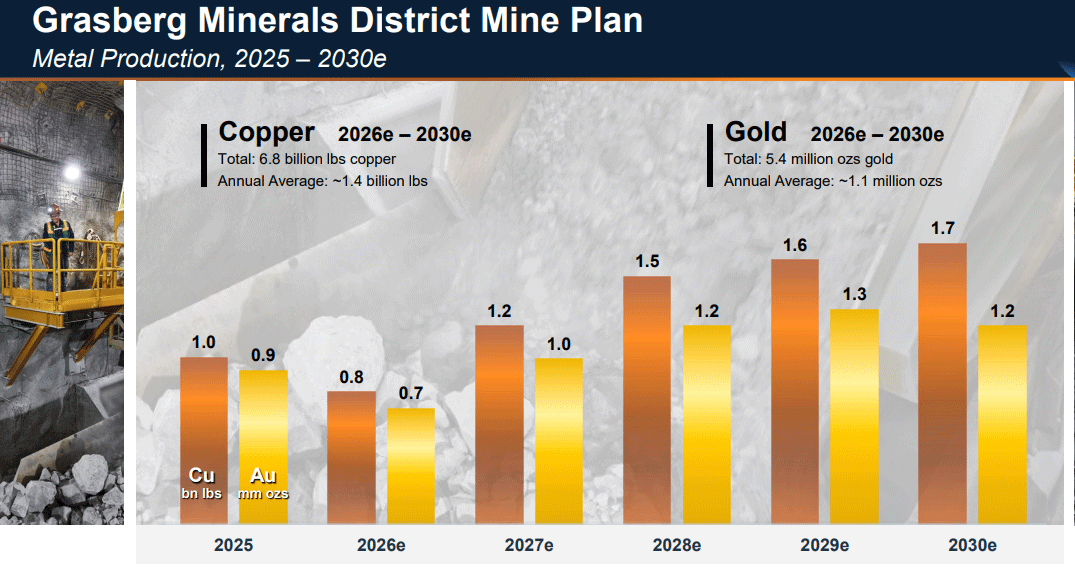 Click for larger graphic
She said: “We are nearing an investment decision for a major expansion of our Bagdad mine in Arizona and advancing our regulatory work in Chile for a significant expansion at our El Abra mine.
“During the quarter, we increased our ownership in Cerro Verde… bringing total purchases over an approximate 2-year time frame to over $300 million, increasing our ownership by 2% to over 55%. In addition, we returned $600 million to shareholders in the first half, including roughly $200 million in share repurchases.
“Production rates at the Grasberg Block Cave doubled during the quarter from an April average of 34,000 tons per day to an average of 69,000 tons per day in June. Consistent with our April update, we continue to target overall rates in the district approximating 65% of full capacity in the second half of this year, reach 80% by mid-2027, and approach full capacity by the end of 2027.
“Our current estimate for 2026 average unit net cash cost approximates $1.90 per pound, slightly below the April estimate of $1.95 per pound, with higher by-product credits more than offsetting other unit cost increases. As we move through 2026, we expect a large increase in second half sales volumes driven by higher volumes at Grasberg and our U.S. operations.”
EVP & CFO Maree Robertson gave their first 2027 outlook. “For 2027, we expect annual copper sales to increase by more than 20% compared with 2026 and gold volumes to increase by more than 50%, with additional growth projected in 2028 for both copper and gold. 2027 capital expenditures are estimated at $4.8 billion, approximately $300 million above the April estimate, reflecting investments in upgraded mining equipment and revised cost estimates.”
Copper isn’t buying gold’s breakdown. After rallying strongly together through most of 2024 and 2025, gold has fallen roughly 28% from its January 29 record near $5,595 an ounce – its worst quarterly decline in 13 years – while copper is up nearly 10% over the same period and within striking distance of an all-time high. Gold’s recent decline appears to be a reaction to extreme sentiment and crowded positioning, not the end of the commodity bull market.
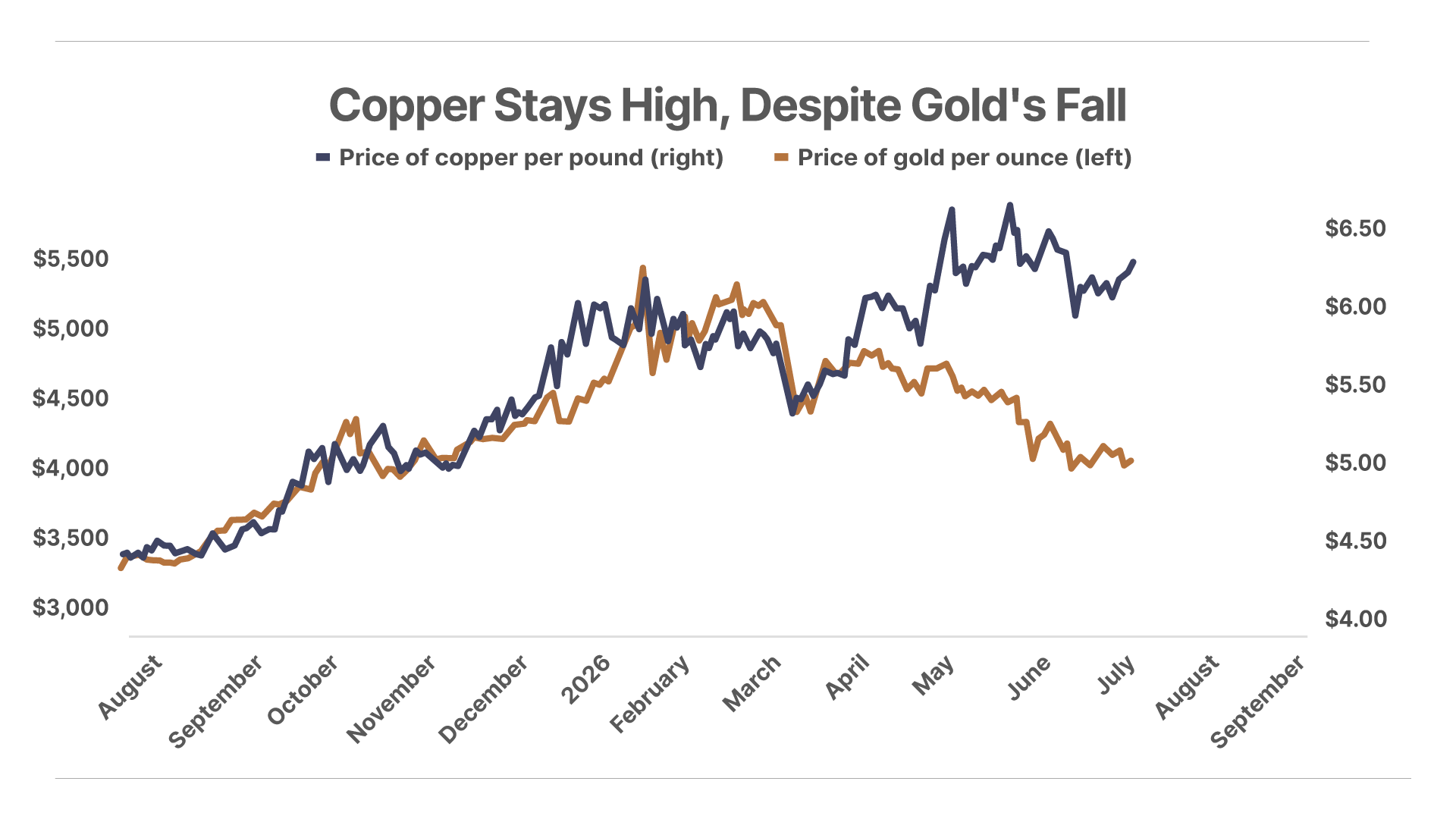
Click for larger graphic h/t Porter & Co.
FCX is a Hold for higher copper prices .
Primary Risk: Copper prices fall.
* * * * *
Legendary Investor Dan Loeb on AI, Credit, & Third Point’s $25B Strategy
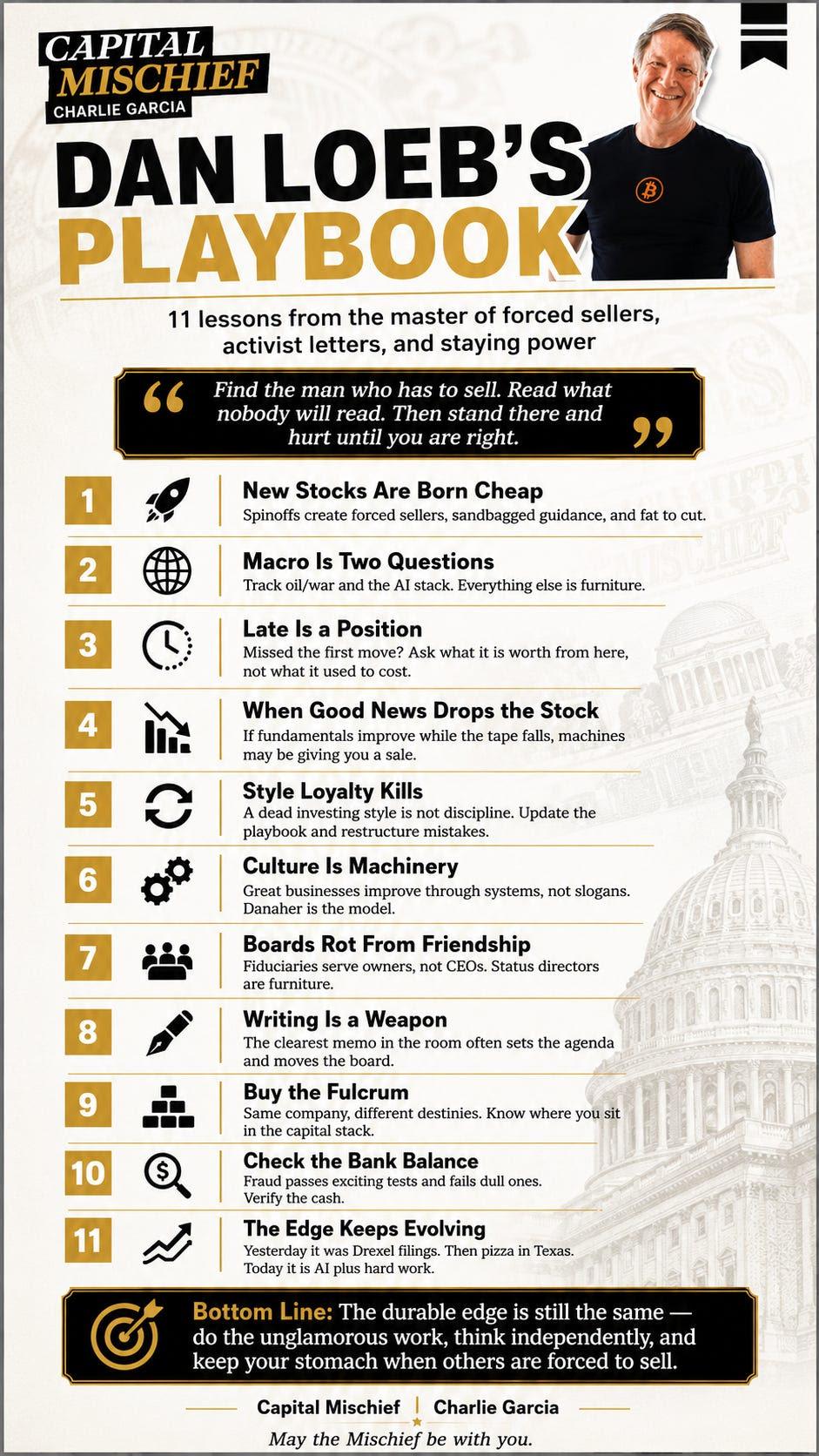 Click for larger graphic h/t Capital Mischief
* * * * *
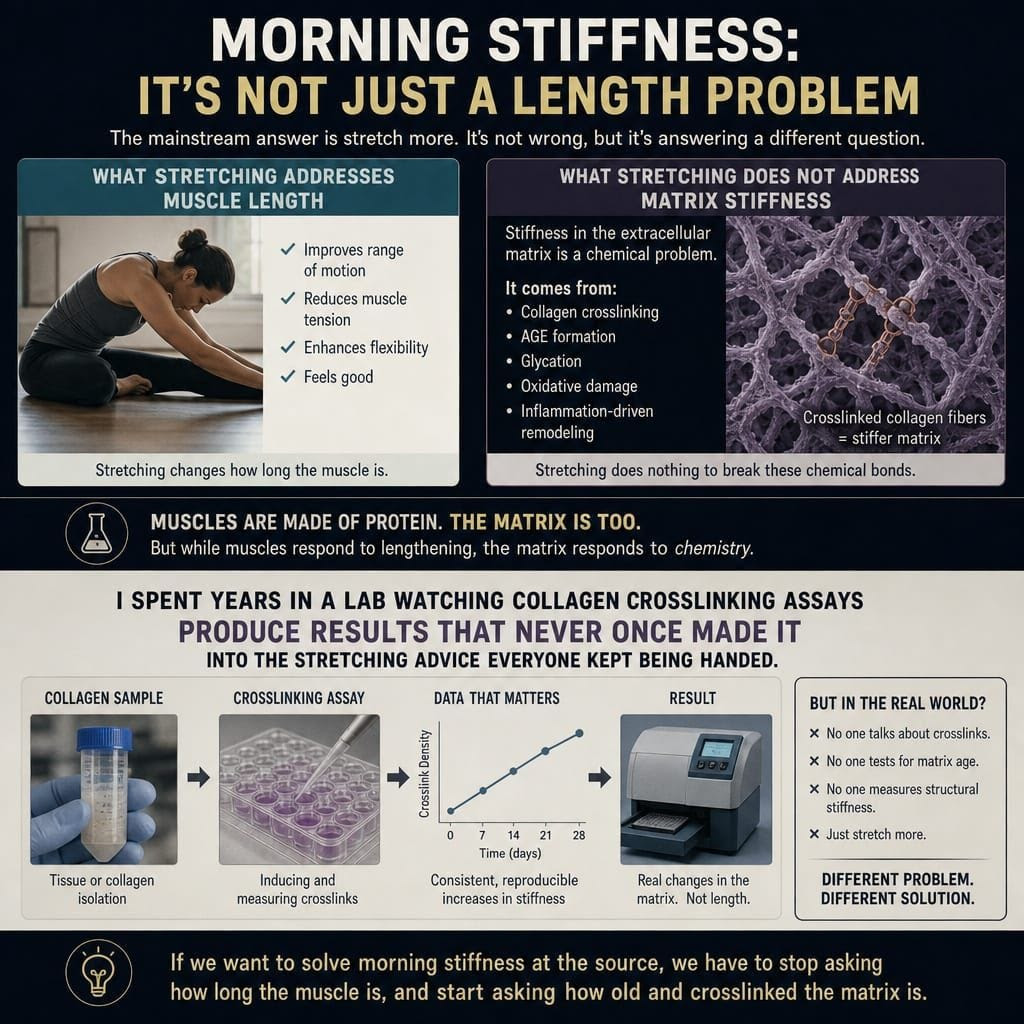 Click for larger graphic h/t Tom Kane
* * * * *
Your writing The Peoplist Manifesto Editor (It’s free!),

Michael Murphy CFA
Founding Editor
New World Investor
All Recommendations
HERE
Publisher: GwynRose LLC, 5348 Vegas Drive, Suite 868, Las Vegas, NV 89108
New World Investor does not act as a personal investment adviser or advocate the purchase or sale of any security or investment for any specific individual. The recommendations and analysis presented to members are for the exclusive use of members. Members should be aware that investment markets have inherent risks and there can be no guarantee of future profits. Likewise, past performance does not assure future results. Recommendations are subject to change at any time. Nothing in this presentation should be considered personalized investment advice. No communication to you by Michael Murphy or any of our employees or contractors should be deemed as personalized investment advice.
Copyright ©GwynRoseLLC 2026
New World Investor Mastermind Group
1. Post unto others as you would have them post unto you.
2. Keep it clean, like a 1950s family television show. Your alter ego can run free on Twitter.
3. NO PERSONAL ATTACKS! If you don’t like the stock, don’t trash the person. Everyone is responsible for their own due diligence and investments.
4. Don’t post here about politics or religion – you aren’t going to change anyone’s mind. Again, NO PERSONAL ATTACKS!
5. The investment implications of something going on in politics or religion is OK.
6. Of course, there’s never a reason to slur someone based on race, religion, gender, sexual orientation, or country of national origin.
7. Please, no snark!
 Print This Post


First. Isn’t anyone eagerly reading this any more? Or is it just no rush.
I love it!
MM continues to ignore my posts on AKBA. He does no hard financial analysis anymore, except for giving his general, intuitive views on AI and other pure tech stocks. Any subscriber interested in AKBA should follow news closely and buy now at $1.20, or wait until after Q2 ER Aug 6. If Vafseo sales are good but not great, expect a dip in PPS to around $1 or less. It will take Q3 ER 3 months later to recover. But MM’s advice to buy below $4 is useless because it is outdated. That’s akin to choosing to meet a woman online by seeing her 20 year old picture. I know someone who was slender as a teenager. 30 years later, she is now obese.
thanks MM
i appreciate your coverage on PLTR, NVDA. the inflation numbers are entertaining at best. inflation is running strong with no letup in spite of the alternative methods of interpretation. We seem to lack the honesty integrity and will required to deal with inflation.
Has {He} drillers production and exploration surfaced for anyone as an investment theme in response to the state of the world.
pray for September.