

Dear New World Investor:
Well, I was wrong. The Fed raised interest rates by 25 basis points (1/4 of 1%) to a target range of 3.75%-4.00%, and hinted at another rate hike in 2026. The Fed raised interest rates to fight an inflation it cannot fix with interest rates, because the inflation is not coming from Americans buying too many pickup trucks on credit. A rate hike cannot produce one additional barrel of crude oil, reopen Hormuz, or repair a pipeline. A tool designed for demand inflation is being applied to a geography problem.
But Fed Chairman Kevin Warsh hiked anyway, because Kevin Warsh said he would, and the bond market either (1) Nice Version – dared him to prove he meant it; or, (2) Not-So-Nice Version – bullied him into it.
Three things changed in 72 hours. Together, they add up to the most coordinated assault on the global oil supply chain since October, 1973. First, drones launched from Iraq struck pump stations along Saudi Arabia’s 1,200-kilometer East-West Pipeline, and the Saudi bypass was disabled. This pipeline was carrying four to five million barrels of crude oil a day and a couple of million barrels of refined products. It was Saudi Arabia’s only functioning export route that bypassed the Strait of Hormuz.
Then, Yemen’s Houthis completed a lightning offensive, capturing the port of Mokha, the island of Perim, and the Hanish Islands. Almost 3,000 square miles of new territory captured in eleven days. The Houthi spokesman declared that “maritime navigation is safe for all companies, with the exception of Saudi ships.”
That exception being the country that exports more crude oil than any other nation on earth.
Third, an Iranian cargo vessel was struck off Qeshm Island in the Strait of Hormuz – maybe by us – so diplomacy collapsed and Oman’s foreign minister had to postpone the scheduled Iran/US negotiation “in the interests of consensus.”
Before the war, the Strait of Hormuz carried 20 million barrels of oil per day (bpd) – 20% of the world’s oil. Energy Information Administration data show flows collapsing from 21.6 million bpd in the December quarter to 14.9 million bpd in the March quarter, to 4.9 million bpd in the June quarter, to…well…nothing right now. The good news is that Saudi Arabia had oil in storage at the receiving end of the pipeline, The bad news is that it was only five to seven days of flows, and it’s gone by now. But, hey, why worry – the Fed raised rates 25 bps.
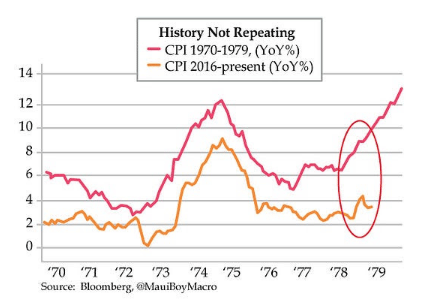
No doubt, inflation is running hot. The August Consumer Price Index was up 3.4% year-over-year. The core CPI was up 0.3% month-over-month, hotter than expected. The Producer Price Index – wholesale inflation – was up 5.4% from last year. The Fed’s preferred gauge, the core Personal Consumption Expenditures (PCE) index was up 3.7% year-over-year. 54% of the headline PCE components are rising more than 3% a year. Gasoline is up 27%. Airline tickets are up 23%. Diesel is at a record. But the Consumer Price Index is not out of control:
 Click for larger graphic h/t @DiMartinoBooth
President Trump is being pressured to block diesel exports to bring down record prices before the midterms. Of course, that won’t work because refiners won’t be able to sell more diesel domestically. Prices are up because crude prices are up, not because there is a shortage of diesel. Refiners will just cut back throughput volume and then we’ll have a shortage of gasoline – not the smartest move going into the midterms. Diesel-using truckers vote, of course, but there are a heck of a lot more gasoline-using voters. Trump needs to change the conversation to the need for short-term sacrifice to prevent Iran from targeting and killing us, a message that has always resonated with the American people.
The world is changing rapidly. I agree with Marc Andreessen that AI Will Save The World, but large swathes are going to be disrupted. An awful lot of companies that seem like fortresses today are going to be the Eastman Kodaks, Xeroxes, and Blockbusters of tomorrow. That means the S&P 500 is likely to dramatically underperform over the next 10 years. What seemed like the easiest way in the world to outperform – buy an S&P Index Fund – is going to become the world’s biggest value trap. And that is coming from the guy who wrote the first index fund prospectus filed with the SEC.
If you want a hint of what life will be like 10 years from now, read the Andreessen article and study trust fund babies. The post-AGI economy will have a lot of similarities and lessons learned around proper parenting at the risk of spoiling your child. There will be an initial boom in areas like travel and experiential living that will far eclipse the small post-Covid remote working millennial wave. Status will become more valuable. But always remember that society is reflexive and technological progress will continue, so this boom will be ephemeral. It will, however, be vicious and like nothing we’ve ever seen before. Constraints like the four-day work week or saving for retirement are about to fall away for large segments of the western world all at once. What they do next will be fascinating.
Fortunately, the AI Doomerism fad has knocked down some stocks and given us a graceful entry point for one of the winners of the next 10 years:
Buy Broadcom (AVGO)
Broadcom did something very unusual that put them on my radar. A few days after Nvidia provided guidance for 2027 that substantially topped forecasts, Broadcom took it one step further and guided for $30 per share earnings in 2028. At the same time, they sharpened their previous 2027 revenue guidance from “well above $100 billion” to $115 billion and said 2028 “will double again.”
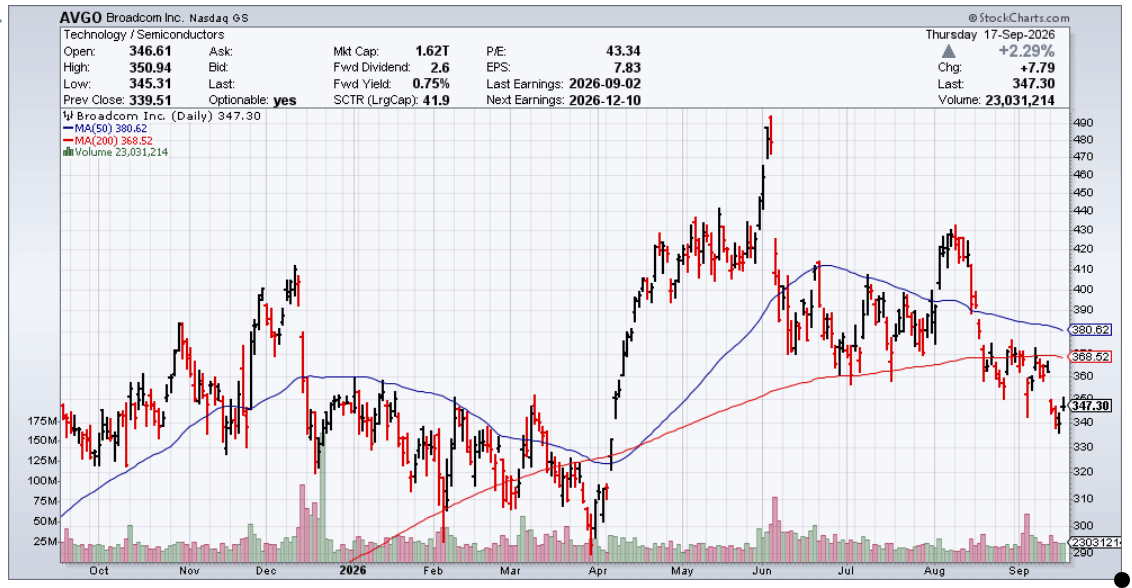
When I took a quick look, I found that in addition to providing AI inference processors to Google, their long-standing customer, they’ve added Anthropic, OpenAI, and Meta. Broadcom is becoming the AI industry’s main supplier of inference chips – Transaction Processing Units (TPUs). It’s not the near-monopoly position Nvidia has in GPUs – in fact, Nvidia is a competitor – but it’s a powerful place to be. The recent decline in the stock from $495 to $347.30 gives us a graceful entry point. Buy AVGO for a return to its $495 high and beyond.
New World Investor
Initiation of Coverage
Broadcom Inc. (NASDAQ: AVGO)
The AI Buildout’s Arms Dealer, Now Trading 31% Off Its High
| Rating | Buy |
| 12-Mo Price Target | $420 |
| 24-Mo Price Target | $560 |
| Current Price (9/15/26) | $339.27 |
| Implied Upside | ~24% (12-mo) / ~65% (24-mo) |
| Market Cap | ~$1.62 trillion |
| 52-Wk Range | $289.96 – $495.00 |
| Catalyst | Q4 FY2026 earnings and FY2027 AI-revenue framing, OpenAI/Anthropic XPU ramps, Tomahawk 7 production timeline, resolution of the Google/Marvell competitive overhang |
Investment Thesis
Broadcom is no longer just a component supplier to the AI buildout — it has become the industry’s default second source and, for a growing list of hyperscalers, the exclusive supplier of the custom silicon (XPUs) and networking chips that turn raw GPU capacity into a working AI data center. Q3 FY2026 revenue hit a record $29.6 billion, up 86% year-over-year, with AI semiconductor revenue of $16.7 billion up 221% year-over-year, and management guided Q4 AI revenue to $21.7 billion, up 236% year-over-year — putting full-year AI semiconductor revenue on track for roughly $58 billion, up from single-digit billions just two fiscal years ago. A reported backlog of roughly $110 billion gives Broadcom a level of forward revenue visibility that is rare among semiconductor stocks.
Yet the stock trades 31% below its 52-week high of $495, weighed down by three overlapping worries: Marvell’s roughly $12 billion warrant-based deal to co-develop custom silicon for Google, which threatens the exclusivity of Broadcom’s largest disclosed customer relationship; sector-wide scrutiny of off-balance-sheet AI infrastructure financing; and customer pushback on VMware’s post-acquisition subscription pricing. I think the market is conflating a real, disclosed risk — Google diversifying their supplier base — with an existential one. Broadcom is simultaneously broadening their own customer base: Meta, ByteDance, OpenAI’s Jalapeño accelerator, and Anthropic’s fast-scaling TPU program are all real, disclosed design wins moving through tape-out toward multi-gigawatt deployment in 2027–2028, while the company generated $13.7 billion of free cash flow in a single quarter and paid down $5.6 billion of debt. I rate AVGO a Buy with a 12-month target of $420 and a 24-month target of $560.
Company Snapshot
Broadcom Inc. is headquartered in Palo Alto, California, and led by CEO Hock Tan. The company traces their lineage to Hewlett-Packard’s semiconductor division, spun out as Avago Technologies in 2005 and combined with, and renamed for, Broadcom Corporation in a 2016 merger. Broadcom now reports in two segments:
- Semiconductor Solutions (70% of Q3 revenue) — custom AI accelerators (XPUs) designed for hyperscale customers, plus Ethernet switching and routing silicon (Tomahawk, Jericho, Trident) that ties AI clusters together, alongside legacy broadband, wireless connectivity, storage, and industrial chips.
- Infrastructure Software (30% of Q3 revenue) — VMware Cloud Foundation (VCF), following the $69 billion VMware acquisition completed in November 2023, alongside Symantec enterprise security and CA Technologies mainframe software.
The Bull Case: Five Pillars
1. AI Semiconductor Revenue Is Compounding at Triple-Digit Rates, With a Backlog to Match
Q3 FY2026 AI semiconductor revenue of $16.7 billion grew 221% year-over-year and 54% sequentially; Q4 guidance of $21.7 billion implies 236% year-over-year growth. Summing the four quarters puts fiscal 2026 AI semiconductor revenue at approximately $58 billion, against a reported backlog of roughly $110 billion that extends well beyond the current fiscal year — a level of forward revenue visibility unusual for a semiconductor company at this stage of a capital-spending cycle.
2. The Hyperscaler Customer Base Is Genuinely Diversifying Beyond Google
Google remains Broadcom’s largest and longest-tenured XPU customer, spanning multiple generations of Tensor Processing Unit (TPU) silicon, but it is no longer the whole story. Meta’s custom inference silicon is in production, ByteDance’s recommendation-engine chip is shipping, OpenAI selected Broadcom to build their Jalapeño custom inference accelerator, and Anthropic — working alongside Google and Broadcom on next-generation TPU capacity since an April partnership — is reportedly scaling their own TPU deployment sharply through 2027–2028. Management has talked publicly about a path to 7–8 hyperscale XPU customers by fiscal 2027, up from five today.
3. Networking Silicon Wins Regardless of Which Accelerator Wins
Every AI cluster — whether built on Nvidia GPUs, Broadcom XPUs, or a competitor’s custom silicon — needs high-radix Ethernet switching to tie thousands of accelerators together. Broadcom’s Tomahawk 6 and Tomahawk Ultra switch silicon are selling briskly across hyperscalers, according to management commentary, and Tomahawk 7 has already taped out with 400 Gb/sec SerDes for switches expected in production in 2027–2028. That franchise partially insulates Broadcom’s AI revenue from any single customer’s decision about whose compute silicon to use.
4. VMware Has Become a High-Margin, Recurring-Revenue Compounder
Infrastructure Software revenue reached $8.8 billion in Q3, up 29% year-over-year, as roughly 90% of top customers have migrated to the subscription-based VMware Cloud Foundation model. That recurring cash flow, combined with AI-driven semiconductor profits, funded $13.7 billion of free cash flow in the quarter alone (a 46% margin) and $5.6 billion of debt repayment — net debt has fallen to roughly $35 billion against $99.7 billion of equity, a comfortably investment-grade balance sheet funding both the AI buildout and continued capital return.
5. The Stock’s 31% Drawdown Already Discounts Real Risk, Setting Up an Asymmetric Entry
AVGO trades at $339, 31% below its 52-week high of $495 and at a forward price/earnings ratio of roughly 20x — modest for a company guiding to more than 200% AI revenue growth. The drawdown reflects real, disclosed concerns (Marvell’s Google deal, VMware pricing criticism, sector-wide financing scrutiny), but sell-side consensus — the large majority of covering analysts at Buy, with an average price target near $510–$535 — suggests the market has not concluded the growth story is broken, only that it wants the diversification and margin questions answered over the next few quarters.
Financial Snapshot
| Metric | Observation |
| Current Price / Market Cap | $339.27 / ~$1.62 trillion (9/15/26) |
| Q3 FY2026 Revenue | $29.6 billion, +86% year-over-year (record quarter) |
| Q3 FY2026 AI Semiconductor Revenue | $16.7 billion, +221% year-over-year (70% of Semiconductor Solutions) |
| Q4 FY2026 Guidance | $34.8 billion total revenue (+93% YoY); $21.7 billion AI semiconductor revenue (+236% YoY) |
| FY2026E Revenue / AI Revenue | ~$105.9 billion total (Q1–Q3 actual + Q4 guide) / ~$58 billion AI semiconductor, vs. $64.0 billion total FY2025 |
| Margins (Q3 FY2026) | 75% GAAP gross margin; 67.9% non-GAAP operating margin |
| Free Cash Flow (Q3 FY2026) | $13.7 billion, a 46% margin on revenue |
| Balance Sheet | $59.4 billion total debt / $24.0 billion cash (~$35.4 billion net debt) vs. $99.7 billion equity; $5.6 billion of debt repaid in Q3 alone |
| Backlog | ~$110 billion, as recently reported |
| Dividend | $0.65/quarter ($2.60 annualized), ~0.8% yield |
| Valuation | 44.0x trailing P/E / ~19.9x forward P/E |
| Analyst Consensus | Buy / Strong Buy (26 of 30 analysts); average target ~$510–$535; range $350–$600 |
| Next Earnings | Q4 FY2026 results, expected mid-December 2026 |
Sources: Company Q1–Q3 FY2026 results and guidance (December 2025–September 2026); Q3 FY2026 earnings call (September 2, 2026); market and analyst data as of September 15, 2026.
Valuation & Price Targets
(a) Forward-revenue approach (12-mo, $420 target). Broadcom’s fiscal 2026 revenue is tracking to roughly $106 billion — summing Q1–Q3 actuals of $19.3 billion, $22.2 billion, and $29.6 billion with Q4 guidance of $34.8 billion — up from $64.0 billion in fiscal 2025. Applying a next-twelve-months enterprise-value-to-sales multiple in the mid-teens, modestly below Broadcom’s current run-rate multiple on an enterprise value near $1.66 trillion, to a next-twelve-months revenue base that blends the tail of fiscal 2026 with the early ramp of fiscal 2027 supports a price near $420.
(b) Catalyst-driven re-rating (24-mo, $560 target). Management’s own long-term framing points to fiscal 2027 AI semiconductor revenue of roughly $115 billion, more than double fiscal 2026’s approximately $58 billion, as OpenAI’s Jalapeño and Anthropic’s TPU programs move from tape-out and early deployment into volume. If that trajectory holds and the Google/Marvell overhang resolves without materially denting Broadcom’s core TPU relationship, fiscal 2027 total revenue could approach $165–$170 billion, and a modest multiple expansion back toward where the stock traded near its highs would support a price near $560.
(c) Comparable-company cross-check. Against the other stocks capturing the AI infrastructure buildout — Nvidia (merchant GPUs), Marvell (custom silicon), and AMD (GPUs/CPUs) — Broadcom’s forward P/E of roughly 20x and mid-teens EV/Sales sit at a discount to Nvidia’s multiple and roughly in line with Marvell’s, despite Broadcom’s larger revenue base, their non-AI networking and VMware diversification, and an apparent cost advantage in delivered AI compute: independent industry estimates put Broadcom’s XPU-based systems at roughly $12–$15 billion per gigawatt of deployed capacity, versus $18–$40 billion per gigawatt for comparable Nvidia GPU systems.
(d) The moonshot. Management has articulated a long-term addressable opportunity in AI semiconductors of roughly $230 billion by fiscal 2028 as more hyperscalers and AI labs standardize on custom silicon for inference at scale. That figure is best read as management’s outer-bound framing of the market opportunity rather than a near-term revenue forecast, but even a fraction of it becoming Broadcom-specific revenue would make today’s price look inexpensive in hindsight. Tail-risk positive, not a base case.
Catalysts (Next 12–24 Months)
- Q4 FY2026 earnings, expected mid-December 2026 — first full look at whether the $21.7 billion AI revenue guide converts to an actual result
- Initial fiscal 2027 revenue and AI-semiconductor guidance, including any update on the ~$115 billion long-term AI revenue framing
- Tape-out and early deployment progress on OpenAI’s Jalapeño accelerator and Anthropic’s TPU 7 ramp (targeted at roughly 1 gigawatt in 2026)
- Any formal confirmation or expansion of the 7–8 hyperscale customer target, including Microsoft, Amazon, or xAI as potential additions
- Resolution or de-escalation of the Google/Marvell competitive overhang and any commentary on the durability of Broadcom’s core TPU relationship
- Tomahawk 7 sampling and production-timeline updates as hyperscalers plan 2027–2028 network refreshes
- Continued VMware Cloud Foundation subscription attach and further debt paydown or capital-return updates
- Any China AI-chip export-policy developments affecting addressable demand
Key Risks
- Customer concentration and a credible competitive threat at the largest account. Google has historically represented more than half of Broadcom’s disclosed XPU revenue, and Marvell’s roughly $12 billion warrant-based deal to co-develop AI infrastructure silicon for Google threatens the exclusivity of that relationship through the remainder of the decade.
- New customer ramps are still early. OpenAI’s Jalapeño accelerator and Anthropic’s TPU 7/8i/9 programs are in design, tape-out, or early-deployment phases; meaningful revenue from either is largely a fiscal 2027–2028 story, not a guarantee.
- Leverage and financing scrutiny. Broadcom carries $59.4 billion of total debt, and Wall Street Journal reporting on roughly $3 trillion of off-balance-sheet financing commitments across major AI infrastructure companies — a sector-wide, not Broadcom-specific, concern — has weighed on sentiment toward AI infrastructure stocks generally.
- VMware pricing backlash. Customers and trade press have criticized post-acquisition subscription pricing and licensing changes; Broadcom executives dispute that the criticism is warranted, but reputational and customer-retention risk persists.
- Supply and export-policy constraints. High-bandwidth memory (HBM) and advanced-packaging capacity, along with China AI-chip export controls, could cap the pace at which backlog converts to recognized revenue.
- Valuation already prices in a lot of good news. A trailing P/E of 44x reflects continued hyperscaler capital-spending growth; any digestion pause in AI infrastructure spending — whether from macro pressure or returns-on-investment scrutiny at the hyperscalers — would likely hit the multiple harder than the underlying earnings.
- Margin mix risk. GAAP gross margin already stepped down 210 basis points sequentially in Q3 as compute silicon, which carries lower margins than networking and software, takes a larger share of revenue.
Bottom Line
Broadcom has turned itself into the AI infrastructure buildout’s indispensable second supplier — the company hyperscalers call when they want an alternative to, or a complement of, Nvidia’s GPUs, and the company whose networking silicon nearly every AI cluster runs through regardless of whose compute chip wins. The 31% drawdown from the 52-week high reflects real, worth-tracking risks — Google’s diversification toward Marvell, VMware pricing friction, and sector-wide scrutiny of AI infrastructure financing — but none of them yet show up in the actual numbers: AI semiconductor revenue is compounding above 200% year-over-year, the backlog exceeds $100 billion, free cash flow is funding both the buildout and rapid debt paydown, and the customer base is diversifying rather than narrowing.
I rate AVGO a Buy. 12-month price target $420. 24-month target $560. Risk rating: Moderate-High. Position size: standard growth-equity allocation.
Disclaimer: Under SEC regulations, this is an educational analysis based on publicly available information, not personalized investment advice. This recommendation is for the exclusive use of New World Investor members. NWI has no obligation to update this recommendation in the future, and this rating and price target may change at any time without notice. Semiconductor and AI-infrastructure stocks carry risk of significant loss of principal, including from customer concentration, competitive share loss, leverage, and a slowdown in hyperscaler capital spending. Do your own due diligence. Past performance does not guarantee future results.
 Click for larger graphic
Market Outlook
The S&P 500 lost 1.4% over the last two weeks but is still up 11.6% year-to-date. The Nasdaq Composite lost 0.1% but is up 13.7% for the year. The SPDR S&P Biotech Exchange-Traded Fund (XBI) fell 3.7% but still leads the 2026 performance derby, up 29.8% year-to-date. The small-cap Russell 2000 dropped 3.1% but is clinging to second place behind biotech, up 15.9% in 2026.
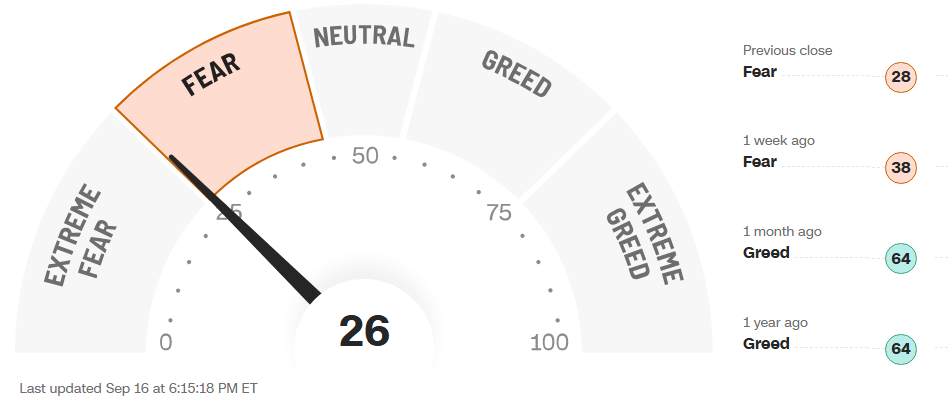
Warren Buffet said: “Buy when others are fearful, and sell when others are greedy.” Good advice.
 Click for larger graphic h/t CNN
My friend Kieth Fitz-Gerald pointed out that since 1928, there have been roughly 24,700 trading sessions and the odds of a higher close are ~53%.
There have been about 94 5-year rolling periods, of which, ~88% resulted in a higher close.
There have been about 89 10-year rolling periods, of which ~95% resulted in a higher close.
There have been about 79 20-year rolling periods, of which 100% resulted in a higher close.
Top 5 Long-Term – alphabetical order
Changes this week: Eliminated the Near-Term Top 5 for two reasons: (1) in the long run, you make the most money by time in stocks, not by timing stocks; and, (2) I’m not good at short-term trading.
ABCL AbCelllera – Will become a huge pharma royalty company
UUUU Energy Focus – Domestic uranium supplier
EQT EQT – largest US natural gas company
IBIT iShares Bitcoin Trust – Bitcoin is headed for $150,000
META Meta – a (the?) leader in the metaverse
PLTR Palantir – a (the?) leader in AI applications software
SCYX ScyNexis –First new antifungal in 20 years
Economy
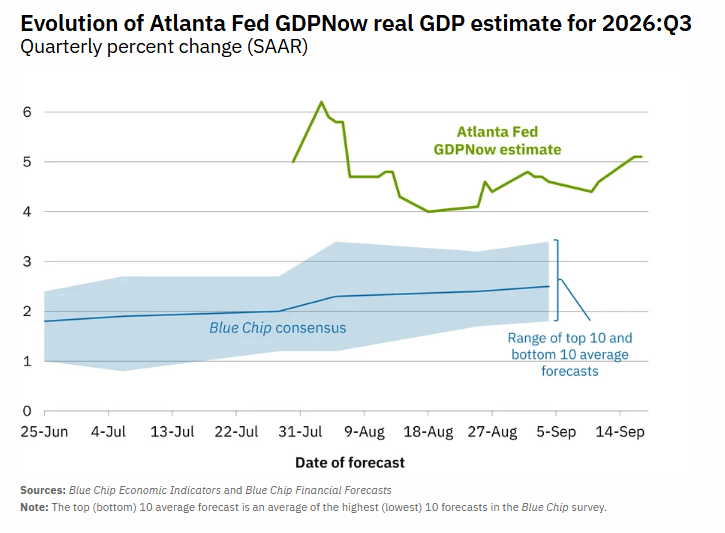
The Atlanta Fed’s GDPNow model forecast for September quarter real GDP growth has climbed from +4.0% to +5.1% in a month. That’s a little more than double Wall Street’s expectations.
Click for larger graphic
Coming Events
All times below are ET, and most presentations and slides are archived on the companies’ websites so you can listen to them.
Tuesday, September 22
AG- First Majestic – Through 9/25 – Precious Metals Summit
PZG- Paramount Gold – Through 9/25 – Precious Metals Summit
Wednesday, September 23
Fall Equinox – 2:05am
Thursday, September 24
Short Interest – After the close
DC- Dakota Gold – 6:00pm – Precious Metals Summit
Monday, September 28
AG- First Majestic – Through 9/30 – Mining Forum Americas
PZG- Paramount Gold – Through 9/30 – Mining Forum Americas
Tuesday, September 29
DC- Dakota Gold – 1:00pm – Mining Forum Americas
When I recommend a stock, I’ve always listed a Buy Limit and a Target Price. I’ve always thought there was no point in changing the Buy Limit unless the underlying investment concept has dramatically changed, in which case the more important change would be to the Target Price.
But I recognize that many subscribers don’t like to see a Buy Limit that is far above the current price, even though it doesn’t bother me. I also realized that what you really want is to know if a stock is a Buy, Hold, or Sell at today’s price, and what has to happen to get to my target price.
So I’m getting rid of the confusing Buy Limits and replacing them with a simple Buy-Hold-Sell rating, while adding a comment on achieving the target price. I hope this helps.
Big Tech: The Biotech & Digital Dominators MegaShift
There are at least four ways to make money in the stocks of these large, growing, dominant companies. You can:
* * Buy a stock and hold it
* * Buy a stock and write a call option against it
* * With a Level IV options account, write an out-of-the-money put option
* * With a Level IV options account, write an out-of-the-money put option and use part of the premium to buy an out-of-the-money call option
Gilead Sciences (GILD – $150.89) is on a tear, with presentations by Chief Medical Officer Dietmar Berger at the Wells Fargo Healthcare Conference (WEBCAST HERE and TRANSCRIPT HERE), by CFO Andy Dickinson at the Cantor Global Healthcare Conference (WEBCAST HERE and TRANSCRIPT HERE), and by CEO Dan O’Day at the Morgan Stanley Global Healthcare Conference (WEBCAST HERE and TRANSCRIPT HERE). The message was more of the same: HIV drugs are strong and getting stronger, their oncology pivot is growing even faster, and a deep R&D and clinical program is paying off big time, both here and in Europe. GILD is a Long-Term Buy for a first target of $150 as new drugs succeed and Wall Street revalues it as an oncology company.
Meta Platforms (META – $682.61) introduced Muse, a secure, private personal AI agent that proactively helps with people’s goals and suggests ideas. Muse is designed around the way people already communicate, so talking to it works just like messaging another person. People just tell Muse what needs to get done, and it takes action, powered by Muse Spark 1.3.
JPMorgan upgraded Meta from Neutral to Overweight and raised its price target from $640 to $820, saying the company is entering the early stages of monetizing artificial intelligence beyond its core advertising business. They think Meta’s latest Muse Spark 1.3 model is competitive with leading AI models, and that the upcoming Watermelon model could unlock opportunities across consumer products, business intelligence, advertising, and internal operations.
Muse is a big success and personal intelligence is a strategic growth pillar, but I am more focused on the core advertising business, which has meaningful headroom from AI-driven improvements. The $18 billion social media addiction case settlement’s financial impact is spread out over 10 years, and has an insignificant effect on Meta’s free cash flow. With the stock trading below 20x forward earnings, META is a Buy for a long-term hold as the AI revolution plays out.
Nvidia (NVDA – $219.34) presented at the Goldman Sachs Communacopia + Technology Conference (WEBCAST HERE and TRANSCRIPT HERE). CEO Jensen Huang said the first Industrial Revolution was about spreading power to everyone. Then the Internet made it possible to find anything. Now AI makes it possible to know everything – ask anything, know anything.
The stock has been under pressure from the ridiculous AI doomerism and calls to slow AI development, but structural demand drivers remain robust. Geopolitical and corporate rivalries make coordinated AI slowdowns highly unlikely, and I expect no slowdown in data center and AI accelerator demand. At the same time, AI-powered cybersecurity and inference workloads are growing rapidly, diversifying Nvidia’s growth beyond foundational model training. The current semiconductor selloff is a buying opportunity. NVDA is a Buy for a $275 first target as the AI revolution plays out.
Onsemi (ON – $68.30) held their long-awaited Investor Day (WEBCAST VIDEO HERE and SLIDES HERE and TRANSCRIPT HERE). CEO Hassane El-Khoury outlined a $213 billion market opportunity by 2030 as Onsemi executes its long-term growth strategy to lead one of the largest and most consequential technology shifts of the next decade by solving the growing power constraints limiting the advancement of AI, electrification, and automation. Hassane said these markets are converging around common technology requirements that can be served by Onsemi’s differentiated portfolio across power and sensing.
Hassane said: “Every transformational technology eventually encounters a physical constraint. As AI, electrification, and automation continue to scale, power density is emerging as one of the defining engineering challenges of this decade. The companies that lead in the next era of innovation will be those that can deliver more energy while consuming less space. As that challenge becomes more urgent, power has become a foundational technology layer that will help shape the pace of innovation, economic growth and global competitiveness. We have spent years building deep expertise and a broad portfolio across power and sensing to help customers solve this challenge and enable the next generation of intelligent machines.”
The company is pursuing a platform-based model to increase the revenue potential of its core technologies by moving from individual components to higher-value solutions and system architectures that address a larger share of each customer’s design requirements. They are focused on improving power density – the ability to deliver greater performance and capability using less energy and less physical space.
Onsemi has two existing strengths and one new technology platform to tackle the power density problem in automotive, industrial, AI data center, and emerging applications. The first existing strength is their high-voltage semiconductor portfolio, including silicon, silicon carbide (SiC), and gallium nitride (GaN) devices. They are the only supplier of vertical gallium nitride (vGaN), designed for next-generation high-voltage applications.
Their second existing strength is their Treo intelligence platform to monitor operating conditions, communicate across the system, respond to changing loads, and protect critical functions in real-time.
What’s new is their Embedded Power Platform (EPP), an integration layer that uses the silicon wafer itself as the package, changing it from passive housing into an active contributor to system performance. EPP enables the seamless integration and interconnection of silicon, SiC, and GaN technologies within a highly integrated wafer-level architecture. This is a big deal because multiple devices, including FETs, drivers and controllers, can be embedded together in a single package and co-optimized for electrical, thermal, and mechanical performance from day one.
The result is higher power density, improved system performance, reduced development complexity. and faster time-to-market. Customers want complete solutions, and Onsemi’s focus on the entire system-level solution creates a competitive advantage that is difficult to replicate through individual components alone. It will make a huge difference in physical AI systems that sense, decide, act, and adapt safely in real-world environments, in real-time, whether deployed in a robot, vehicle, factory, medical system or autonomous platform.
Hassan said: “The most attractive opportunities of the next decade are emerging as markets converge around the same technologies. The ability to efficiently deliver power, sense the environment, and enable intelligent decision-making will define the next generation of intelligent machines. Our differentiated technology platforms enable us to solve power density across the device, intelligence, and integration layers in a way no other semiconductor company can, positioning us to expand our content and grow as AI moves from infrastructure into the physical world.”
ON is a Buy for a $130 first target as their legacy business recovers and power semiconductors benefit from the AI and physical AI revolutions.
Palantir (PLTR – $176.24) held AIP Con 11, which will be followed by the usual bolus of new customers. Presenting customers included Acrisure, Cisco, Eaton, the Federal Aviation Administration, Hexion, L3Harris, Nvidia, Ondas Sentinel, USA TODAY, and Zeta Global.
Palantir and Nvidia teamed up to deploy sovereign AI across critical supply chains, starting with Nvidia’s own internal operations. Nvidia deploying Palantir is technical validation at the highest level of PLTR’s moat, showing its architecture can integrate proprietary data and human decisions for superior enterprise AI outcomes. Only Palantir can capture and structure human operational judgment, outperforming larger general models. And it all stays on the customers’ computers, which is the core of Alex’s “sovereignty” argument. PLTR is a Buy for a $200 first target as the AI revolution plays out.
PayPal Holdings (PYPL – $52.94) presented at the Goldman Sachs Communacopia + Technology Conference (WEBCAST HERE and TRANSCRIPT HERE). CEO Enrique Lores said the turnaround is gaining traction, supported by operational restructuring and cost-saving initiatives. He said his new three-unit structure and $1.5 billion cost-cutting plan are driving margin improvements, pointing to recent double-beat quarters and raised guidance.
The company laid off 600 employees in India, about 10% of its local workforce. Enrique is focusing on increasing Venmo profitability and improving user experience with the legacy PayPal checkout button, in part by offering better rewards to increase usage.
I think the 9.5x Price/Earnings multiple and 14%+ forward free cash flow show significant undervaluation relative to the company’s improving fundamentals – and another acquisition offer could come anytime. PYPL is a Buy for a triple in three years as the turnaround plays out.
Snap (SNAP – $5.65) launched their SPECS augmented reality glasses that CEO Evan Spiegel introduced three months ago at the Augmented World Expo in June :
Evan said SPECS is the culmination of 10 years of development and a cumulative investment in excess of $3 billion. There are a ton of “first tryout” videos on YouTube, but I think the $2,195 price and 4.65-4.80 ounce weight doom the product to failure – which is already in the price of the stock.
However, the company’s core business is improving, and the stock has meaningful upside as advertising growth accelerates if subscription growth can be maintained. SNAP is a Buy for a $17+ target as the AI revolution plays out.
SoftBank (SFTBY – $21.15) is a Hold for a target of $30 as the discount to hard book value shrinks.
Small Tech
Enovix (ENVX – $2.94) said their drone and defense battery portfolio manufactured in South Korea is compliant with the Trade Agreements Act (TAA). That expanding their ability to serve U.S. government defense programs, so they are doubling drone battery production capacity by mid-2027 to support growing demand from the U.S. and allied government customers. ENVX is a Buy for a 4-year hold to $100+ as their BrakeFlow lithium-ion battery takes market share.
Primary Risk: A new competitor invents a better battery.
First Trust NASDAQ Cybersecurity Exchange-Traded Fund (CIBR – $101.66) is a Buy for a 3- to 5-year hold as the need for cybersecurity gets stronger and stronger at every level of society.
Primary Risk: A technology emerges to stop hackers.
Fastly (FSLY – $24.57) CFO Rich Wong presented at both the Citi Global TMT Conference (WEBCAST HERE and TRANSCRIPT HERE), and the Piper Sandler Growth Frontiers Conference (WEBCAST HERE and TRANSCRIPT HERE). Rich reviewed the excellent recent quarter and said it was a combination of the better product they’ve always had, new management, and the impact of AI on the need for security.
They just won Comcast for their basic content delivery service. It pushes live streaming content closer to customers’ homes at the edge of the network, helping power faster, lower-latency experiences for millions of Xfinity members. Fastly’s software both reduces lag time and improves video quality even when millions of people are watching at the same time. Bringing computing power and content close to customers can also improve performance for other latency-sensitive applications, from online gaming to emerging AI services such as AI inference.
Fastly is holding an Investor Day next Tuesday. FSLY is a Buy for a 3- to 5-year hold to $50+ as the AI revolution plays out.
Primary Risk:Content and applications delivery networks are a competitive area.
PagerDuty (PD – $14.44) is a Buy for a 2- to 5-year hold as their digital operations management Software-As-A-Service gains market share.
Primary Risk: Digital operations management is a competitive area.
QuickLogic (QUIK – $10.52) presented at the Lake Street Best Ideas Growth Conference, but didn’t make the replay available. I’m sure it was the standard corporate presentation – SLIDES HERE.
QUIK is a Buy for my $40 target as their earnings repeatedly surprise Wall Street.
Primary Risk: Customers’ product introductions and associated royalties are unpredictable.
ARK Venture Fund (ARKVX – $59.71) is a Buy for the Anthropic IPO.
Primary Risk: Cathie sells the stock before the IPOs.
Biotech MegaShift
If you can afford it – and it would not be too big a position in your portfolio – putting $2,000 into each of these speculative biotechs might be a good way to start. Buying these out-of-favor, fallen, or forgotten companies that can get important products through the FDA at very low market capitalizations seems like a good strategy to me.
Risks
Development-stage biotechs are subject to investor sentiment swings from wildly optimistic to excessively pessimistic – mostly the latter recently. After the Primary Risk for each company, I’ve added the clinical stage of their lead product, the probable time of their first FDA approval, and the probable time of their next financing.
As always, you need to think about an appropriate position size. You could buy a full position upfront and then just hold on, or buy some upfront and leave room to add more on the inevitable financings, transient clinical trial setbacks, and the like
AbCellera Biologics (ABCL- $12.73) and almost every other biotech recommendation presented at the Cantor Global Healthcare Conference (WEBCAST HERE). CEO Carl Hansen reviewed the very positive Phase 2 interim top line results for ABCL635 to treat moderate-to-severe hot flashes released in mid-August that I covered in the last issue. They followed the data release with an oversubscribed $200 million stock offering at $9.75 a share.
They are going to present the interim results on October 1 at the International Menopause Society 20th World Congress on Menopause. By the end of 2026 they will wrap up the Phase 2 trial and proceed to Phase 3 in the second half of 2027. Buy ABCL for a long-term hold to $30 or more as their and partners’ drugs get approved.
Primary Risk: Partnered and owned drugs fail in the clinic.
Clinical stage of lead product: Partnered: Various Owned: Phase 2
Probable time of next FDA approval: 2027-2028
Probable time of next financing: 2029-2030 or never
Akebia Therapeutics (AKBA- $0.90) dosed the first patient in their Phase 2 basket trial evaluating ebribafusp for the treatment of rare complement-mediated kidney diseases, including IgA nephropathy (IgAN), lupus nephritis (LN), and C3 glomerulopathy (C3G). Ebribafusp is an investigational, next-generation anti-C3d factor H fusion protein designed to inhibit complement activation in tissues without inhibiting the complement system in the blood. The Phase 2 basket trial is open-label, and Akebia expects to report initial data in 2027. Buy AKBA for the Vafseo launches in the EU, UK, and US. I think Vafseo will become the standard of care in dialysis patients. I expect GSK and/or Amgen to make a bid for the company.
Primary Risk: Vafseo doesn’t sell in the US.
Clinical stage of lead product: Approved
Probable time of next approval: 2030
Probable time of next financing: Never
Compass Pathways (CMPS – $15.00) really did a full-court press, presenting at the Cantor Global Healthcare Conference (WEBCAST HERE), the H.C. Wainwright Global Investment Conference (WEBCAST HERE), the Morgan Stanley Global Healthcare Conference (WEBCAST HERE), and this morning’s fireside chat at the Deutsche Bank Healthcare Summit (WEBCAST HERE). The spoken message was the trials were strong, the FDA is already doing a rolling review, they have the two-month review voucher, they expect to get a decision early in 2027, and they have laid the groundwork for a successful launch.
The unspoken message was: “Hey! Morons! We’re about to get approval of a blockbuster drug! Why is our stock only at $15?”
We need to be ready for a launch delay while the Drug Enforcement Administration (DEA) and the individual states reclassify psilocybin from “Schedule I: High potential for abuse with no accepted medical use (e.g., heroin, LSD, marijuana, peyote, MDMA)” to either “Schedule III: Lower potential for abuse than schedules I and II, with accepted medical use (e.g., fentanyl, oxycodone, cocaine, methamphetamine, adderall)” or, hopefully, “Schedule IV: Low potential for abuse and low risk of dependence (e.g., Xanax, Valium, Ambien, Tramadol).”
HHS Secretary RFKJr. did a podcast on the future of psychedelic medicine:
CMPS is a Buy for a very long-term hold to $200 as COMP360 succeeds.
Primary Risk: Their drugs fail in the clinic.
Clinical stage of lead product: Phase 3
Probable time of first FDA approval: 2027
Probable time of next financing: Never
Editas Medicine (EDIT – $2.72) also presented at the Cantor Global Healthcare Conference (WEBCAST HERE) and the Wells Fargo Healthcare Conference (WEBCAST HERE). CEO Gilmore O’Neill said they are focused onin vivo gene therapy where they can dramatically improve the standard of care with an easy-to-use single injection.
Their lead program, EDIT-401, fits those criteria and reduced LDL-C cholesterol by 90% in nonhuman primates. While I doubt LDL cholesterol has much if anything to with heart attacks, the medical mainstream disagrees with me and a successful gene therapy would be a big deal. We’ll see the first safety data in the March quarter and efficacy data later in 2027. EDIT is a Buy for a double in 12 months and a long-term hold to much higher prices.
Primary Risk: Other companies’ gene-sequencing drugs fail in the clinic.
Clinical stage of lead product: Partnered: Approved. Owned: Going into the clinic mid-2025.
Probable time of next FDA approval: 2030
Probable time of next financing: 2028
Inovio (INO – $1.21) CEO Jacqueline Shea presented at both the Cantor Global Healthcare Conference (WEBCAST HERE and TRANSCRIPT HERE), and the H.C. Wainwright Global Investment Conference (Virtual) (WEBCAST HERE and TRANSCRIPT HERE). Jackie made the usual presentation, looking forward to the approval of INO-3107 on October 1 and a fast launch. If the stock pops before or after approval, I expect her to do another equity offering. INO is a Buy for a very long-term hold.
Primary Risk: Their drugs fail in the clinic.
Clinical stage of lead product: Phase 3
Probable time of first FDA approval: Mid-2026
Probable time of next financing:After FDA approval in 2026
Medicenna (MDNAF – $0.26) made a rare presentation at the H. C. Wainwright Global Investment Conference (WEBCAST HERE and SLIDES HERE). CEO Fahar Merchant said their pipeline is positioned for multiple near-term catalysts:
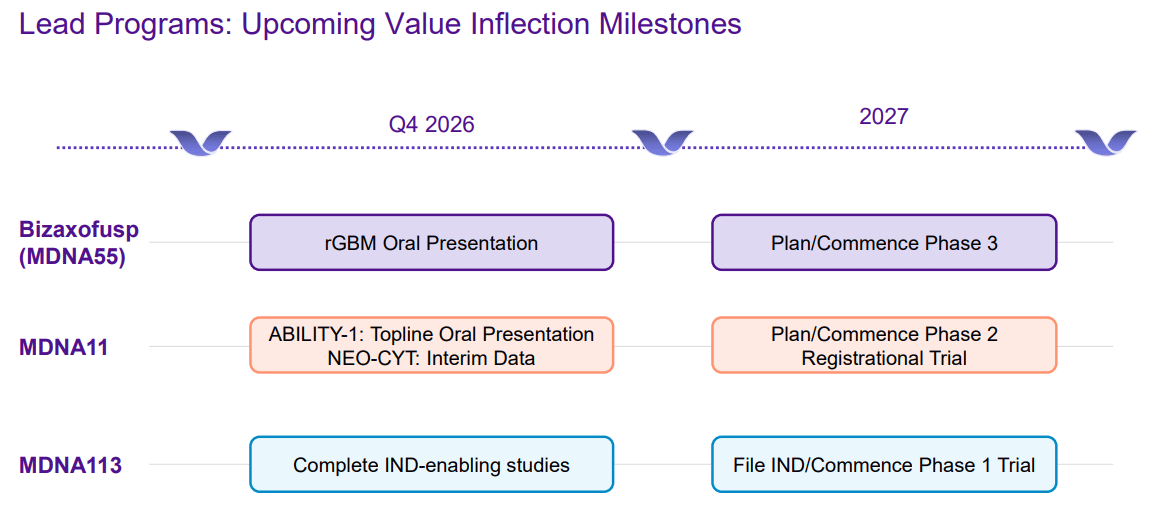 Click for larger graphic
Hold MDNAF to see the structured financing terms.
Primary Risk: Their drugs fail in the clinic.
Clinical stage of lead product: Entering Phase 2
Probable time of first FDA approval: 2028
Probable time of next financing: 2026
ScyNexis (SCYX – $4.45) is coming out of their self-imposed silence, presenting at both the Cantor Global Healthcare Conference (WEBCAST HERE) and doing 1on1s at the H.C. Wainwright Global Investment Conference. At Cantor, CEO David Angulo focused on their new drugs and the analyst didn’t ask a single question about GSK, Brexafemme, or ibrexafungerp. Shameful. Hold SCYX through the the after-effects of the reverse split.
Primary Risk: Ibrexafungerp fails to sell.
Clinical stage of lead product: Approved
Probable time of next FDA approval: 2028
Probable time of next financing: Never
TG Therapeutics (TGTX – $56.47) presented at the Cantor Global Healthcare Conference (WEBCAST HERE) and the H.C. Wainwright Global Investment Conference (WEBCAST HERE). CEO Mike Weiss said what we already know: Briumvi is taking market share and when it is approved as a subcutaneous injection it will really take share. Buy TGTX for a target price in a buyout of $60 or more.
Primary Risk: Briumvi, the MS drug, fails to sell.
Clinical stage of lead product: Approved
Probable time of next FDA approval: NM
Probable time of next financing: Never
Inflation MegaShift
Gold ($4,284.40) is trading between its 50-day and 200-day moving averages, building up energy for the next push up. The Fed can raise rates, but that just increases the budget deficit and forces the Treasury Department to sell more bonds – which the Fed will buy.
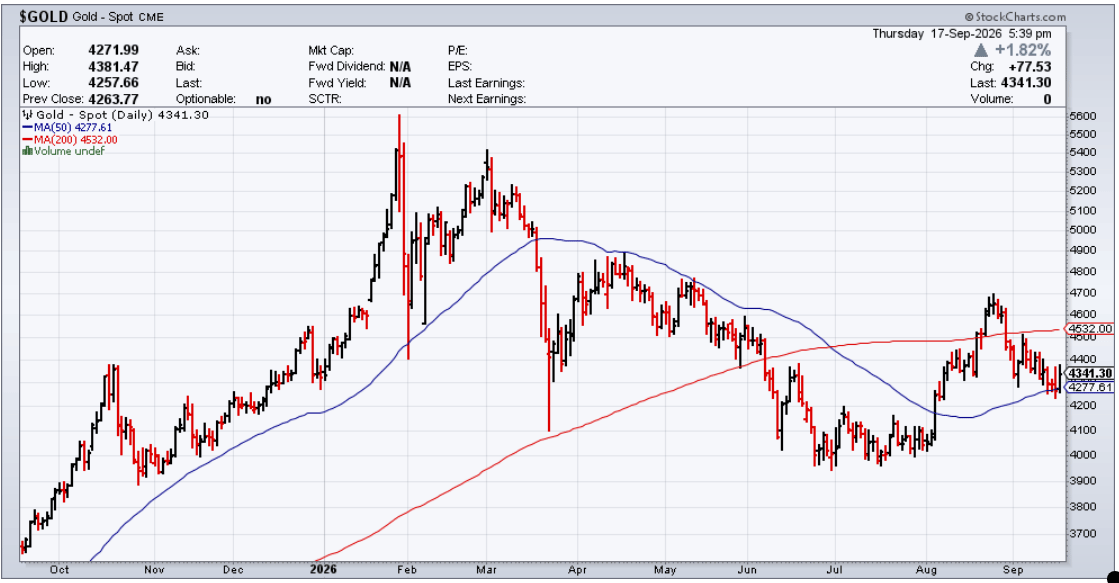 Click for larger graphic
A Bag of Junk Silver ($65.71) is a Buy for a hold until 2027-2030.
Primary Risk: Prices of precious metals fall due to US dollar strength.
Exchange-Traded & Closed-End Funds
Sprott Gold Miners Exchange-Traded Fund (SGDM – $80.27) is a Buy for a $100 first target. The miners should outperform the metal in the next upleg for gold that will run until 2027-2030.
Primary Risk: Prices of precious metals fall due to US dollar strength.
ALPS Sprott Junior Gold Miners Exchange-Traded Fund (SGDJ – $95.12) is a Buy for a $140 first target price. The small miners should outperform the large miners, although with more volatility, in the next upleg for gold that will run until 2027-2030.
Primary Risk: Prices of precious metals fall due to US dollar strength.
Global X Silver Miners Exchange-Traded Fund (SIL – $95.01) is a Buy for a first target of $150 when as silver goes to new highs. The silver miners should outperform both the large and junior gold miners in the next upleg for precious metals that will run until 2027-2030.
Primary Risk: Prices of precious metals fall due to US dollar strength.
Sprott Physical Gold and Silver Trust (CEF – $44.20) is a Buy for a first target price of $65.
Primary Risk: Prices of precious metals fall due to US dollar strength.
Miners & Related
Coeur Mining (CDE – $19.98) is a Hold as gold goes higher.
Primary Risk: Prices of precious metals fall due to US dollar strength.
Dakota Gold (DC – $6.08) presented at the H.C. Wainwright Global Investment Conference (WEBCAST HERE and SLIDES HERE). CFO Sean Campbell gave the standard corporate presentation. DC is a Hold as gold goes higher.
Primary Risk: Robert Quartermain doesn’t find enough gold. Secondary risk: Prices of precious metals fall due to US dollar strength.
First Majestic Silver (AG – $19.49) is a Hold as production increases and the price of silver rises.
Primary Risk: Prices of precious metals fall due to US dollar strength.
Paramount Gold Nevada (PZG – $1.33) said that the Bureau of Land Management (BLM) has completed its review as required under the National Environmental Policy Act and approved the company’s Plan of Operations for the Grassy Mountain Gold Project. PZG is a Buy for a $10 first target as gold moves higher.
Primary Risk: Prices of precious metals fall due to US dollar strength.
Probable time of next financing: 2026
Royal Gold (RGLD – $251.45) did another presentation in the Renmark Financial Communications Virtual Non-Deal Roadshow Series and also presented at the Jefferies Global Industrials Conference (WEBCAST HERE and TRANSCRIPT HERE). CEO Bill Heissenbuttel yet again focused on two incontrovertible facts: (1) the Sandstorm acquisition makes them as diversified as Franco-Nevada and Wheaton Precious Metals; and (2) their stock is undervalued compared to Franco-Nevada and Wheaton Precious Metals. It’s a simple story and Bill will keep hammering it until the valuation discount disappears. RGLD is a Buy until the valuation discount disappears or precious metals top out.
Primary Risk: Prices of precious metals fall due to US dollar strength.
Cryptocurrencies
Cryptocurrencies are a diversifying asset that offer a unique opportunity to make (or lose!) a lot of money quickly.
Bitcoin (BTC-USD on Yahoo – $76,542.98) is holding up well even though the federal Clarity Act died.
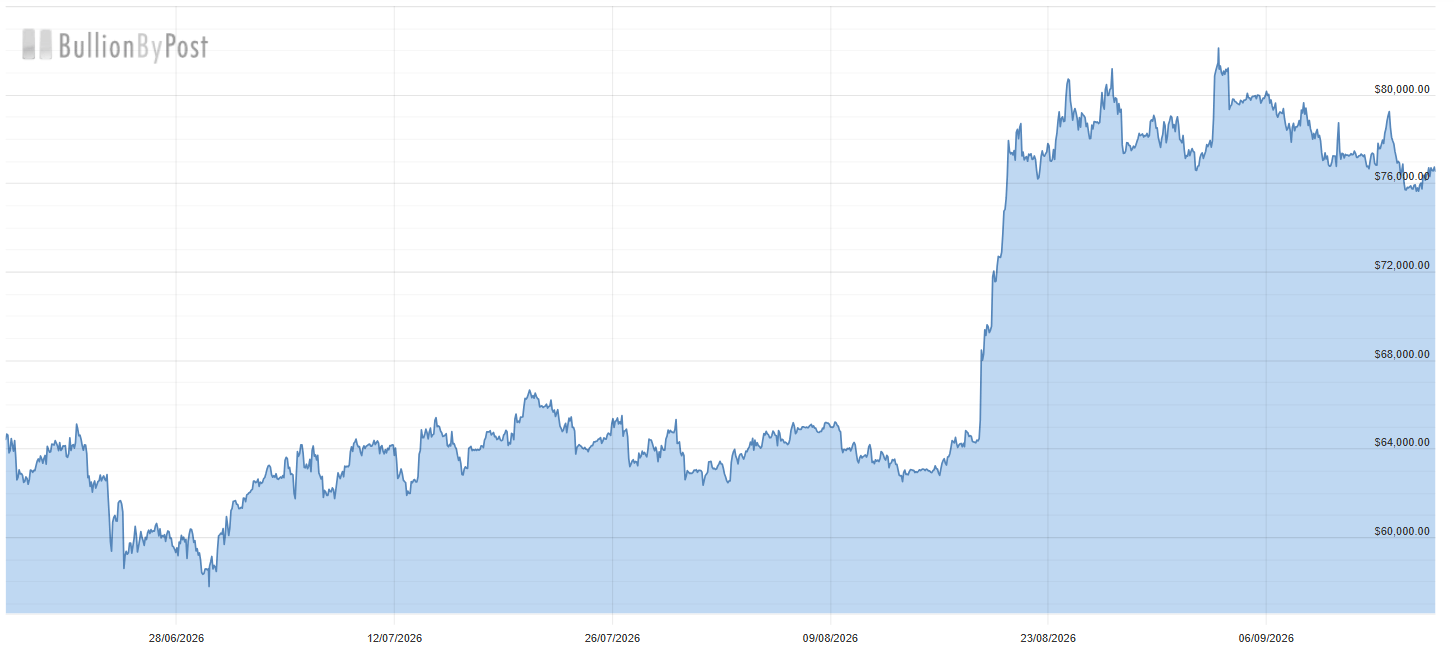
Click for larger graphic
BTC-USD, ETH-USD, IBIT, and ETHA are Strong Buys.
Primary Risk: Bitcoin falls due to over-regulation or is surpassed by another cryptocurrency.
iShares Bitcoin Trust (IBIT- $43.30) remains the cheapest and easiest way to buy bitcoin. IBIT is a Buy for the 2028, 2032, and 2036 halvings.
Primary Risk:Bitcoin falls due to over-regulation or is surpassed by another cryptocurrency.
Ethereum (ETH-USD on Yahoo – $2,446.45) is a Buy for crypto startups using the ethereum blockchain.
Primary Risk: Bitcoin extensions outperform ethereum.
iShares Ethereum Trust (ETHA- $18.47) remains the cheapest and easiest way to buy ethereum. ETHA is a Buy for the coming explosion in token-funded start-ups.
Primary Risk: Ethereum falls due to over-regulation or is surpassed by another cryptocurrency.
Commodities
Oil – $101.18
Phase 1 of Reality Bites: Oil is here, with West Texas crude oil over $100. On to Phase 2. President Trump said: “I think the war is going to end immediately after the election. They can’t hold out any longer. They’re desperate to try and affect the election…”
That’s 48 more days until the election times 4 million+ barrels a day of inventory draws = 192 million barrels. We’re going to need a new chart!
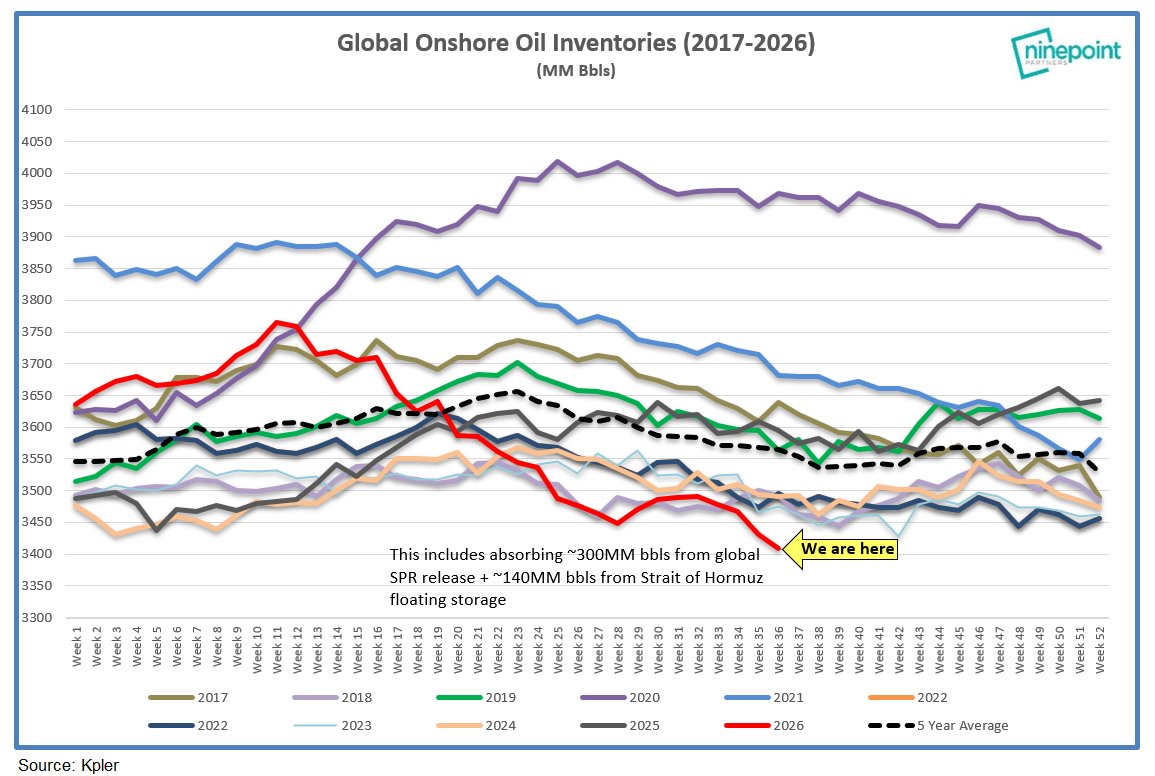 Click for larger graphic h/t @ericnuttall
The September 2027 Crude Oil Futures (CLU7.NYM – $74.47) are a Buy for my $200+ target. Only buy futures for all cash; do not use margin.
The United States 12 Month Oil Fund, LP (USL – $56.55) is a Buy for a $150+ target.
Vermilion Energy (VET – $12.65) is a Buy for a target price of $24 or more.
Primary Risk: Oil and natural gas prices fall.
Energy Fuels (UUUU – $11.68) held an Australian Investor Day yesterday. On the conference call (WEBCAST HERE and NEW CORPORATE PRESENTATION HERE and TRANSCRIPT HERE) to discusses their planned evolution from only uranium mining to an integrated, diversified critical minerals and rare earths miner and processor.
I was first attracted to Energy Fuels because they have been the leading US producer of natural uranium concentrate for the past several years, which is sold to nuclear utilities that process it further for the production of carbon-free nuclear energy. The company owns and operates several conventional and in situ recovery uranium projects in the western US.
Importantly, they also owns the White Mesa Mill in Utah, which is the only fully licensed and operating conventional uranium processing facility in the US. At the Mill, they also produce advanced rare earth element (REE) products, including vanadium oxide when market conditions warrant, and is preparing to begin pilot-scale recovery of certain medical isotopes from existing uranium process streams needed for emerging cancer treatments.
They also own the operating Kwale heavy mineral sands (HMS) project in Kenya which is nearing the end of its life and is developing three additional HMS projects, including the Toliara Project in Madagascar, the Bahia Project in Brazil, and the Donald Project in Australia. They have the right to earn up to a 49% interest in the Donald Project, a joint venture with Astron Corporation Limited. Energy Fuels is based in Colorado, with its HMS operations managed from Perth, Australia. UUUU is a buy for a $30 target.
Primary Risk: Uranium prices fall.
EQT (EQT – $50.35) is a Buy for a long-term hold for much higher natural gas prices.
Primary Risk:Natural gas prices fall.
Freeport McMoRan (FCX – $70.85) presented at both the Jefferies Global Industrials Conference (WEBCAST HERE and TRANSCRIPT HERE) and Morgan Stanley’s Laguna Conference (WEBCAST HERE ). It is good to see them re-engaging now that they have a solid plan for restarting the whole Grasberg mine.
The stock dipped following a Reuters report that the Trump administration has not yet made a decision on refined copper tariffs, as the U.S. seeks to balance concerns over rising prices and the need for more domestic mining and stockpiling of critical minerals. The market is expecting a 15% tariff on copper cathode starting in January 2027, and then increasing to 30% in 2028. I agree with Goldman Sachs, which called the 7% FCX dip an overreaction and reiterated their buy recommendation.
Freeport mainly mines copper, of course, but they mine another metal where the price is exploding: Molybdenum. You only hear about it buried three paragraphs deep in a steel demand story, framed as a niche alloying additive by people who have never looked at where the metal actually comes from.
About 25% goes into stainless steel. Another 35% goes into structural steel, with the remainder spread across chemical catalysts, superalloys, and oil and gas pipelines. 40% of consumption is non-steel — aerospace superalloys (jet engine turbine blades contain 0.4%–4.3% molybdenum by weight), oil and gas tubulars, chemical catalysts, and now the one that will reshape the demand curve for a generation: renewable energy infrastructure. The growth rate is accelerating into a supply system that physically cannot keep up. The World Bank has flagged molybdenum among the metals facing surging demand as clean energy infrastructure scales through 2050.
Molybdenum prices are up 39% in twelve months, and China’s domestic price just hit $75,200 per tonne — a 17% jump in a single quarter. Beijing’s export controls on the metal, imposed in February 2025, were quietly excluded from the US-China truce. They remain in force today. South Korea’s government is issuing public notices begging private companies to secure supply because the national stockpile is running short. Nobody on Wall Street seems to have noticed.
Roughly 90% of Western supply is a 0.01%–0.25% byproduct of copper mining, so supply responds to copper investment, not molybdenum demand. In 2025, global production of moly grew 4% from 2024 to 672.6 million pounds. Global consumption was nearly balanced at 671.8 million pounds. But 2026 demand growth is higher than both primary and byproduct recovery, and the projected deficit is 13,000 tonnes.
Freeport operates the only two primary molybdenum mines in the United States — Climax and Henderson, both in Colorado. They produced 23 million pounds of moly in the June quarter, and Freeport is guiding to 93 million pounds for the full year. At current prices, that’s roughly $2.7–$2.8 billion of revenue from what most analysts still treat as a footnote. When the market realizes moly is contributing double-digit percentages of cash flow at integrated copper-moly producers, the re-rating will be sharp. FCX is a Hold for higher copper and molybdenumprices .
Primary Risk: Copper prices fall.
* * * * *
RIP Rosalind Ashford
* * * * *
Your understanding exponential growth Editor,

Michael Murphy CFA
Founding Editor
New World Investor
All Recommendations
Priced 9/17/26. Check out the complete Portfolio page HERE.
Buys
These are the stocks everyone needs to own because transformative events are happening over the next year or two, and I expect to hold them long-term.
Tech Dominators
Broadcom (AVGO – $347.30) – Buy for a long-term hold
Gilead Sciences (GILD – $150.89) – Buy, first target price $150
Meta (META – $682.31) – Buy for a long-term hold
Nvidia (NVDA – $219.34) – Buy, first target price $275
Onsemi (ON – $68.30) – Buy, first target price $130
Palantir (PLTR – $176.24) – Buy, first target price $200
PayPal (PYPL – $52.94) – Buy, target a triple in 3 years
Snap (SNAP – $5.65) – Buy, target price $17+
Small Tech
Enovix (ENVX – $2.94) – Buy, 4-year hold to $100+
First Trust NASDAQ Cybersecurity ETF (CIBR – $101.66) – Buy, 3- to 5-year hold
Fastly (FSLY – $24.57) – Buy for a 3- to 5-year hold to $50+
PagerDuty (PD – $14.44) – Buy, 2- to 5-year hold
QuickLogic (QUIK – $10.52) – Buy under $10, target price $40
ARK Venture Fund (ARKVX – $59.71) – Buy for Anthropic IPO
$20-for-$1 Biotech
AbCellera Biologics (ABCL – $12.73) – Buy, long-term hold to $30+
Akebia Therapeutics (AKBA – $0.90) – Buy, target $10
Compass Pathways (CMPS – $15.00) – Buy, hold a long time for $200
Editas Medicines (EDIT – $2.72) – Buy for a double in 12 months and a long-term hold to much higher prices
Inovio (INO – $1.21) – Buy for a very long-term hold
TG Therapeutics (TGTX – $56.47) – Buy, target in buyout $60+
Inflation
A Short-Sale or REO House – ($415,400) – Hold
Bag of Junk Silver – ($65.71) – hold through silver bull market
Sprott Gold Miners ETF (SGDM – $80.27) – Buy, first target $100
Sprott Junior Gold Miners ETF (SGDJ – $95.12) – Buy, first target $140
Sprott Physical Gold and Silver Trust (CEF – $44.20) – Buy, first target $65
Global X Silver Miners ETF (SIL – $95.01) – Buy, first target $150
Paramount Gold Nevada (PZG – $1.33) – Buy, first target price $10
Royal Gold (RGLD – $251.45) – Buy until the valuation discount disappears or precious metals top out.
Cryptocurrencies
Bitcoin (BTC-USD – $76,542.98) – Buy
iShares Bitcoin Trust (IBIT – $43.30) – Buy
Ethereum (ETH-USD – $2,446.45)– Buy
iShares Ethereum Trust (ETHA- $18.47) – Buy
Commodities
Crude Oil Futures – September 2027 (CLU27.NYM – $74.47) – Buy, $200 target
United States 12 Month Oil Fund, LP (USL – $56.55) – Buy, $150 target
Vermilion Energy (VET – $12.65) – Buy, $24+ target
Energy Fuels (UUUU – $11.68) – Buy for a long-term hold for much higher natural gas prices
EQT (EQT – $50.35) – Buy under $70; hold for much higher prices ($100+)
Holds
These are holds but not sells – yet. They could get moved back to one of the buy categories if their prices drop or outlook improves, or they could become sell recommendations in the future.
SoftBank (SFTBY – $21.15) – Hold for $30 target
Medicenna (MDNAF – $0.26) – Hold to see structured financing terms
ScyNexis (SCYX – $4.45) – Hold through the after-effects of the reverse split
Coeur Mining (CDE – $19.98) – Hold for higher gold prices
Dakota Gold (DC – $6.08) – Hold for higher gold prices
First Majestic Silver (AG – $19.49) – Hold for higher silver prices
Freeport McMoRan (FCX – $70.85) – Hold for higher copper and molybdenum prices
Publisher: GwynRose LLC, 5348 Vegas Drive, Suite 868, Las Vegas, NV 89108
New World Investor does not act as a personal investment adviser or advocate the purchase or sale of any security or investment for any specific individual. The recommendations and analysis presented to members are for the exclusive use of members. Members should be aware that investment markets have inherent risks and there can be no guarantee of future profits. Likewise, past performance does not assure future results. Recommendations are subject to change at any time. Nothing in this presentation should be considered personalized investment advice. No communication to you by Michael Murphy or any of our employees or contractors should be deemed as personalized investment advice.
Copyright ©GwynRoseLLC 2026
New World Investor Mastermind Group
1. Post unto others as you would have them post unto you.
2. Keep it clean, like a 1950s family television show. Your alter ego can run free on Twitter.
3. NO PERSONAL ATTACKS! If you don’t like the stock, don’t trash the person. Everyone is responsible for their own due diligence and investments.
4. Don’t post here about politics or religion – you aren’t going to change anyone’s mind. Again, NO PERSONAL ATTACKS!
5. The investment implications of something going on in politics or religion is OK.
6. Of course, there’s never a reason to slur someone based on race, religion, gender, sexual orientation, or country of national origin.
7. Please, no snark!
 Print This Post


MM CMPS you mentioned a possible launch delay. Could you explain that a bit regarding the amount of time the delay could be?
Who would be considered the nearest term to success, ENVX or CMPS? Thoughts?
MM–again you have copped out of responsible financial analysis by hiding behind buy-sell-hold. With ENVX, you still have target of $100 based on financial and product acceptance realities. It’s been several years since you recommended it. It is now under $3, rather than moving to $100. The more time passes, the more competition their battery faces. Dilution to raise cash to pay debt is a stock killer. You spend no time discussing that. Suppose ENVX gets production going that it can afford to invest in, and achieves pps of $10. Are you going to still copy and paste, hold for $100?
“QUIK is a buy for my $40 target as earnings surprise Wall Street?” This has been a copy and paste refrain for the past decade. No, earnings continue to suck as legacy losses are not saved by new products. Recently, the stock hit mid-20’s. Where were you? Now back in the dumps again.
You continue to tell stories, without doing financial analysis. It looks like the different text in your Broadcom reco may be AI, not your original views. All the AI plays have had booms over the past year, so the risk at moderate/high is probably more like high risk/medium reward. I can read AI articles on Yahoo Finance for free.