

Dear New World Investor:
The latest numbers show employment is weak and inflation is still a problem, but the big problem is nobody knows what the actual employment and inflation statistics really are. The disappointing September payrolls report of only 29,000 jobs added versus 90,000 expected was as meaningless as every other payrolls report, simply because the subsequent revisions are huge. I have a rule of thumb that three months in a row of revisions in the same direction usually indicate what’s really happening, at least directionally. The July and August numbers were revised down by a total of 60,000 jobs, so maybe the labor market really is weakening, although it doesn’t feel like it. Call it one vote for the Fed standing pat.
But there was an unusually large increase in the third estimate of June quarter real GDP growth from +1.5% to +2.2%, and a March quarter revision up from +2.1% to +2.5%. That’s one vote for a Fed rate increase.
However, the lower than expected Personal Consumption Expenditures Index (PCE) after methodology revisions that dropped the Fed’s favorite three-month annualized core inflation rate to precisely 2% is a vote for standing pat. After all, the Fed has said the core PCE is their favorite inflation measure.
But, wait! Yesterday’s headline Consumer Price Index, impacted by rising gas and diesel prices, came in hot. The year-over-year number was up 3.7%, faster than August’s YoY 3.4% and a tenth above the 3.6% consensus expectation. The month-over-month increase was 0.6%, also faster than August’s 0.4%. Because even the Fed must know that raising interest rates won’t lower the price of oil during a Mideast war, they’ll probably pay more attention to the core CPI. It excludes energy prices, except the extra cost of diesel that winds up in many other components of the core CPI. It was up 0.3% Month-over-Month, the same as August, but 2.6% year-over-year, faster than August’s 2.4%. The total picture is confusing enough to justify the Fed raising 1/4 point or doing nothing at their October 28 meeting. “Nothing” would be a good thing, because the Fed seems to make the wrong move most of the time.
Federal Reserve interest rate changes on the eve of elections are tricky propositions, but for the third election in a row, they may be unable to dodge that prospect. The CME FedWatch Tool stands at 70.7% thinking no change and 29.3% expecting another ¼ point increase. The next Federal Open Market Committee interest rate decision is scheduled for October 28, just six days before Election Day.
We are about to see a deluge of strong September quarter earnings reports, but everyone is positioned for pain. Bond volatility has exploded, 5% Treasuries are challenging equities, France remains under pressure, and macro trading is migrating into fixed income with hedge fund US net positioning in the 0th percentile, according to Goldman Sachs.
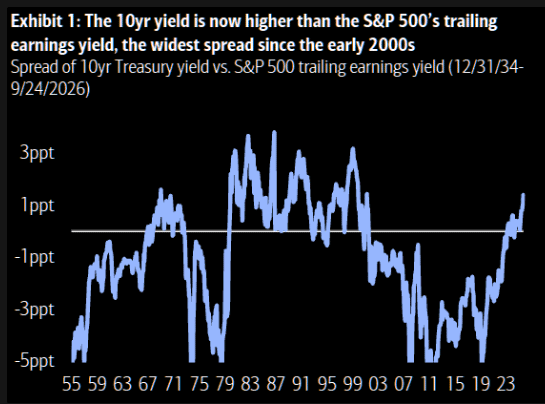
Click for larger graphic h/t The Market Ear
Goldman’s clients have largely moved into protection mode with their chips off the table into year-end. Non-dealers have sold $63.7 billion of S&P futures over the past six weeks, selling in five of those six weeks. The latest week added another $10.5 billion of selling, with asset managers responsible for $11.7 billion. Importantly, more than 70% of the six-week move came from long liquidation rather than new shorts.
But let’s ask: what if nothing breaks? The real pain trade may be to the upside. The market hasn’t collapsed, but a lot of exposure has already left the building. If the macro backdrop simply stops getting worse, earnings could become the clearing event for an extremely defensive market.
We don’t need the (unreliable) Fed put. In 2022-23, Ukraine, the UK mini-budget, and the Silicon Valley Bank failure all triggered dovish repricing. Each time, persistent inflation ultimately forced central banks back toward tightening. Financial stress doesn’t automatically equal a central-bank rescue anymore.
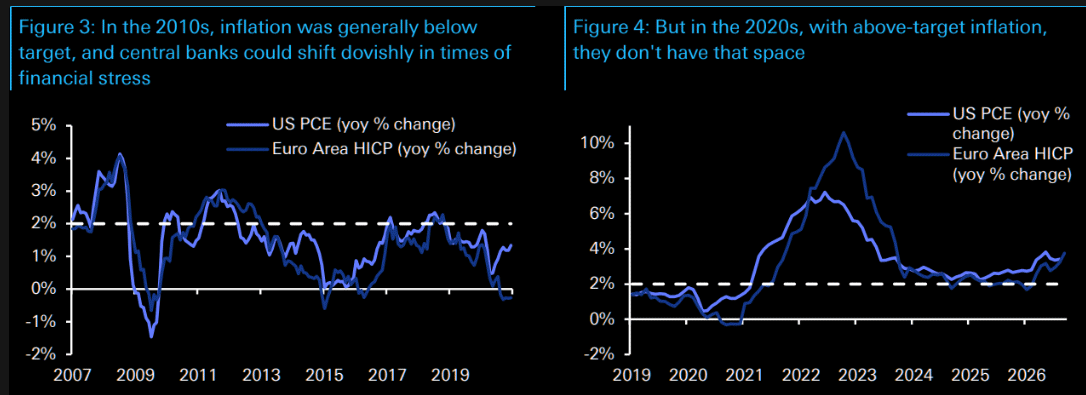 Click for larger graphic h/t The Market Ear
Like the hedge funds, individual investors are unusually gloomy as stocks trade near record highs. The American Association of Individual Investors (AAII) weekly survey’s long-term “bear” average is 31.5%. For more than the last four weeks, the bears expecting stocks to fall over the next six months have been well above average, the first such streak since the peak of the Iran War this spring.
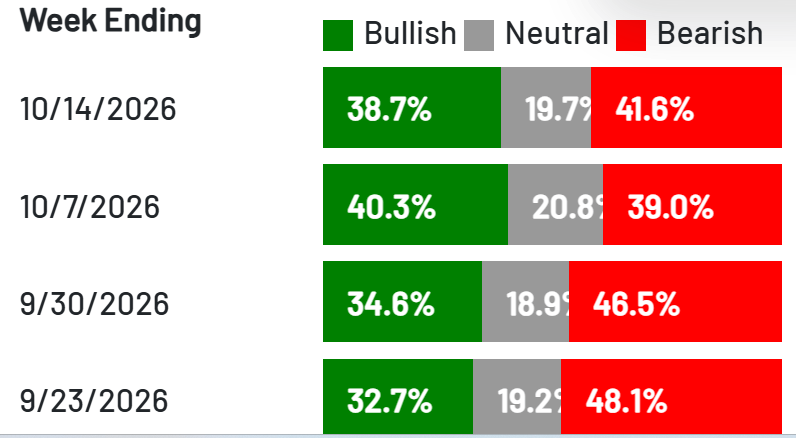
Click for larger graphic h/t AAII\
CNN’s Fear & Greed Index, which combines seven market measures into a score from 0 to 100, ended today at 30, just above the 25 cutoff for “Extreme Fear.” Yet the S&P 500 closed today less than 1% below its August 13 peak.
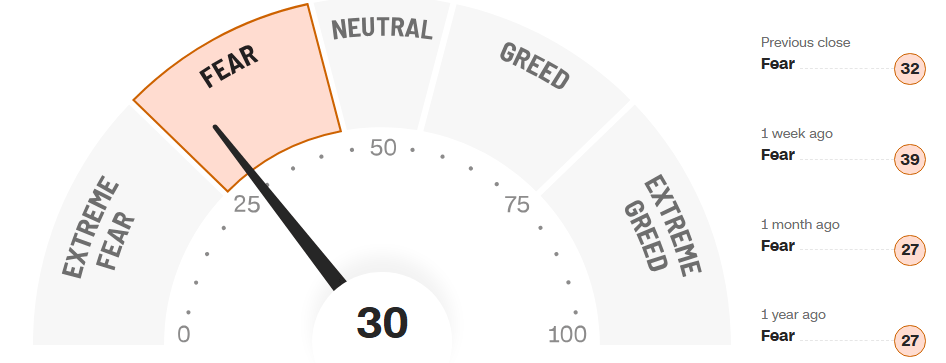 Click for larger graphic h/t CNN
Here’s what they are missing, in three Truist charts:
Stocks are not expensive:
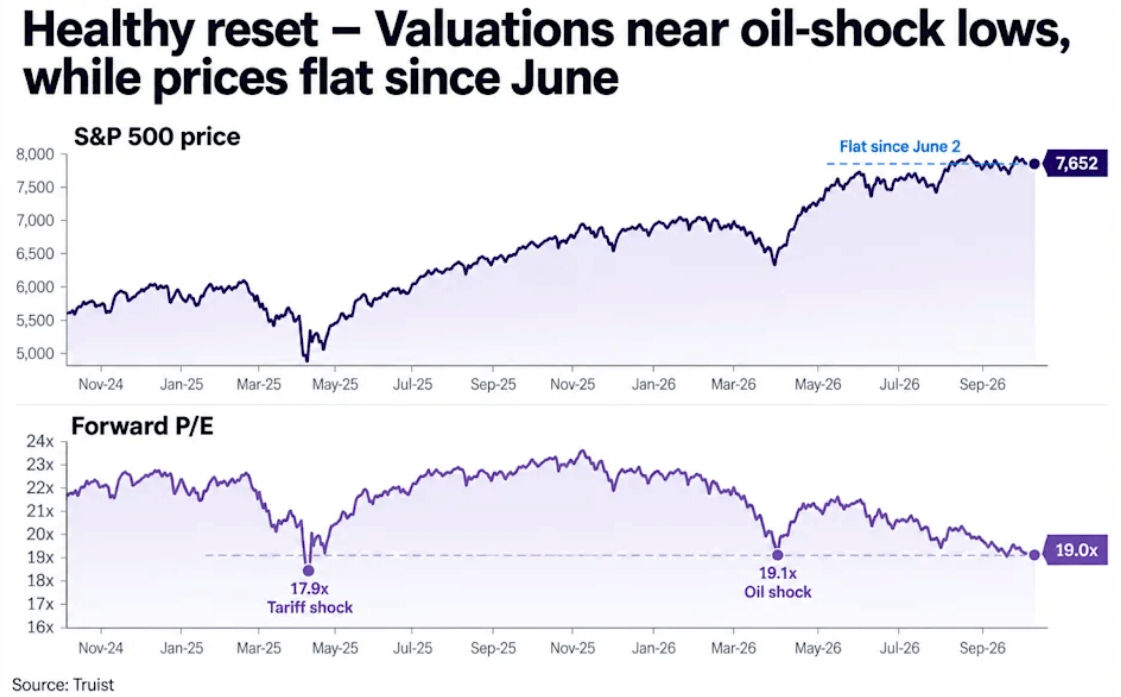
Click for larger graphic h/t Truist via Yahoo Finance
Earnings are supporting stocks:
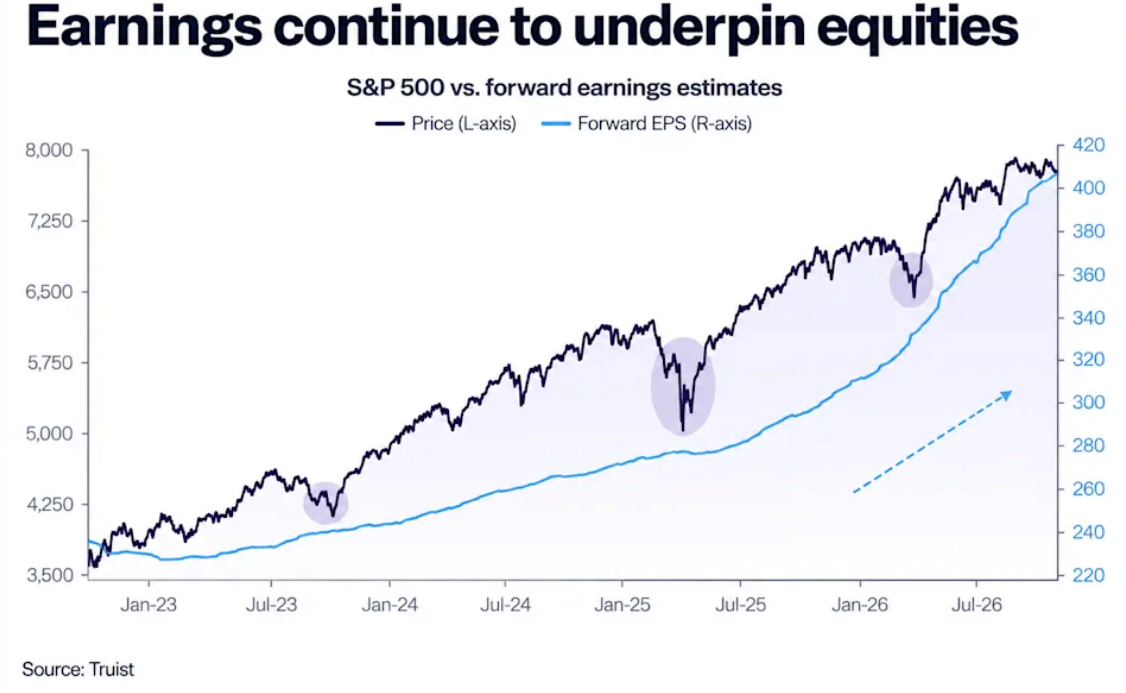 Click for larger graphic h/t Truist via Yahoo Finance
Earnings estimates for 2027 are already looking solid:
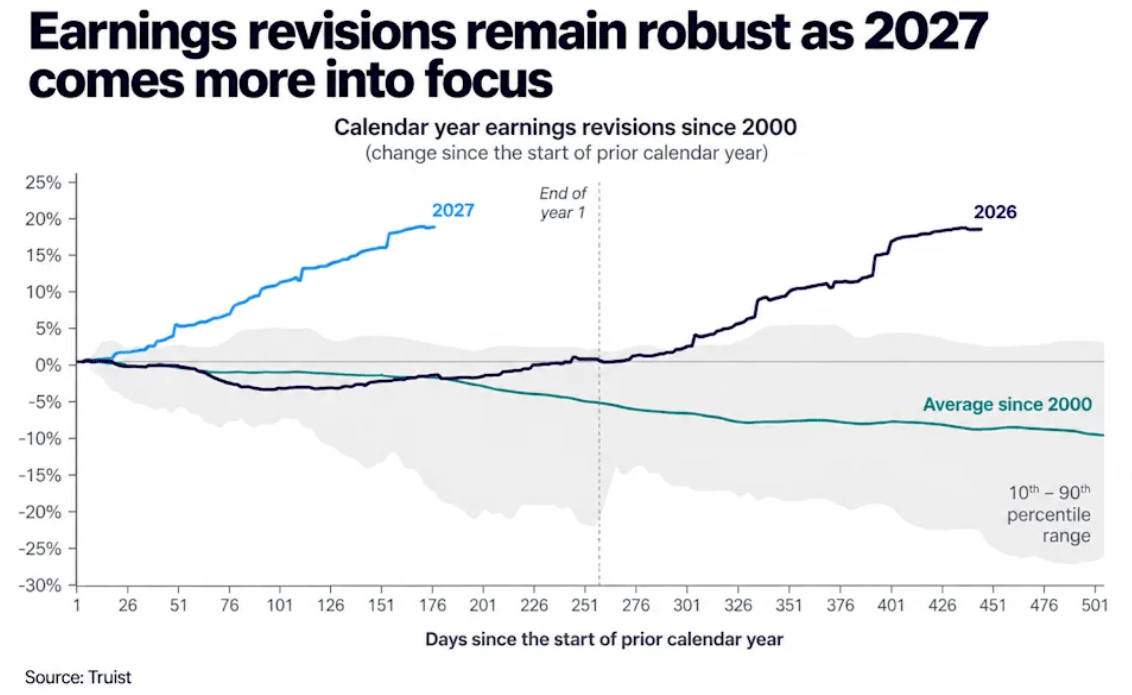 Click for larger graphic h/t Truist via Yahoo Finance
Market Outlook
The S&P 500 added 1.8% over the last two weeks. The Index is up14.0% year-to-date after celebrating its fourth bull market anniversary on Monday. Back on October 12, 2022, the index hit its final bear-market closing low of 3,577, and only a few years later, we’re at 7,805, a gain of nearly 120%. The S&P has now gone more than 1,000 trading sessions without recording a new 52-week low, the sixth longest run on record.
The Nasdaq Composite lost 0.6% as the Luddites scared the uninformed out of the AI sector. It is up 14.9% for the year. The SPDR S&P Biotech Exchange-Traded Fund (XBI) fell 3.1% in the risk-off environment. It is still up 22.8% year-to-date, though.
The small-cap Russell 2000 dropped 1.4% but is up 11.5% in 2026. Goldman Sachs noted that Russell 2000 positioning remains deeply depressed. Systematic exposure sits in just the 7th percentile, while leveraged funds are carrying record shorts according to CFTC data through September 22.
More than half of the larger Russell 3000 is already in a bear market. Since June 1, 54% of the index’s stocks have fallen 20% or more from their high, and 29% have dropped at least 30%. The index itself is down only 2.5% , but 96% of the semiconductor stocks are down 20% or more. Software is down 77%, technology hardware at 68%. This is a rotation out of the AI complex, and the stocks on the wrong side of it are already in a bear market.
Top 5 Long-Term – alphabetical order
Changes this issue: None
ABCL AbCelllera – Will become a huge pharma royalty company
UUUU Energy Focus – Domestic uranium supplier
EQT EQT – largest US natural gas company
IBIT iShares Bitcoin Trust – Bitcoin is headed for $150,000
META Meta – a (the?) leader in the metaverse
PLTR Palantir – a (the?) leader in AI applications software
SCYX ScyNexis –First new antifungal in 20 years
Economy
The Atlanta Fed’s GDPNow model, updated this morning, expects 3.6% real GDP growth in the September quarter. The first government estimate will be posted two weeks from today.
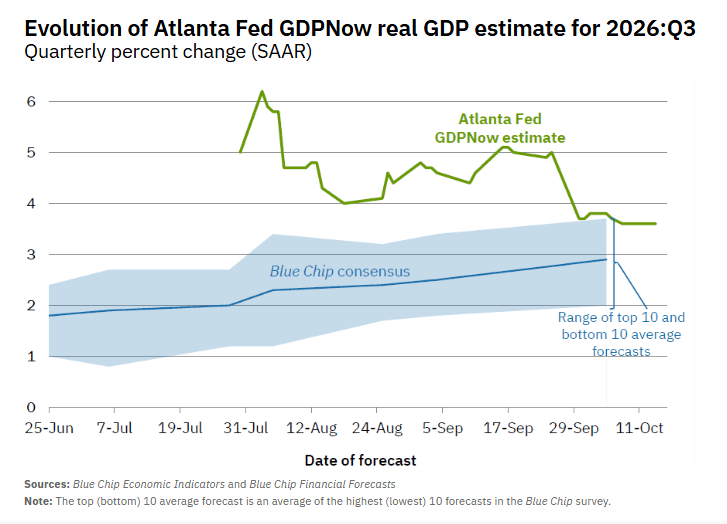
Click for larger graphic
Coming Events
All times below are ET, and most presentations and slides are archived on the companies’ websites so you can listen to them.
Friday, October 16
AG – First Majestic – Unspec. – Nordic Funds & Mines Conference
Monday, October 19
DC – Dakota Gold – Through 10/21 – LD Micro Main Event
Wednesday, October 21
META – Meta Platforms – 4:30pm – Earnings conference call
Monday, October 26
Short Interest – After the close
Tuesday, October 27
PYPL – PayPal – 8:00am – Earnings conference call
EQT – EQT – After the close – Earnings release; call tomorrow
Wednesday, October 28
AG – First Majestic – Through 10/31 – New Orleans Investment Conference
PZG – Paramount Gold – Through 10/29 – Red Cloud Fall Mining Showcase
EQT – EQT – 10:00am – Earnings conference call
Business Employment Dynamics – 10:00am – More accurate payroll numbers
Fed Meeting – 2:00pm press release; 2:30pm press conference
Thursday, October 29
September quarter GDP – 8:30am – First estimate
Personal Consumption Expenditures Index – 8:30am – The Fed’s favorite inflation indicator
Friday, October 30
DC – Dakota Gold – 8:15am – New Orleans Investment Conference
Sunday, November 1
Time Change – 2:00am local time – turn clocks back one hour
Big Tech: The Biotech & Digital Dominators MegaShift
There are at least four ways to make money in the stocks of these large, growing, dominant companies. You can:
* * Buy a stock and hold it
* * Buy a stock and write a call option against it
* * With a Level IV options account, write an out-of-the-money put option
* * With a Level IV options account, write an out-of-the-money put option and use part of the premium to buy an out-of-the-money call option
Broadcom (AVGO – $344.33) and Nvidia are benefiting from the massive spending on artificial intelligence. Both are making a fortune for stockholders selling the technology needed to build and operate AI data centers. Nvidia has used its dominance of GPU processors to build an entire ecosystem, while Broadcom has built an outstanding business around custom AI processors (application-specific integrated circuits, or ASICs) and networking equipment. You should own both.
ASICs are designed for the specific tasks they need to handle. They are not as flexible as Nvidia’s GPUs, but they can be just as powerful for specific tasks and are much more affordable. Broadcom also supplies networking technology that connects processors and other equipment inside data centers. As AI systems become larger, moving information efficiently between chips becomes increasingly important.
The financial results show just how successful Broadcom has become. In the June third quarter, the company reported revenue of $29.6 billion, up 86% from last year. They generated $13.7 billion in free cash flow, and guided for September fourth-quarter revenue of $34.8 billion, 93% year-over-year growth. The company has deep engineering partnerships with Google, OpenAI, and Meta. Their 3.5D XDSiP platform and advanced chip packaging expertise are critical as Moore’s Law advancements slow down even as customers demand ever-larger, more complex silicon.
Despite the drop in gross profit margin to 73%–75% due to memory content, the company’s operating margin remain robust at 66%, driven by volume and leverage. AVGO trades at only 18.7x the fiscal 2027 earnings estimate, and remains a Buy for a return to its $495 high and beyond.
Meta Platforms (META – $736.72) began an overhaul of their AI efforts 14 months ago, and just introduced competitive frontier models: Muse Wonder and Muse Wonder Full. They are designed to deliver state-of-the-art performance on personal and professional agentic tasks.
Let Wall Street’s financial predictions for Muse Wonder and Muse Wonder Full begin! First out of the gate is Deutsche Bank, which said: “Muse has the potential to become an always-on personal assistant for consumers.” They see Muse reaching up to 8% of Meta’s revenue by 2030, or roughly $36 billion in sales. Of course, that is “up to.” Their lower end prediction is sales of $2.4 billion by 2030. Hmm, $2.4 billion to $36.0 billion – that’s quite a range and would let them claim prescience in 2030 almost regardless of what happens. META is a Buy for a long-term hold as the AI revolution plays out.
Nvidia (NVDA – $217.23) is the world’s most valuable company, yet still posting revenue growth that would be impressive for a business a fraction of its size. June quarter revenues were up 106% from a year ago to $96.2 billion, while net income increased 126% to $59.7 billion. Their data center business alone generated $89 billion in revenue, up 117%, and Jensen guided for September quarter revenue of $108 billion.
CFO Colette Kress said: “The surge in AI demand is driving a global infrastructure build-out, supported by an expanding and diverse set of growth opportunities, spanning hyperscalers, AI labs, AI natives, enterprises, and sovereign customers. We expect to grow revenue by approximately 70% in fiscal 2028.”
Nvidia’s competitive advantage starts with the best-by-far graphics processing units (GPUs) as the base of an entire computing platform, including networking equipment, software, and the CUDA software platform to give developers tools to build applications that run on Nvidia’s hardware. The next-generation Vera Rubin computing platform is already moving into production.
Yet the stock trades below 20x forward earnings, like an average S&P 500 company, which really baffles me. Nvidia is reinforcing its AI dominance and proliferating the ecosystem beyond the hyperscalers, including the compute-hungry AI frontier labs, to major corporations and sovereign government datacenters. Multiple options from SpaceX, open-source AI, and physical AI infrastructure remain largely underappreciated. I expect a significant re-rating as the market coalesces around the company’s explosive breakout potential. NVDA is the must-own stock for the AI revolution even if you just buy a few shares.
BNP Paribas raised its Nvidia target price from $285 to $345, citing the company’s broad range of AI hardware, CUDA software, and networking products. They think Nvidia’s position will remain strong as AI workloads shift increasingly toward inference, or the process of running AI models after they have been trained. They expect Nvidia to retain more than 70% gross margins despite growing competition from custom chips and other semiconductor companies.
Morgan Stanley reinstated Nvidia as its top semiconductor pick with an Overweight rating and a $300 target price. They wrote: “Nvidia remains very early in the ramp of a new product cycle, powered shell constraints play into Nvidia’s strengths, and recent agentic enthusiasm can accelerate Vera Rubin adoption. With the stock still relatively inexpensive at 13.7x FY28 EPS, there’s opportunity for multiple expansion if enthusiasm returns to AI, but multiple expansion is also not required for the stock to work as the numbers continue to go higher. Nvidia has also underperformed more CPU stories around the recent Muse enthusiasm, but we think that outperformance will broaden as consumer agents as a category add to long-term AI use cases and token demand.”
They recently met with Nvidia management, including CEO Jensen Huang, and said AI agents are likely to boost CPU demand higher, though the biggest portion of spending will still be on GPUs. “That said, the CPU shortage is intense – though we do not believe that it has intensified over the last month – and NVIDIA remains confident in its ramp of CPUs from $20 billion in 2026 to $40 billion in 2027, of which we think is a little more than 50% is driven by the head node CPU in the AI racks, meaning the balance is standalone CPU racks.”
Other takeaways from the meeting include that Nvidia will continue to use its balance sheet to fortify its competitive advantage (and still return 50% of cash to shareholders), and it will stay firm in its commitment to drive revenue per gigawatt up “significantly.” It also aims to diversify its customer base, yet still see growth from the traditional hyperscalers and AI frontier labs.
The company’s $235 billion stock buyback program through 2028 and record $26 billion June quarter capital return signal a powerful commitment to shareholders. Institutional investors, “the smart money,” have returned to raising portfolio exposure to Nvidia’s shares following recent news, which is fueling the breakout further.
The consensus EPS for 2028 has risen to $15.91. With NVDA trading at less than 14x forward earnings – well below its historical average multiple – and 70%–95% earnings per share growth, NVDA’s valuation remains compelling amid robust institutional inflows and AI infrastructure tailwinds. NVDA is a Buy for a $275 first target as the AI revolution plays out.
Onsemi (ON – $73.70) apparently was competing with Cirrus Logic to acquire Synaptics in September. Onsemi agreed to acquire Synaptics for $123 per share in an all-cash deal worth roughly $5.7 billion, revising its previous all-stock bid in June worth about $7 billion.
StoneX initiated coverage of ON with a Buy rating and a $110 target, saying the company will benefit from a recovery in semiconductor demand and growth in automotive and AI data center power systems. Their $110 target is based on 16x their fiscal 2028 pro forma earnings estimate, including an expected 5%-10% contribution from Synaptics to earnings per share. The brokerage expects Onsemi’s AI data center revenue to rise from about $500 million in 2026 to more than $2.5 billion by 2030. The transition to 800-volt direct-current power systems could increase the company’s addressable content per data center rack to about $115,000 from roughly $15,000.
ON is a Buy for a $130 first target as their legacy business recovers and power semiconductors benefit from the AI and physical AI revolutions.
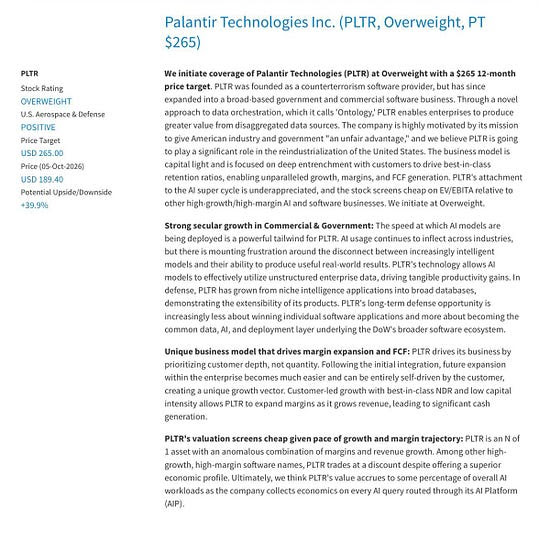
Palantir (PLTR – $200.50) jumped after Goldman Sachs upgraded the stock from Neutral to Buy and set a $230 price target, based on sovereign AI, deeper enterprise adoption, and continued government work. Palantir’s determined push for sovereign AI infrastructure and open-source integration counters competitive threats from proprietary models linked to Anthropic and OpenAI.
CEO Dr. Alex Karp gave the keynote with Zeta Global’s CEO at Zeta Live 2026 on data sovereignty and AI integration. He spotlighted how Palantir’s AI infrastructure is being woven into Zeta’s customer intelligence platform for enterprise clients.
Barclays rated PLTR Overweight with a $265 target. They wrote:
“PLTR has a deep competitive moat that enables unparalleled levels of growth and margins.”
“Mounting frustration around the disconnect between increasingly intelligent models and their ability to produce useful real-world results.”
“Less about winning individual software applications and more about becoming the common data, AI, and deployment layer.”
“Prioritizing customer depth, not quantity.”
 Click for larger graphic
PLTR is a Buy for a $200 first target as the AI revolution plays out.
PayPal Holdings (PYPL – $57.16) has a new shareholder. David Einhorn’s Greenlight Capital added the stock in the June quarter. That’s good company!
Both payment transactions and payment volume had robust growth in the June quarter, especially in Venmo and Peer-2-Peer. The new CEO is targeting at least $1.5 billion in gross run rate cost savings over the next two to three years through structural simplification and AI-driven efficiencies. I think the stock is very undervalued at 9x forward earnings, and buyout speculation plus aggressive share repurchases add upside catalysts. PYPL is a Buy for a triple in three years as the turnaround plays out.
Snap (SNAP – $6.44) is transitioning to self-funded growth, driven by rapid subscription expansion and improving free cash flow generation. Their advertising business shows early signs of pricing power recovery, as subscription revenue reached $316.5 million in the June quarter, up 84.7% from last year, with significant room for penetration and high incremental margins supporting robust free cash flow.
At a 14% free cash flow yield, SNAP is a Buy for a $17+ target as the AI revolution plays out.
SoftBank (SFTBY – $16.30) CEO Masayoshi Son is seeking to raise up to $100 billion from Gulf investors to fund a new wave of AI investments, according to the Financial Times. They said Masa has held discussions in recent weeks with senior figures, including in the United Arab Emirates, about the potential fundraising. Hold SFTBY for a $30 target as the discount to hard book value shrinks.
Small Tech
Enovix (ENVX – $2.68) gave us a peek at the September quarter results. Revenues of $11.0 million were up 38% from last year, beating their guidance of $9-$10 million for their sixth consecutive quarter of year-over-year revenue growth. Drone and defense customers accounted for approximately 70% of revenues. They said the driving factors this quarter were continued growth in the size and diversity of their drone and other defense pipeline, and product sample validation by multiple customers. They are investing $19 million to double their defense manufacturing capacity in Korea. Due to the federal sourcing rules under the National Defense Authorization Act (NDAA), the Trade Agreements Act (TAA), and foreign entity of concern (FEOC) provisions in several laws that effectively eliminate the use of any Chinese content, the U.S. and allied defense programs need to source non-Chinese batteries for drone and other defense programs.
Enovix has identified $216 million in drone, defense, and industrial contract opportunities, which they label as their pipeline. Interim CEO Ryan Benton said: “We are focusing on moving our $216 million drone, defense, and industrial pipeline forward into design wins, purchase orders and shipments. The added Korean manufacturing capacity will enable timely delivery of those orders, which in the first part of the December quarter have already exceeded our September quarter total revenue. [WOW!] Meanwhile, year-to-date we have shipped approximately 17,000 production samples to one of our 24 current and prospective smart eyewear customers.”
Ryan said customer breadth has expanded meaningfully, with a growing number of sample requests from defense customers for aerial, maritime, and soldier-worn applications. He said these new programs offer premium pricing to secure sourcing from the very limited list of qualified defense suppliers. Enovix’s defense-related cells are manufactured completely in-house in Korea, which is already military qualified, offering customers a single, auditable chain of custody.
The company plans to scale their production in the same order as their backlog: aerial (Unmanned Aerial Vehicle or UAV), subsea (Unmanned Underwater Vehicle or UUV), and maritime (Unmanned Surface Vehicle or USV) drone programs. They promoted Steve Bakos, SVP: Worldwide Sales to the newly created role of Chief Revenue Officer and General Manager.
The pro forma loss for the quarter was $29.2 million or 14¢ per share, in line with their 13¢-17¢ guidance. Executive Chairman T. J. Rodgers said: “We have now revamped ENVX’s executive staff and aligned it with immediate revenue growth opportunities in the high-margin defense markets that need our capacity as well as the sampling requirements of the broad and higher–volume consumer markets.”
After the September quarter revenue peek, Enovix followed up by announcing an initial purchase order from a multinational provider of dual-use drone systems. The initial order is for 100,000 battery units, with deliveries scheduled in the first half of 2027. Following a successful initial deployment, the customer is expected to place follow-on orders for the program in the second half of 2027 and beyond. This order moves one opportunity from the $216 million drone, defense, and industrial pipeline into backlog.
They finished the quarter with a strong balance sheet anchored by $512 million in cash. Although the stock has moved up, ENVX remains a Buy for a 4-year hold to $100+ as their BrakeFlow lithium-ion battery takes market share.
Primary Risk: A new competitor invents a better battery.
Fastly (FSLY – $26.07) was named a Leader in the IDC MarketScape: Worldwide Web Application and API Protection Platforms 2026 Vendor Assessment. Chief Product Officer Kelly Shortridge said: “Complexity is fractalizing. Every enterprise has seen an explosion in APIs, speed of change, and AI agents and bots calling them. Single, siloed defenses do not work. Fastly runs differentiated layers of defense that compound as applications multiply. I believe being named a Leader in this year’s IDC MarketScape for WAAP Platforms reflects our depth of investment in protecting our customers’ AI-native applications – from patent-pending Deception to our more recent API Enforcement and AI Firewall.”
FSLY is a Buy for a 3- to 5-year hold to $50+ as the AI revolution plays out.
Primary Risk:Content and applications delivery networks are a competitive area.
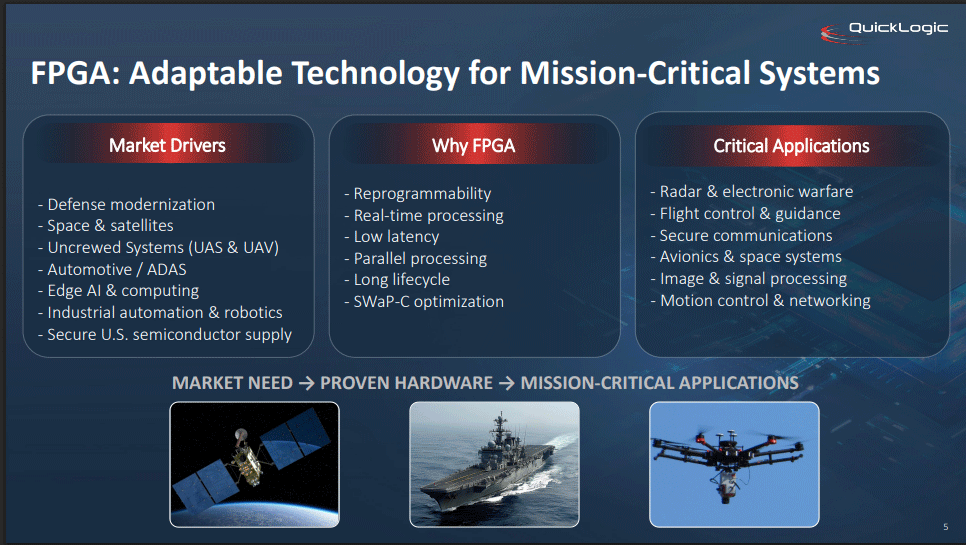
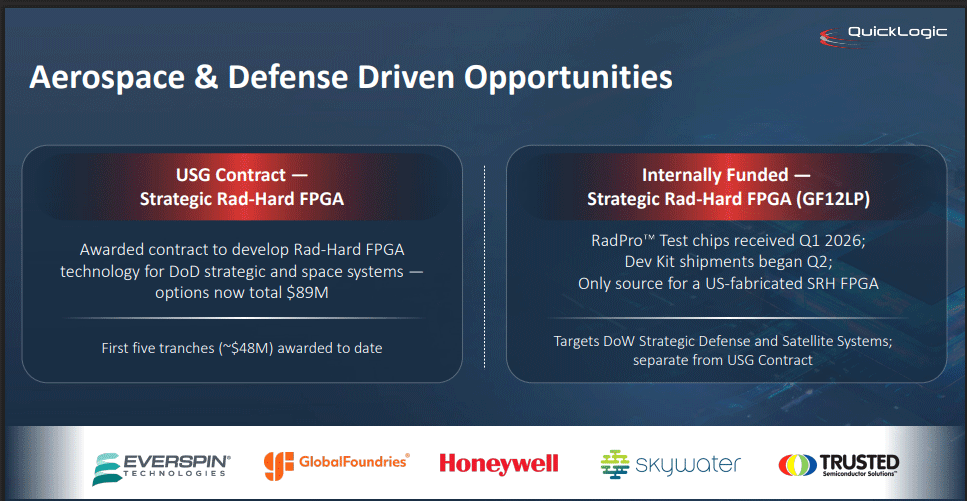
QuickLogic (QUIK – $9.36) presented at the18th Annual CEO Investor Summit at SEMICON West (BRAND-NEW SLIDES HERE ). CEO Brian Faith really focused on the technology for this geek conference:
Click for larger graphic
 Click for larger graphic
They announced a six-figure eFPGA Hard IP design win for a programmable system-on-chip (SoC) targeting battery management, precision motor control, and industrial robotic applications on a 16nm automotive process technology. The initial contract is expected to generate license revenue over the next six months, with royalty revenue anticipated upon production shipments.
This design win expands QuickLogic’s presence into the rapidly growing robotics and battery management semiconductor markets, which is being driven by increasing adoption of electric vehicles, battery energy storage systems, renewable energy infrastructure, and industrial manufacturing management solutions. QUIK is a Buy for my $40 target as their earnings repeatedly surprise Wall Street.
Primary Risk: Customers’ product introductions and associated royalties are unpredictable.
Rocket Lab USA (RKLB – $55.25) unveiled the Neutron rocket in 2021 with a 2024 first-flight target, then moved it to mid-2025 and then to mid-2026. A first-stage tank ruptured during testing in January, so they moved the first-flight target to the end of 2026. This week, due to manufacturing issues in the forward propellant dome on the rocket’s first stage, they moved it to 2027.
When I recommended taking our big profit in RKLB, I said I liked the company, but the Neutron timeline posed a big risk. That is still true. I’m not sure people understand the accounting impact of delaying the first flight. All the costs of Neutron development have to be deducted from current earnings as R&D. Once they have first flight, future improvement costs can be capitalized and amortized against future Neutron revenues. There’s also a strategic issue, as SpaceX may slash the price of a medium-lift rocket launch any time. SpaceX is upscaling to heavier launch payloads than Neutron can handle.
The Bottom Line: I want to get back into RKLB, but not at the current expensive valuation before Neutron has a clear path to launch.
Biotech MegaShift
If you can afford it – and it would not be too big a position in your portfolio – putting $2,000 into each of these speculative biotechs might be a good way to start. Buying these out-of-favor, fallen, or forgotten companies at very low market capitalizations that can get important products through the FDA seems like a good strategy to me.
Risks
Development-stage biotechs are subject to investor sentiment swings from wildly optimistic to excessively pessimistic – mostly the latter recently. After the Primary Risk for each company, I’ve added the clinical stage of their lead product, the probable time of their first FDA approval, and the probable time of their next financing.
As always, you need to think about an appropriate position size. You could buy a full position upfront and then just hold on, or buy some upfront and leave room to add more on the inevitable financings, transient clinical trial setbacks, and the like.
A new, potentially big, positive: the FDA has launched a Rare Disease Framework Initiative that is designed to reflect “the realities of rare disease drug development by considering the nuances of each disease, patient needs, product type and the evidence that can be realistically generated in small patient populations. While flexibility is built into the regulatory framework for drug development and approval of therapies addressing unmet medical need, the FDA needs to leverage recent technologies and scientific understanding of the biologic basis for any particular rare disease coupled with the perspectives of the patient to maximize the use of current authorities that can ensure scientific rigor without unnecessary demands that are infeasible for diseases that affect small patient populations.”
A white paper on the program says that there is a significant unmet need for rare diseases, given that only 5% of such ailments have an FDA-approved treatment. The agency is asking for feedback from patients and disease advocates and will hold an October 28 meeting.
Akebia Therapeutics (AKBA- $0.70) said at the American Society of Nephrology Kidney Week (October 21-25), U.S. Renal Care will present, as a late-breaking presentation, the results of the VOICE trial evaluating the safety of three-times-weekly vadadustat compared with an erythropoiesis-stimulating agent (ESA) in patients receiving in-center hemodialysis. Buy AKBA for the Vafseo launches in the EU, UK, and US. I think Vafseo will become the standard of care in dialysis patients. I expect GSK and/or Amgen to make a bid for the company.
Primary Risk: Vafseo doesn’t sell in the US.
Clinical stage of lead product: Approved
Probable time of next approval: 2030
Probable time of next financing: Never
Compass Pathways (CMPS – $11.62) opened a new office in Jersey City, NJ, in anticipation of the US launch of COMP-360 in the first half of 2027. They already have 175 US employees. CMPS is a Buy for a very long-term hold to $200 as COMP360 succeeds.
Primary Risk: Their drugs fail in the clinic.
Clinical stage of lead product: Phase 3
Probable time of first FDA approval: 2027
Probable time of next financing: Never
Editas Medicine (EDIT – $2.44) traded higher after Australian authorities cleared a Phase 1/2 trial for EDIT-401 in heterozygous familial hypercholesterolemia, a genetic disorder characterized by high levels of low-density lipoprotein cholesterol (LDL-C), also known as “bad” cholesterol. We’ll get initial safety and tolerability data in the March quarter, and top-line safety and efficacy data from Part 1 of the study later in 2027.
Wells Fargo upgraded the stock from Equal Weight to Overweight and raised their target from $4 to $6, saying this “marks a key step towards unlocking a highly differentiated LDL-C approach.”
EDIT is a Buy for a double in 12 months and a long-term hold to much higher prices.
Primary Risk: Other companies’ gene-sequencing drugs fail in the clinic.
Clinical stage of lead product: Partnered: Approved. Owned: Going into the clinic mid-2025.
Probable time of next FDA approval: 2030
Probable time of next financing: 2028
ScyNexis (SCYX – $3.91) completed their Phase 1 study of SCY-770, their first-in-class, selective, and direct AMP-activated protein kinase (AMPK) activator. The study was conducted to evaluate safety and tolerability, as well as to characterize the pharmacokinetics of SCY-770 to support dose selection for the Phase 2 study in patients with Autosomal Dominant Polycystic Kidney Disease (ADPKD). They saw favorable safety and tolerability across all the doses studied. SCY-770 has been granted Orphan Drug Designation by the FDA for the treatment of ADPKD.
Their new corporate presentation SLIDES HERE is focused almost entirely on SCY-770. They have completed IV dosing of SCY-247,their second-generation antifungal, and we should get the results any day. They obviously have no idea what GSK is doing with Brexafemme.
ScyNexis had no debt and $71.1 million in cash at the end of June, which will fund them into 2029. Hold SCYX through the the after-effects of the reverse split.
Primary Risk: Ibrexafungerp fails to sell.
Clinical stage of lead product: Approved
Probable time of next FDA approval: 2028
Probable time of next financing: Never
TG Therapeutics (TGTX – $56.00) announced the publication in Science Direct.com of results from a five-year matching-adjusted indirect comparison (MAIC) evaluating long-term relapse activity and disability progression outcomes with Briumvi compared with ocrelizumab and ofatumumab in patients with relapsing multiple sclerosis (RMS).
CEO Mike Weiss said: “In an era where physicians and patients are fortunate to have multiple anti-CD20 treatment options available for relapsing MS, the lack of comparative data makes choosing the right one challenging. This is particularly important for people living with a chronic disease like MS, where preventing the accumulation of disability over time is an important treatment goal. We are encouraged that this analysis showed that Briumvi was associated with consistently lower relapse activity versus ocrelizumab, and a lower risk of confirmed disability progression compared with both ocrelizumab and ofatumumab over five years.”
Buy TGTX for a target price in a buyout of $60 or more.
Primary Risk: Briumvi, the MS drug, fails to sell.
Clinical stage of lead product: Approved
Probable time of next FDA approval: NM
Probable time of next financing: Never
Inflation MegaShift
Gold ($4,189.00) has been all over the place, dropping when it looked like the Fed will increase and jumping whenever it looks like they won’t. All the short-term noise masks the long-term reason to own gold. The Uniparty can’t or won’t balance the national budget, so the deficits just keep coming and, longer term, the dollar is toast.
Miners & Related
First Majestic Silver (AG – $16.09) said it agreed in principle to a framework to settle their long-running tax dispute with Mexico’s government and will temporarily suspend NAFTA arbitration proceedings. They have been in discussions with Mexico to settle the tax issue for several years, with significant progress made this year, so the have requested that the tribunal overseeing the arbitration temporarily suspend proceedings until year-end 2026, with the possibility of extending the suspension into the March quarter.
Mexico’s Tax Administration Service reportedly has sought more than $500 million in taxes from First Majestic for allegedly keeping its silver prices artificially low, which is laughable. First Majestic said the negotiations to date have been “constructive and cordial,” and it is “optimistic that a settlement will be finalized by the end of 2026.” But if a final settlement cannot be concluded, the company said it will ask the tribunal to lift the suspension and arbitration proceedings will recommence. AG is a Hold as production increases and the price of silver rises.
Primary Risk: Prices of precious metals fall due to US dollar strength.
Royal Gold (RGLD – $233.00) SVP: Strategy Jason Hynes presented at the John Tumazos Very Independent Research conference (WEBCAST AND TRANSCRIPT HERE). It was another audience for the same message: Royal Gold now deserves the same valuation as Franco-Nevada and Wheaton Precious Metals. And it does! RGLD is a Buy until the valuation discount disappears or precious metals top out.
Primary Risk: Prices of precious metals fall due to US dollar strength.
Cryptocurrencies
Cryptocurrencies are a diversifying asset that offer a unique opportunity to make (or lose!) a lot of money quickly.
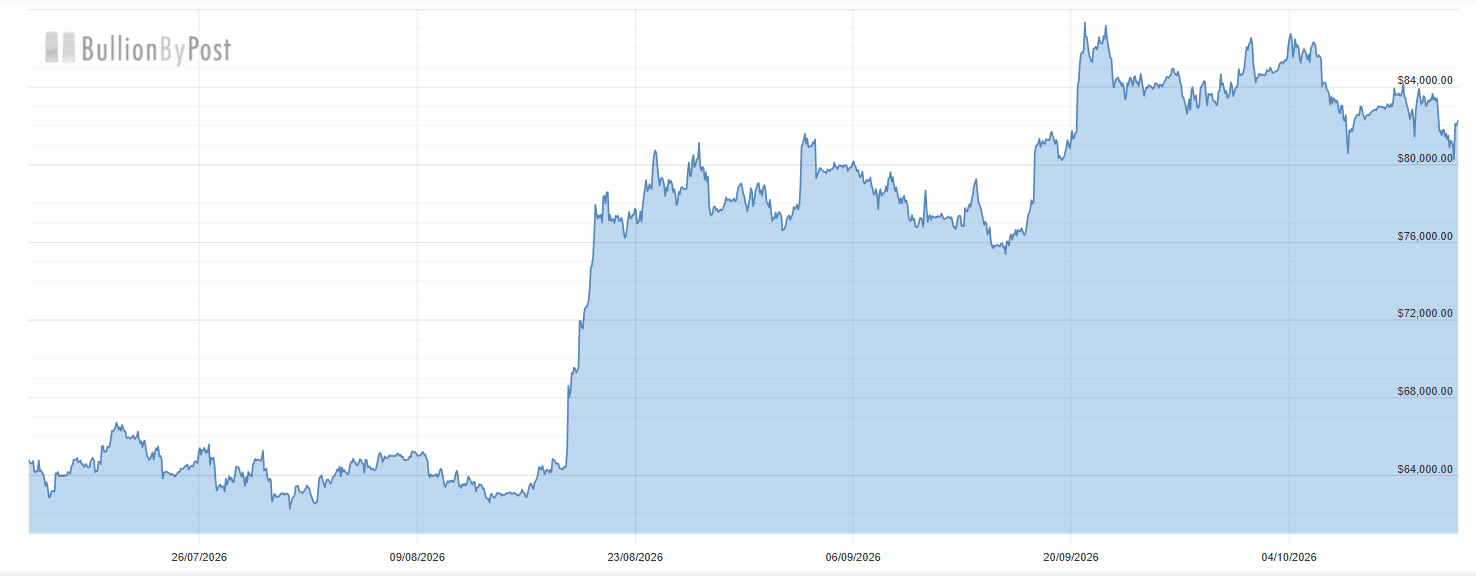
Bitcoin (BTC-USD on Yahoo – $82,266.33) is building a strong base for its next leg up. Patience.
Click for larger graphic
BTC-USD, ETH-USD, IBIT, and ETHA are Strong Buys.
Primary Risk: Bitcoin falls due to over-regulation or is surpassed by another cryptocurrency.
iShares Bitcoin Trust (IBIT- $46.59) remains the cheapest and easiest way to buy bitcoin. IBIT is a Buy for the 2028, 2032, and 2036 halvings.
Primary Risk:Bitcoin falls due to over-regulation or is surpassed by another cryptocurrency.
iShares Ethereum Trust (ETHA- $55.41) did a 1-for-3 reverse stock split for, as Forrest Gump would say, no particular reason. It remains the cheapest and easiest way to buy ethereum. ETHA is a Buy for the coming explosion in token-funded start-ups.
Primary Risk: Ethereum falls due to over-regulation or is surpassed by another cryptocurrency.
Commodities
Oil – $95.99
Oil rallied a bit more as the war drags on and the physical market is tighter than a submarine’s hatch. Paul Tudor Jones said he is bullish on oil and believes prices could rally another $20 to $25. He thinks that any diplomatic resolution to Middle East tensions would have already materialized before the midterms, if a softer approach were available.
Seriously, what demand destruction? Implied total US oil demand is at a 5-year high for this time of the year.
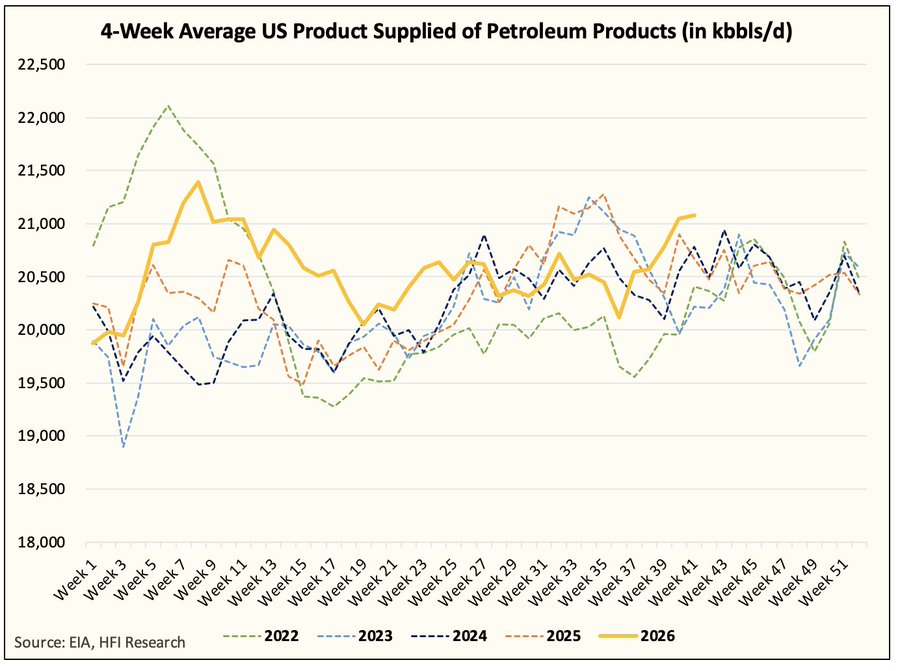
Click for larger graphic h/t @HFI Research
But supply…
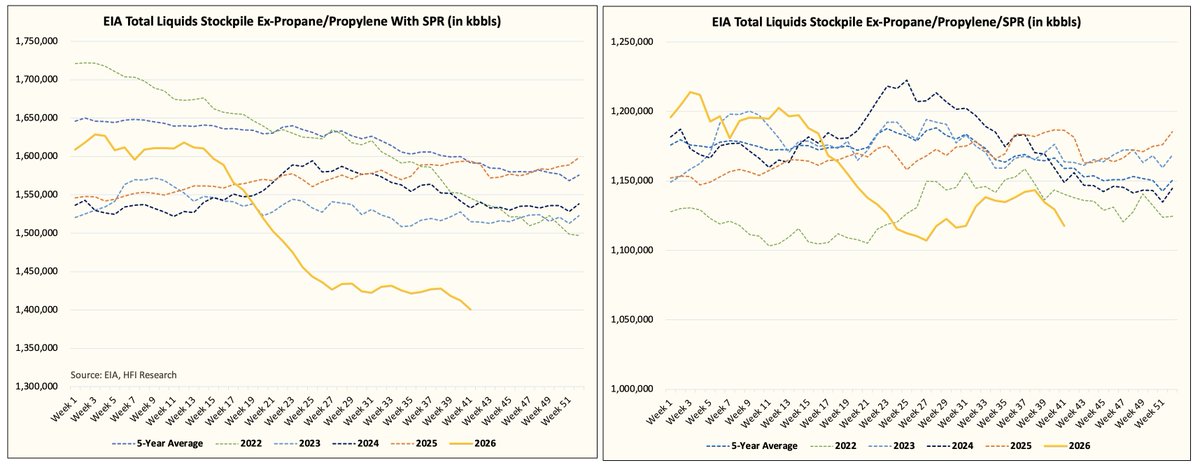
Click for larger graphic h/t @HFI Research
Demand strong + supply vanishing = record prices ahead.
The September 2027 Crude Oil Futures (CLU7.NYM – $82.18) are a Buy for my $200+ target. Only buy futures for all cash; do not use margin.
The United States 12 Month Oil Fund, LP (USL – $61.20) is a Buy for a $150+ target.
Vermilion Energy (VET – $12.65) is a Buy for a target price of $24 or more.
Primary Risk: Oil and natural gas prices fall.
Energy Fuels (UUUU – $8.57) dropped to a 52-week intraday low of $8.36 after disclosing it filed a prospectus supplement allowing it to sell up to an additional $500 million in common shares under an at-the-market equity program. Not that they’ll actually sell much or anything at these low prices.
Wall Street realizes that the White Mesa Mill drives uranium revenue at good profit margins, but they are afraid of the rare earths initiative that continue to generate losses and adds execution risk. I think rare earths are a gamble worth taking, given the situation with China. UUUU is a buy for a $30 target.
Primary Risk: Uranium prices fall.
EQT (EQT – $52.45), the largest U.S. natural gas producer, is well-positioned for growth amid record demand and robust infrastructure. Their vertical integration, contiguous land holdings, and economies of scale drive operational efficiency and competitive advantage. The key catalysts include the Blackline Midstream acquisition, Mountain Valley Pipeline expansions, long-term data center supply contracts, and CEO Toby Rice’s disciplined, contract-backed growth strategy.
In the first half of 2026. they generated $2.16 billion in free cash flow, reduced net debt by $2.15 billion, and raised production guidance while lowering capex guidance, clearly demonstrating robust operational execution. I think natural gas prices are headed much higher, but EQT’s disciplined capital allocation, deleveraging, and strong cash generation underpin my bullish outlook regardless of commodity prices. EQT is a Buy for a long-term hold for much higher natural gas prices.
Primary Risk:Natural gas prices fall.
* * * * *
Does 60 minutes of Jensen Huang equal a Stanford MBA?
* * * * *

Click for larger graphic.
* * * * *
Your happy with Starlink Editor, (affiliate link for $100 credit in the US)

Michael Murphy CFA
Founding Editor
New World Investor
All Recommendations
Priced 10/15/26. Check out the complete Portfolio page HERE.
Buys
These are the stocks everyone needs to own because transformative events are happening over the next year or two, and I expect to hold them long-term.
Tech Dominators
Broadcom (AVGO – $344.33) – Buy for a long-term hold
Gilead Sciences (GILD – $157.37) – Buy, first target price $150
Meta (META – $736.72) – Buy for a long-term hold
Nvidia (NVDA – $217.23) – Buy, first target price $275
Onsemi (ON – $73.70) – Buy, first target price $130
Palantir (PLTR – $200.50) – Buy, first target price $200
PayPal (PYPL – $57.16) – Buy, target a triple in 3 years
Snap (SNAP – $6.44) – Buy, target price $17+
Small Tech
Enovix (ENVX – $2.68) – Buy, 4-year hold to $100+
First Trust NASDAQ Cybersecurity ETF (CIBR – $103.53) – Buy, 3- to 5-year hold
Fastly (FSLY – $25.07) – Buy for a 3- to 5-year hold to $50+
PagerDuty (PD – $17.25) – Buy, 2- to 5-year hold
QuickLogic (QUIK – $9.36) – Buy under $10, target price $40
ARK Venture Fund (ARKVX – $60.92) – Buy for Anthropic IPO
$20-for-$1 Biotech
AbCellera Biologics (ABCL – $12.68) – Buy, long-term hold to $30+
Akebia Therapeutics (AKBA – $0.70) – Buy, target $10
Compass Pathways (CMPS – $11.62) – Buy, hold a long time for $200
Editas Medicines (EDIT – $2.44) – Buy for a double in 12 months and a long-term hold to much higher prices
Inovio (INO – $1.04) – Buy for a very long-term hold
TG Therapeutics (TGTX – $56.00) – Buy, target in buyout $60+
Inflation
A Short-Sale or REO House – ($415,400) – Hold
Bag of Junk Silver – ($57.39) – hold through silver bull market
Sprott Gold Miners ETF (SGDM – $83.67) – Buy, first target $100
Sprott Junior Gold Miners ETF (SGDJ – $87.35) – Buy, first target $140
Sprott Physical Gold and Silver Trust (CEF – $40.58) – Buy, first target $65
Global X Silver Miners ETF (SIL – $82.30) – Buy, first target $150
Paramount Gold Nevada (PZG – $1.06) – Buy, first target price $10
Royal Gold (RGLD – $233.00) – Buy until the valuation discount disappears or precious metals top out.
Cryptocurrencies
Bitcoin (BTC-USD – $82,266.33) – Buy
iShares Bitcoin Trust (IBIT – $46.59) – Buy
Ethereum (ETH-USD – $2,440.40)– Buy
iShares Ethereum Trust (ETHA- $55.41) – Buy
Commodities
Crude Oil Futures – September 2027 (CLU27.NYM – $82.18) – Buy, $200 target
United States 12 Month Oil Fund, LP (USL – $61.20) – Buy, $150 target
Vermilion Energy (VET – $12.65) – Buy, $24+ target
Energy Fuels (UUUU – $8.57) – Buy for a long-term hold for much higher uranium prices
EQT (EQT – $52.45) – Buy under $70; hold for much higher natural gas prices
Holds
These are holds but not sells – yet. They could get moved back to one of the buy categories if their prices drop or outlook improves, or they could become sell recommendations in the future.
SoftBank (SFTBY – $16.30) – Hold for $30 target
Medicenna (MDNAF – $0.31) – Hold to see structured financing terms
ScyNexis (SCYX – $3.91) – Hold through the after-effects of the reverse split
Coeur Mining (CDE – $15.41) – Hold for higher gold prices
Dakota Gold (DC – $5.52) – Hold for higher gold prices
First Majestic Silver (AG – $16.09) – Hold for higher silver prices
Freeport McMoRan (FCX – $70.06) – Hold for higher copper and molybdenum prices
Publisher: GwynRose LLC, 5348 Vegas Drive, Suite 868, Las Vegas, NV 89108
New World Investor does not act as a personal investment adviser or advocate the purchase or sale of any security or investment for any specific individual. The recommendations and analysis presented to members are for the exclusive use of members. Members should be aware that investment markets have inherent risks and there can be no guarantee of future profits. Likewise, past performance does not assure future results. Recommendations are subject to change at any time. Nothing in this presentation should be considered personalized investment advice. No communication to you by Michael Murphy or any of our employees or contractors should be deemed as personalized investment advice.
Copyright ©GwynRoseLLC 2026
New World Investor Mastermind Group
1. Post unto others as you would have them post unto you.
2. Keep it clean, like a 1950s family television show. Your alter ego can run free on X.
3. NO PERSONAL ATTACKS! If you don’t like the stock, don’t trash the person. Everyone is responsible for their own due diligence and investments.
4. Don’t post here about politics or religion – you aren’t going to change anyone’s mind. Again, NO PERSONAL ATTACKS!
5. The investment implications of something going on in politics or religion is OK.
6. Of course, there’s never a reason to slur someone based on race, religion, gender, sexual orientation, or country of national origin.
7. Please, no snark!
 Print This Post


just arrived in the inbox so posted the traditional “1st” !
Looks like there is a new link to the portfolio page. Plus the portfolio page write – ups have been updated. Good. Thanks for both.
How about including the current price next to each item in the portfolio page so we don’t have to go elsewhere to look individually while reading. Seems like it would be straightforward to auto download price say at yesterday’s close if can’t do in real time.