

Dear New World Investor:
The third estimate of June quarter real GDP growth was raised an unusually large amount from +1.5% to +2.2%, and the March quarter was revised up from +2.1% to +2.5%. The 30-year Treasury yield hit its highest level since 2004, the 19-year hit its highest level since 2007, and the US dollar hit an eight-week high as the economy continues to be stronger than most of the pundits expected, probably blocking the Fed from lowering interest rates.
At the same time, the August Personal Consumption Expenditures Index (PCE) was weaker than expected. The headline number increased 3.4% versus the +3.7% consensus forecast. July was revised down from +3.7% to +3.4%. The month-over-month change was +0.3% from August versus the +0.4% consensus.
The core PCE – the number the Fed wants to get down to +2.0% – was up 3.0% year-over-year, less than the +3.3% forecast. July was revised down from 3.3% to 3.0%. The month-over-month increase was +0.2%, a tenth lower than the +0.3% consensus.
Good news, right? Not so fast. There’s an old trick when you don’t like the numbers: Change How They Are Calculated. The Bureau of Economic Analysis changed its methodology for calculating inflation across three categories of the PCE price index, retroactive to 2021: computer software, legal fees, and investment advice. Two of those categories — computer software and investment advice — have experienced sharp price increases over the past year. The changes took about 0.3% off overall core inflation. The downward revisions to price growth in June and July mean that the three-month annualized core inflation rate is now running at – surprise! – precisely 2%.
The CME FedWatch Tool now sees only a 24.9% chance the Fed hikes at the end of October, down from 70% earlier this week.
And that’s how it should be. The Fed has no better idea of what’s really happening than you or I do – maybe less, actually, because so many of them live in the government bubble. What we do know is that the September quarter earnings season will be robust across the board, as the benefits of AI spending start to flow across the economy. According to Bloomberg, for the first time since 2021, when corporate America emerged from the pandemic slump, every sector in the S&P 500 is expected to deliver earnings growth.
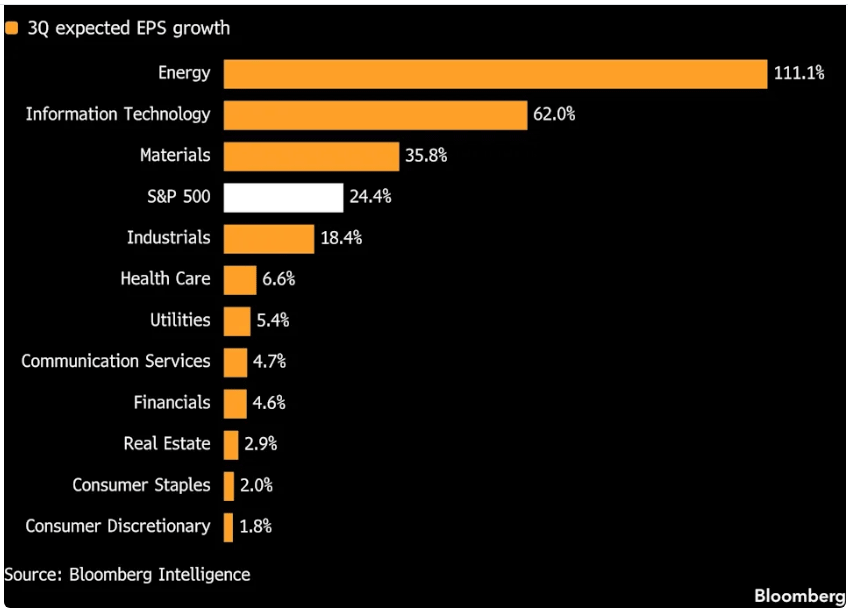 Click for larger graphic h/t Yahoo Finance
Companies that make products like vacuum pumps, cooling systems, and specialty paint coatings have seen revenues surge as data center construction continues to stoke demand for their products. Consumer firms are getting a boost from the AI buildout, which is creating jobs and demand for housing, while rising stock portfolios are encouraging people to splurge on shopping, travel, and dining out. When rates go up, one of the first casualties normally is construction jobs, but we haven’t seen that because the data center growth has been so dramatic that most of the labor has been reallocated.
Meanwhile, China has chimed in on the calls by Anthropic’s CEO Dario Amodei, OpenAI’s CEO Sam Altman, and xAI’s CEO Elon Musk to ask regulators to slow the pace of frontier AI development. (You won’t be surprised to learn that would stifle their smaller competitors with open-source models. Sorry, Dario, Sam, and Elon, nobody’s actually slowing anything down and that train has left the station.)

China’s Foreign Ministry spokesman Guo Jiakun said: “Fear-mongering, confrontation, and vicious competition will only disrupt the process of global AI governance and serve the interests of no one.”
More bluntly, State Security Minister Chen Yixin wrote that misuse by adversaries (guess who he’s referring to) could threaten China’s political and ideological security as well as critical infrastructure.
With the S&P 500 Index shrugging off negative news and hovering near all-time highs, I think it’s likely that a decisive breakout based on the upcoming earnings reports will spark widespread FOMO chasing. led by global tech stocks.
Also, corporate buyback windows reopen in mid-October as companies report earnings. More than half of the S&P 500 by market-cap weight exits their blackout by November 1, and nearly all of it by November 8. In the conference calls we’re also likely to hear about new or increased stock buyback authorizations.
Finally, today seasonality flipped bullish – the December quarter of midterm years has averaged +5.6% returns versus +2.9% across all years. As usual, I expect retail investors, sidelined during September’s typical seasonal lull, to return for the year-end Santa Claus rally. Stay or get fully invested.
Market Outlook
The S&P 500 added 0.4% over the last two weeks as the data played will they/won’t they with the Fed. The Index is up 12.0% year-to-date. The Nasdaq Composite gained 1.7% as investors realized AI is not going to kill us. It is up 15.6% for the year. The SPDR S&P Biotech Exchange-Traded Fund (XBI) fell 2.4%, mostly today. It is up 26.7% year-to-date, though. The small-cap Russell 2000 also dropped 2.4%. but is still up 13.1% in 2026.
Top 5 Long-Term – alphabetical order
Changes this issue: None
ABCL AbCelllera – Will become a huge pharma royalty company
UUUU Energy Focus – Domestic uranium supplier
EQT EQT – largest US natural gas company
IBIT iShares Bitcoin Trust – Bitcoin is headed for $150,000
META Meta – a (the?) leader in the metaverse
PLTR Palantir – a (the?) leader in AI applications software
SCYX ScyNexis –First new antifungal in 20 years
Economy
The Atlanta Fed’s GDPNow model forecast for September quarter real GDP growth has slipped a bit to a still-robust +3.7% annual rate, comfortably above Wall Street’s expectations. We’ll see the first official estimate on October 29.
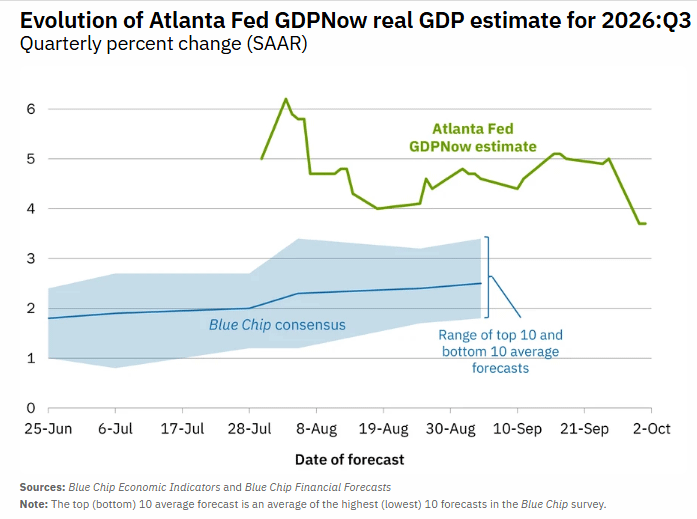 Click for larger graphic
Coming Events
All times below are ET, and most presentations and slides are archived on the companies’ websites so you can listen to them.
Friday, October 2
September payrolls – 8:30am – +90,000 expected
Wednesday, October 7
RGLD – Royal Gold – 11:00am – John Tumazos Very Independent Research 2026 Virtual Conference
Friday, October 9
Short Interest – After the close
Tuesday, October 13
QUIK – QuickLogic – 1on1s – CEO Investor Summit at SEMICON West
Wednesday, October 14
Consumer Price Index – 8:30am – Expected Headline: YoY +3.3%; MoM +0.5%
Thursday, October 15
AG – First Majestic – Through 10/16 – Nordic Funds & Mines Conference
Big Tech: The Biotech & Digital Dominators MegaShift
There are at least four ways to make money in the stocks of these large, growing, dominant companies. You can:
* * Buy a stock and hold it
* * Buy a stock and write a call option against it
* * With a Level IV options account, write an out-of-the-money put option
* With a Level IV options account, write an out-of-the-money put option and use part of the premium to buy an out-of-the-money call option
Broadcom (AVGO – $343.64) is the latest company to lend money to Anthropic to buy Broadcom chips. According to Reuters, which obtained Anthropic’s IPO prospectus, Broadcom is lending up to $42 billion to Anthropic for its infrastructure buildout. In turn, Anthropic is estimated to spend so much on Broadcom’s technologies that the Claude developer will become the chip designer’s largest compute customer by 2027.
In April, Anthropic announced it was teaming up with Broadcom and Google for a deal that would see Google provide its Tensor Processing Unit (TPU) capacity to Anthropic, with the supply coming online in 2027. Broadcom designs Google’s TPUs.
When NVDA does this, it’s probably safer because their GPUs are the standard used by everyone. But in this case, it is TPU custom chips, so if Anthropic goes insolvent, there are fewer buyers for the chips. But with Anthropic recording annual recurring revenue that has increased from $9 billion to $25 billion to $47 billion to $65 billion to $100 billion within a year’s time, I think it’s a small risk.
Broadcom and the TOPPAN Group in Japan have a joint venture, Advanced Substrate Technologies (AST). It announced the opening of its new manufacturing facility in Singapore, the first in the country capable of producing high-end Flip Chip Ball Grid Array (FC-BGA) substrates. Demand for advanced substrate capacity, a persistent bottleneck for AI, networking, and next-generation computing chips, continues to outpace global supply. The 1,000,000-square-foot facility is designed to meet the growing demand for generative AI and data centers, including AI compute and networking devices.
Broadcom is trading at only 18.5x 2027 earnings and 12x 2028 earnings, with over 60% two-year expected revenue growth. That valuation is compelling for long-term investors. AVGO is a Buy for a return to its $495 high and beyond.
Meta Platforms (META – $725.93) president, vice chairman, and co-leader of Meta Compute Dina Powell McCormick was the subject of an excellent Bloomberg article that gives us an unusual insight into how a company’s management operates.
The stock has been on a tear. Analysts are getting really excited about Muse, Meta’s AI model and AI agent. Muse took the top spot on Apple’s US App Store a little more than a week after its release. Muse doesn’t really need to be the smartest model in the world. It needs to be smart enough, reliable enough, and sufficiently embedded in people’s lives that they start giving it jobs instead of prompts. There is a huge difference between AI that produces information and AI that produces economic outcomes. If Muse becomes the interface through which people delegate economic activity, Meta potentially owns a new layer between human intention and transaction. And the monetization is almost embarrassingly obvious if the product works.
Expedia will enable travelers to plan and book trips, hotels, and flights directly through Muse. In a post on X, Expedia said: “ We’re joining with Muse: tell it where you’re headed, and it can work with Expedia to sort your hotels and everything in between.”
Shopify and PayPal also are partnering with Muse, allowing customers to shop and book travel through the Muse agent. It’s possible and probably Zuck’s intention that Muse becomes the middleman for the entire Internet economy as a transaction layer rather than as a subscription product, allowing Meta to monetize purchases, bookings, leads, and other completed outcomes. Meta already has the distribution, advertiser relationships, business agents, and performance-based monetization infrastructure needed to extend its model from attention toward transaction-based revenue. Amazon’s decision to block Muse highlights how strategically valuable control over purchase intent could become.
Meta’s vertical integration – owning data centers, AI models, and user platforms – creates unique cost and distribution advantages over their AI competitors. The stock looks cheap at a forward P/E of 21.8x and a Price/Earnings/Growth (PEG) ratio of 1.09x. It’s a $1,000 stock someday – maybe soon. META is a Buy for a long-term hold as the AI revolution plays out.
Nvidia (NVDA – $230.86) stunned the financial world, including yours truly, by announcing an additional $150 billion stock buyback program, raising the remaining total program to $235 billion. Now that’s returning cash to shareholders! It is the largest share repurchase authorization increase in history. Jensen said he expects to execute the total remaining program through the January 2028 fiscal year. “NVIDIA’s growth is being driven by a once-in-a-generation platform shift to AI and accelerated computing. Our cash generation gives us the capacity to invest in the technologies that advance this transformation and return capital to shareholders. This authorization reflects our confidence in the long-term opportunity ahead.”
Nvidia is evolving from the GPU leader into a capital-driven AI ecosystem powerhouse, leveraging its massive cash flows to entrench its market position. Their strategic investments, supply commitments, and financing partnerships are creating a self-reinforcing flywheel that deepens their ecosystem and drives recurring demand. I still worry about the impact on them of an OpenAI bankruptcy, but NVDA remains a Buy for a $275 first target as the AI revolution plays out.
Onsemi (ON – $80.08) has revised their Synaptics acquisition deal from a $7 billion all-stock purchase price to a $5.7 billion all-cash transaction, reportedly in response to a competing offer. The deal is expected to be immediately accretive to Onsemi’s non-GAAP earnings per share.
CEO Hassane El-Khoury said: “As was the case when we initially announced the acquisition, Synaptics addresses an important aspect of our strategic direction, and we believe the revised merger agreement represents a more financially attractive transaction for our shareholders.”
The deal will be financed through a combination of cash on hand and fully committed debt financing from Morgan Stanley, and still will close by mid-2027.
Onsemi had a transformative Investor Day on September 16 that I covered in the last issue. Wall Street is catching on that the data center diversification and legacy business exits have driven ON’s accelerated growth prospects far beyond the mixed automotive/softer industrial demand. The new product launches, expanded customer wins, and accretive acquisitions underpin their growing data center opportunities of $115,000 per rack by 2030.
Meanwhile, the drop in the stock that gave me an opportunity to recommend it has resulted in a 23.2x forward Price/Earnings ratio and a three-year PEG ratio of 0.63x. Seaport Research Partners initiated coverage, saying the company is benefiting from improving industrial and automotive demand for analog chips and could gain from the expected 800-volt data center buildout in 2027 and 2028. Seaport also viewed Onsemi’s planned Synaptics deal more favorably than the broader market, citing potential expansion into digital logic and gross-margin benefits. They recommended Buy with a modest $100 target. ON is a Buy for a $130 first target as their legacy business recovers and power semiconductors benefit from the AI and physical AI revolutions.
Palantir (PLTR – $190.04) is using CEO Alex Karp’s data sovereignty argument to drive new deals. He points out that the enterprise model for AI labs is simple: more token consumption equals more revenue. That can lead to budget-busting spending. Uber provides a high-profile example of a company that consumed tokens uncontrollably with little tangible evidence of value creation. Even worse, the AI labs can use a company’s data to train its next generation of models.
D. A. Davidson reiterated their Buy rating and raised their target price from $200 to $250, saying: “Palantir’s push into data sovereignty is resonating with customers. Customers are getting savvier about what AI model they need and how to work with a range of models, and Palantir is capitalizing on that trend. Trust means Palantir is naturally positioned to become the control plane, orchestration layer and harness provider for a wide range of customers. Palantir is creating those layers for customers and solving the problem of choosing models and managing token costs. The Nvidia announcement really drove home the point about trust. Palantir built a supply management system for Nvidia leveraging Nemotron, which appears to address one of the most important challenges for the most important company in the world.”
Nvidia built its supply chain command center on Palantir’s Foundry using its own 30-billion-parameter post-trained open-weight specialized model, with results superior to a 550-billion-parameter general model.
Palantir benefits from complex agentic workloads and expanding enterprise demand for secure, scalable AI control planes. New features like AIP Evolve, Palantir MCP, and SuperRepo reinforce its leadership in sovereign AI and enterprise workflow automation critical in the agentic era. Rising automation across AIP and Foundry is poised to drive incremental deployment efficiencies while supporting incremental operating leverage and free cash flow expansion. Commercial momentum is accelerating, driven by AIP adoption, strategic partnerships, and a net dollar retention rate around 157%, all positioning Palantir for further expansion. PLTR is a Buy for a $200 first target as the AI revolution plays out.
PayPal Holdings (PYPL – $53.06) moved up after they said they are partnering with Meta to allow PayPal customers to shop using Muse personal AI agents at participating merchants worldwide. PYPL is a Buy for a triple in three years as the turnaround plays out.
Snap (SNAP – $5.65) is partnering with Nvidia, Amazon Web Services, and Salesforce to bring its $2,195 Specs augmented-reality glasses to the enterprise market. Snap also is partnering with Verizon to offer custom data plans, flexible financing, digital setup and hands-on experiences at select Verizon stores. The SPECS Connected Case bundle will be available for $2,395. Verizon will offer eligible customers financing options, including a 36-month payment plan. Connected wearable data plans are available from $10/month for Verizon customers and from $20/month for non-Verizon customers.
I still think SPECS will flop, but I also think that’s in the price of the stock. The social media landscape is consolidating, and in the June quarter Snap’s global monthly active users grew 4% year-over-year to 971 million, while revenue rose 19% year-over-year to nearly $1.6 billion and average revenue per user (ARPU) increased. SNAP is a Buy for a $17+ target as the AI revolution plays out.
SoftBank (SFTBY – $20.81) continues to twist and turn to fund its $65 billion commitment to OpenAI. The saga so far:
Bank Loans & Credit Facilities
$40 Billion Unsecured Bridge Loan Facility: In late March 2026, SoftBank executed a $40 billion short-term bridge facility structured with a syndicate of over 20 global banks. This facility was designed to provide immediate liquidity to complete its follow-on equity tranches in OpenAI.
Collateralized Loan Attempts: SoftBank attempted to negotiate a $6 billion to $10 billion loan facility secured against its private equity stake in OpenAI. However, major lending banks declined to accept the unlisted OpenAI shares as collateral, forcing SoftBank to rely instead on corporate debt and bridge refinancing.
Bond Sales & Debt Issuances
$11.1 Billion Multi-Tranche Senior Notes (September 2026): SoftBank issued a landmark $11.1 billion high-yield bond deal—marking the largest junk bond sale on record. It was made up of
USD Senior Notes that included multi-billion-dollar tranches with maturities ranging from 3 to 10 years, offering coupon yields of 8.625%, 9.25%, and 9.75%; and EUR Senior Notes that included two €500 million (~$570 million USD) tranches maturing in four and six years with yields of 7.125% and 8.00%. The proceeds were used directly to pay down and refinance portions of the March 2026 maturing bridge loan facility.
Domestic Hybrid Notes & Straight Corporate Bonds (Japan):
Japanese Retail & Institutional Subordinated Hybrid Debt: Issued about $4.3 billion in subordinated hybrid notes featuring interest deferral options to raise equity-like capital without directly diluting share value.
70th Unsecured Straight Corporate Bond: A domestic Japanese yen bond sale (~$387 million) issued to institutional and retail investors.
The company also secured a $10 billion margin loan backed by its OpenAI stake. CEO Masayoshi Son is evolving SoftBank into a vertically integrated AI platform, with OpenAI as its core equity exposure and SB Energy as the infrastructure arm. But the delayed OpenAI IPO undermined SB Energy’s $50 billion listing plans.
AI adoption in Japan could provide tailwinds, but slow monetization and implementation may challenge Masa’s debt-laden strategy. It certainly increases the risk. Plus, the strengthening yen poses a headwind, because SoftBank’s debt is yen-denominated while key assets, like ARM and its OpenAI stakes, are in dollars.
Continue to Hold SFTBY for a $30 target as the discount to hard book value shrinks, but keep your sneakers laced.
Small Tech
Enovix (ENVX – $2.78) benefits from AI adoption, because AI requires much more energy from a smartphone or AR glasses battery. Everyone knows that. What isn’t so obvious is how AI is doing the same thing to mobile defense and drone applications. Drones accounted for over 60% of Enovix’s June quarter revenues, and the company is dramatically increasing capacity in their South Korean factory. ENVX is a Buy for a 4-year hold to $100+ as their BrakeFlow lithium-ion battery takes market share.
Primary Risk: A new competitor invents a better battery.
First Trust NASDAQ Cybersecurity Exchange-Traded Fund (CIBR – $103.78) is up about 40% year-to-date as fears over AI-driven security threats sparked a significant rally in cybersecurity stocks. JPMorgan wrote in a note that the theme of AI security is expected to remain a critical driver for the sector. CIBR is a Buy for a 3- to 5-year hold as the need for cybersecurity gets stronger and stronger at every level of society.
Primary Risk: A technology emerges to stop hackers.
Fastly (FSLY – $26.39) held a well-received Investor Day (WEBCAST HERE and SLIDES HERE and TRANSCRIPT HERE). CEO Kip Compton set fiscal 2029 targets that included revenue growth of 14% to 21% a year, a pro forma operating profit margin of 20% to 22%, and free cash flow of 12% to 15% of revenues. These were much higher than Wall Street expected.
Fastly started as a simple content delivery network to accelerate delivery of web pages and streaming video to end users. They’ve built on their position between the content originator, often on the cloud, and the end user to add services like security that manage automated bot traffic and counteract distributed denial of service (DDoS) attacks. Those two services are growing over 100% a year.
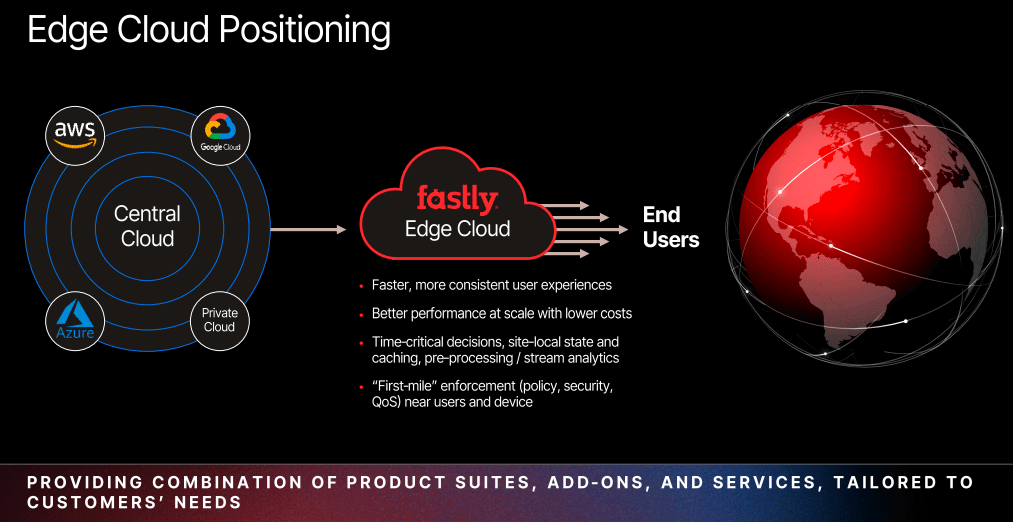 Click for larger graphic
As a result of their expanding portfolio of edge services, Fastly now has a much larger total available market (TAM) opportunity:
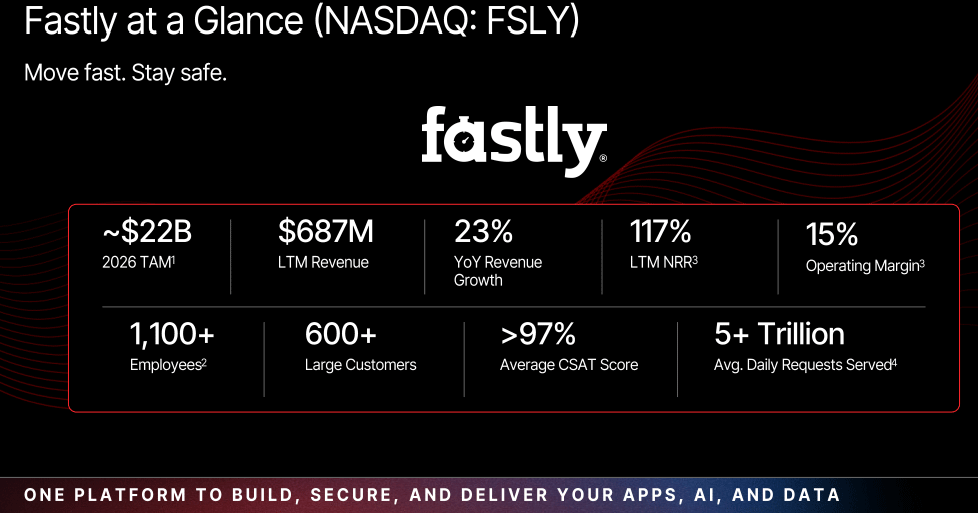 Click for larger graphic
The June quarter delivered record revenue of $183.3 million, up 23% year-over-year, with pro forma earnings of 15¢ a share, both beating the consensus. Security revenue mix, customer retention, and large customer spend all improved. Kip has guided 2026 to midpoints of $739 million in revenue and 52¢, reflecting enhanced operating leverage and margin expansion. FSLY is a Buy for a 3- to 5-year hold to $50+ as the AI revolution plays out.
Primary Risk:Content and applications delivery networks are a competitive area.
PagerDuty (PD – $15.58) leverages AI to deliver industry-leading rapid IT incident response. After management changes and a 15% workforce restructuring, the company has transitioned to profitability, is no longer burning cash, and is steadily enhancing its platform with AI capabilities. They now deliver >20% pro forma operating margins and are profitable on a GAAP basis, with mid-80% gross profit margins supporting strong economies of scale.
At 10.5x 2027 earnings, PD is way too cheap. PD is a Buy for a 2- to 5-year hold as their digital operations management Software-As-A-Service gains market share.
Primary Risk: Digital operations management is a competitive area.
Biotech MegaShift
Breaking: The FDA is beginning the Expedited Investigational New Drug (IND) Pilot Program to speed up the time from when a drug is first identified to beginning a first-in-human clinical trial. The goal is to have more clinical trials done domestically rather than oversees, and bring medicines to market more quickly. The Agency said that in the US currently, first-in-human trials can take up to two years, considerably slower than in China and Australia, a reality that is “threatening America’s leadership in scientific innovation.”
The pilot program involves having eight to ten drug companies work with selected US qualified research institutions that have the scientific expertise to support efficient development of IND applications. The FDA will review and accept individual components on a rolling review during the pre-IND phase, rather than waiting for all the components to begin their review.
If you can afford it – and it would not be too big a position in your portfolio – putting $2,000 into each of these speculative biotechs might be a good way to start. Buying these out-of-favor, fallen, or forgotten companies at very low market capitalizations that can get important products through the FDA seems like a good strategy to me.
Risks
Development-stage biotechs are subject to investor sentiment swings from wildly optimistic to excessively pessimistic – mostly the latter recently. After the Primary Risk for each company, I’ve added the clinical stage of their lead product, the probable time of their first FDA approval, and the probable time of their next financing.
As always, you need to think about an appropriate position size. You could buy a full position upfront and then just hold on, or buy some upfront and leave room to add more on the inevitable financings, transient clinical trial setbacks, and the like
Compass Pathways (CMPS – $11.95) did a fireside chat at the TD Cowen Novel Mechanisms in Neuropsychiatry Summit (WEBCAST HERE). CEO Kabir Nath gave the now-familiar pitch – two successful Phase 3 trials, rolling review at FDA underway will be completed by year-end, voucher for two-month review, approval in February, and they are ready to launch. He gave the usual caution about the need for DEA and state rescheduling of psilocybin. CMPS is a Buy for a very long-term hold to $200 as COMP360 succeeds.
Primary Risk: Their drugs fail in the clinic.
Clinical stage of lead product: Phase 3
Probable time of first FDA approval: 2027
Probable time of next financing: Never
Editas Medicine (EDIT – $2.52) was upgraded by Guggenheim from Neutral to Buy with a $5 target based on a 30% probability of success for EDIT-401, but no revenue estimates for the company’s other pipeline assets. EDIT-401 is a novel gene editing approach for hyperlipidemia, or severely high blood cholesterol (heterozygous familial hypercholesterolemia). Editas is about to to start a Phase 1/2 clinical trial by the end of 2026, with a data update expected in the March quarter. EDIT is a Buy for a double in 12 months and a long-term hold to much higher prices.
Primary Risk: Other companies’ gene-sequencing drugs fail in the clinic.
Clinical stage of lead product: Partnered: Approved. Owned: Going into the clinic mid-2025.
Probable time of next FDA approval: 2030
Probable time of next financing: 2028
Medicenna (MDNAF – $0.26) will present survival outcomes with bizaxofusp (formerly MDNA55) in unresectable, IDH-wildtype recurrent glioblastoma (rGBM) at the 31st Annual Meeting of the Society for Neuro-Oncology (SNO 2026) on November 13. CEO Fahar Merchant said: “Selection for an oral presentation at SNO highlights the interest of the neuro-oncology community in the continued clinical development of bizaxofusp for patients with recurrent glioblastoma. We look forward to presenting this survival analysis in the intended Phase 3 population and continue engaging with leading clinicians, researchers, and potential pharma partners during SNO 2026.”
It’s good to see they haven’t given up on finding a Phase 3 partner for this terrible disease. Hold MDNAF to see structured financing terms.
Primary Risk: Their drugs fail in the clinic.
Clinical stage of lead product: Entering Phase 2
Probable time of first FDA approval: 2028
Probable time of next financing: 2026
ScyNexis (SCYX – $5.37) got a Biomedical Advanced Research and Development Authority (BARDA) contract for up to $214 million in non-dilutive funding to advance SCY-247 through Phase 2 and Phase 3 trials for both the treatment of invasive candidiasis, and the prevention of invasive fungal infections in high-risk patients. Hold SCYX through the the after-effects of the reverse split.
Primary Risk: Ibrexafungerp fails to sell.
Clinical stage of lead product: Approved
Probable time of next FDA approval: 2028
Probable time of next financing: Never
Inflation MegaShift
Gold ($4,207.80) is under steady accumulation by China’s central bank. They added 20.2 metric tons of gold in August, their largest monthly purchase since October 2023. That makes 22 consecutive months of buying, covering gold’s run above $5,000, the correction that followed, and the recovery since. China bought through all of it. Beijing isn’t asking how high, it’s asking how much.
Miners & Related
Coeur Mining (CDE – $17.56) plans to spend $158 million on exploration in 2026, more than double 2025 levels. They are targeting reserve growth in Canada and Mexico, prioritizing organic expansion over costly acquisitions. They continue to focus their exploration efforts at New Afton’s K-Zone deposit, building on the maiden mineral resource of 48 million metric tons of measured and indicated resources and 6 million metric tons of inferred resources announced in March. New Afton’s 2025 proven and probable reserves totaled 36 million tons containing 780,000 ounces of gold at an average grade of 0.67 grams per tonne (g/t), and 591 million pounds of copper at an average grade of 0.74%.
At their other Canadian mine, Rainy River, Coeur said expansion drilling extended the Main Zone by more than 150 meters. Notable drill results included 8.1 meters at 14.8 g/t of gold and 5.8 meters at 43.6 g/t of gold. CDE is a Hold as gold goes higher.
Primary Risk: Prices of precious metals fall due to US dollar strength.
Dakota Gold (DC – $5.98) has concluded key process and site-layout trade-off studies for the Richmond Hill Pre-Feasibility Study (PFS) that will be released in this quarter, and received additional assay results that will be incorporated into the Feasibility Study (FS) resource update that will be released in mid-2027.
CEO Jack Henris said: “Receipt of the final Richmond Hill assays is an important milestone as we complete the dataset for our upcoming PFS resource update expected to be released in conjunction with our PFS in the fourth quarter of this year. We have also concluded two significant trade-off studies by selecting a 0.5-inch design crush size and a single heap-leach facility in the area contemplated for Phase 1 of the IACF. Together, these decisions support a simpler operating configuration, reduce geotechnical complexity and provide greater definition for the overall PFS design.”
DC is a Hold as gold goes higher.
Primary Risk: Robert Quartermain doesn’t find enough gold. Secondary risk: Prices of precious metals fall due to US dollar strength.
Cryptocurrencies
Cryptocurrencies are a diversifying asset that offer a unique opportunity to make (or lose!) a lot of money quickly.
Bitcoin (BTC-USD on Yahoo – $84,770.16) gained even though the Digital Asset Market Clarity Act failed its procedural Senate vote, falling short of the required 60 votes. Senate Democrats blocked the advancement of the Clarity Act, joined by a handful of Republican defections following intense lobbying from community banks over stablecoin reward rules.
After dipping to $75,000 early in September, bitcoin climbed above its May high near $86,000, fueled by exchange-traded fund inflows and short liquidations.
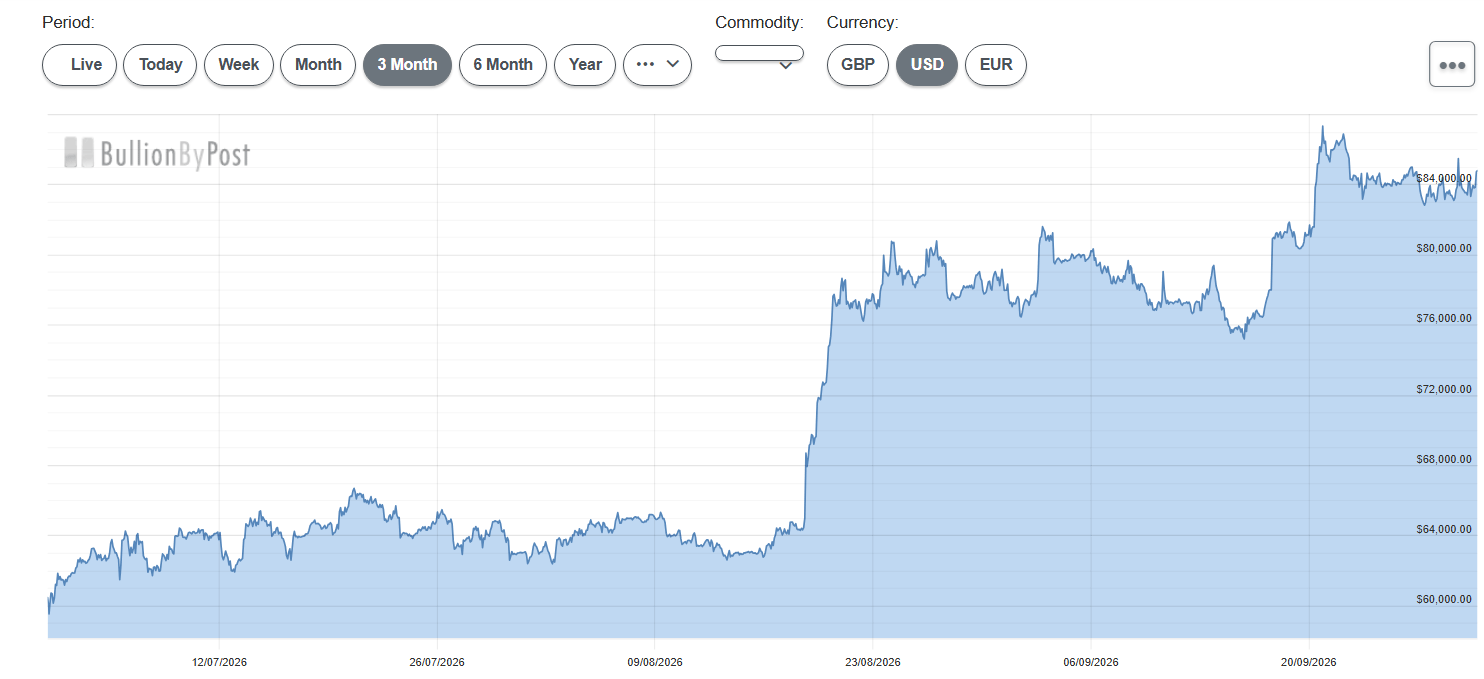 Click for larger graphic
BTC-USD, ETH-USD, IBIT, and ETHA are Strong Buys.
Primary Risk: Bitcoin falls due to over-regulation or is surpassed by another cryptocurrency.
iShares Bitcoin Trust (IBIT- $47.96) remains the cheapest and easiest way to buy bitcoin. IBIT is a Buy for the 2028, 2032, and 2036 halvings.
Primary Risk:Bitcoin falls due to over-regulation or is surpassed by another cryptocurrency.
iShares Ethereum Trust (ETHA- $20.37) remains the cheapest and easiest way to buy ethereum. ETHA is a Buy for the coming explosion in token-funded start-ups.
Primary Risk: Ethereum falls due to over-regulation or is surpassed by another cryptocurrency.
Commodities
Oil – $92.91
Oil slipped back below $100, but rose today after Chinese refiners suspended exports of oil products to regions beyond Hong Kong and Macau until further notice, tightening fuel markets already coping with global supply shortages. After the recent sharp draw-downs in Chinese crude and fuel inventories, this probably means they need the refined products domestically.
The International Energy Agency (IEA) apparently thinks that when there is a shortage of oil and refined products, the market adjusts by reducing demand instead of increasing prices. Seriously. The IEA just cut its forecast for oil demand and said consumption may have to decline further in the coming months as the Iran war drags on and consumers are forced to adjust to lower supply.
The Paris-based agency deepened its estimates for this year’s decline in global oil demand by 940,000 barrels a day to 2.5 million barrels a day — the biggest loss in annual average terms since the 2020 COVID pandemic shuttered vast swathes of the world economy. The return of the supply surplus they’ve been forecasting for this year (!!) will now be delayed until 2027.
They finally noticed a few things: “Global oil inventories have been drawing at record rates. With supplies still constrained, and commercial inventory buffers rapidly depleting, further demand reductions may be required in the coming months to close the gap.”
Maybe they know another way to get “ further demand reductions” than a sharp increase in prices, but somehow I doubt it.
The Agency said the hit to 2026 oil demand looks to be on a comparable scale to the four largest shocks of the last 60 years, with the biggest impact falling on middle distillates like diesel, and feedstocks for petrochemicals plants in Asia.
They finally realized that the war is having an even bigger impact on the flow of oil than on consumption. Their latest data indicate an average global oil deficit of about 1.7 million barrels a day this year, compared with a shortfall of 1.3 million a day in last month’s report. It shows stockpiles continuing to draw in the fourth quarter, instead of a marginal increase for the same period that it previously forecast. The agency’s August report said the market would return to surplus towards the end of this year. Forget that!
They lowered projections for global supply by 28% or 1.3 million barrels a day, to an annual loss of 5.7 million a day, and said they had pushed back expectations for a recovery into next year. As a result, world supplies are on track to fall short of demand this year by about 1.75 million barrels a day. Between February and August, inventories declined at even more stark clip of 2.8 million barrels a day, the IEA said.
The September 2027 Crude Oil Futures (CLU7.NYM – $77.56) are a Buy for my $200+ target. Only buy futures for all cash; do not use margin.
The United States 12 Month Oil Fund, LP (USL – $57.89) is a Buy for a $150+ target.
Vermilion Energy (VET – $11.60) is a Strong Buy, trading at a deep discount amid its ongoing portfolio transformation. The company is on the verge of a major cash flow inflection, with Montney and European projects ramping. They are targeting C$1.7 billion in free cash flow for stockholders from 2026–2030 on realistic commodity assumptions. Production per share is up 6% this year, net debt is falling, and a new buyback program plus a 3% dividend supports strong shareholder returns. VET is a buy for a target price of $24 or more.
Primary Risk: Oil and natural gas prices fall.
Energy Fuels (UUUU – $10.71) is transforming into a vertically integrated critical minerals company, expanding beyond uranium into rare earths and permanent magnets. Their uranium assets are profitable at current prices, and the rare earths strategy is advancing with acquisitions (Australian Strategic Materials, pending Vacuumschmelze GmbH) and customer product qualifications. UUUU is a buy for a $30 target.
Primary Risk: Uranium prices fall.
EQT (EQT – $50.09) CEO Toby Rice said the company will increase natural gas production in 2026 to meet the growing global demand while spending less money than last year, despite curtailed output in recent months by EQT and others in the Marcellus and Utica shale regions. Toby said: “We have a shut-in program. During times of low prices, we sell less. When prices are higher, we sell more. Having a business that’s able to throttle the production aligned with what the market requires… is one of the reasons we’ve been able to beat our pricing expectations.”
He said EQT has benefited by more than $200 million annually from its ability to sell less gas when prices are low and more when prices are high. He added: “We’re incredibly bullish on the international markets,” foreseeing gas demand growing through 2040 by ~20 billion cubic feet per day (Bcf/day) in domestic markets and by ~200 Bcf/day in international markets. EQT has said it will have ~6 million metric tons/year of LNG available to sell by 2030-31, when some LNG export plants under construction and development enter service. EQT is a Buy for a long-term hold for much higher natural gas prices.
Primary Risk:Natural gas prices fall.
Freeport McMoRan (FCX – $69.28) will benefit from copper markets tipping into deficit next year, widening to over 12 million tonnes by 2040, due to booming demand from AI infrastructure, EVs, and renewables alongside scarce new supply. Billionaire investor Stanley Druckenmiller is heavily invested in copper, citing eight years without new output and data center growth. Ivanhoe Mines founder Robert Friedland says the industry must mine as much in the next 20 years as in all human history for 3% GDP growth. The long mine development times – around 18 years – and fewer discoveries are pushing prices to record highs. FCX is a Hold for higher copper and molybdenum prices .
Primary Risk: Copper prices fall.
* * * * *
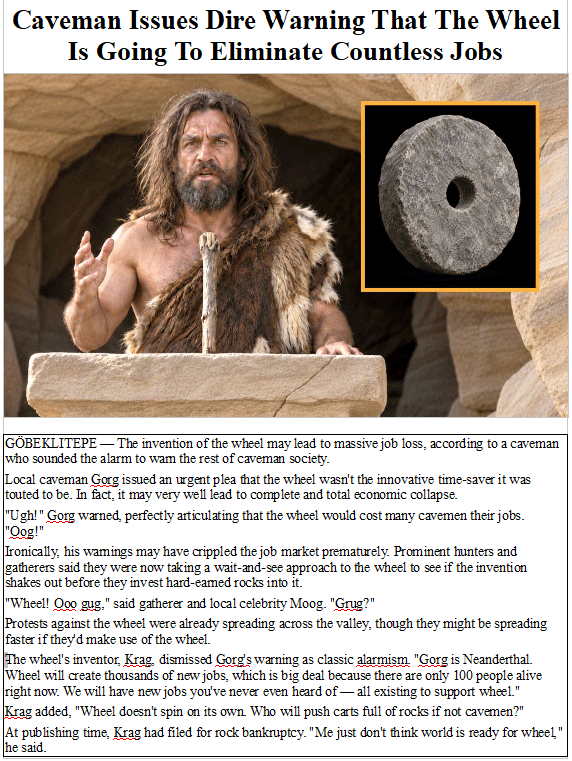 Click for larger graphic h/t Babylon Bee
* * * * *
Your reading a reply to Dario Amodei Editor,

Michael Murphy CFA
Founding Editor
New World Investor
All Recommendations
Priced 10/1/26. Check out the complete Portfolio page HERE.
Buys
These are the stocks everyone needs to own because transformative events are happening over the next year or two, and I expect to hold them long-term.
Tech Dominators
Broadcom (AVGO – $343.64) – Buy for a long-term hold
Gilead Sciences (GILD – $147.50) – Buy, first target price $150
Meta (META – $725.93) – Buy for a long-term hold
Nvidia (NVDA – $230.86) – Buy, first target price $275
Onsemi (ON – $80.08) – Buy, first target price $130
Palantir (PLTR – $190.04) – Buy, first target price $200
PayPal (PYPL – $53.06) – Buy, target a triple in 3 years
Snap (SNAP – $5.65) – Buy, target price $17+
Small Tech
Enovix (ENVX – $2.78) – Buy, 4-year hold to $100+
First Trust NASDAQ Cybersecurity ETF (CIBR – $103.78) – Buy, 3- to 5-year hold
Fastly (FSLY – $26.39) – Buy for a 3- to 5-year hold to $50+
PagerDuty (PD – $15.58) – Buy, 2- to 5-year hold
QuickLogic (QUIK – $11.66) – Buy under $10, target price $40
ARK Venture Fund (ARKVX – $60.42) – Buy for Anthropic IPO
$20-for-$1 Biotech
AbCellera Biologics (ABCL – $13.91) – Buy, long-term hold to $30+
Akebia Therapeutics (AKBA – $0.87) – Buy, target $10
Compass Pathways (CMPS – $11.95) – Buy, hold a long time for $200
Editas Medicines (EDIT – $2.52) – Buy for a double in 12 months and a long-term hold to much higher prices
Inovio (INO – $1.21) – Buy for a very long-term hold
TG Therapeutics (TGTX – $53.62) – Buy, target in buyout $60+
Inflation
A Short-Sale or REO House – ($415,400) – Hold
Bag of Junk Silver – ($61.35) – hold through silver bull market
Sprott Gold Miners ETF (SGDM – $73.06) – Buy, first target $100
Sprott Junior Gold Miners ETF (SGDJ – $87.35) – Buy, first target $140
Sprott Physical Gold and Silver Trust (CEF – $41.74) – Buy, first target $65
Global X Silver Miners ETF (SIL – $85.63) – Buy, first target $150
Paramount Gold Nevada (PZG – $1.22) – Buy, first target price $10
Royal Gold (RGLD – $232.23) – Buy until the valuation discount disappears or precious metals top out.
Cryptocurrencies
Bitcoin (BTC-USD – $84,770.16) – Buy
iShares Bitcoin Trust (IBIT – $47.96) – Buy
Ethereum (ETH-USD – $2,699.00)– Buy
iShares Ethereum Trust (ETHA- $20.37) – Buy
Commodities
Crude Oil Futures – September 2027 (CLU27.NYM – $77.56) – Buy, $200 target
United States 12 Month Oil Fund, LP (USL – $57.89) – Buy, $150 target
Vermilion Energy (VET – $11.60) – Buy, $24+ target
Energy Fuels (UUUU – $10.71) – Buy for a long-term hold for much higher natural gas prices
EQT (EQT – $50.09) – Buy under $70; hold for much higher prices ($100+)
Holds
These are holds but not sells – yet. They could get moved back to one of the buy categories if their prices drop or outlook improves, or they could become sell recommendations in the future.
SoftBank (SFTBY – $20.81) – Hold for $30 target
Medicenna (MDNAF – $0.26) – Hold to see structured financing terms
ScyNexis (SCYX – $5.37) – Hold through the after-effects of the reverse split
Coeur Mining (CDE – $17.56) – Hold for higher gold prices
Dakota Gold (DC – $5.98) – Hold for higher gold prices
First Majestic Silver (AG – $17.66) – Hold for higher silver prices
Freeport McMoRan (FCX – $69.28) – Hold for higher copper and molybdenum prices
Publisher: GwynRose LLC, 5348 Vegas Drive, Suite 868, Las Vegas, NV 89108
New World Investor does not act as a personal investment adviser or advocate the purchase or sale of any security or investment for any specific individual. The recommendations and analysis presented to members are for the exclusive use of members. Members should be aware that investment markets have inherent risks and there can be no guarantee of future profits. Likewise, past performance does not assure future results. Recommendations are subject to change at any time. Nothing in this presentation should be considered personalized investment advice. No communication to you by Michael Murphy or any of our employees or contractors should be deemed as personalized investment advice.
Copyright ©GwynRoseLLC 2026
New World Investor Mastermind Group
1. Post unto others as you would have them post unto you.
2. Keep it clean, like a 1950s family television show. Your alter ego can run free on X.
3. NO PERSONAL ATTACKS! If you don’t like the stock, don’t trash the person. Everyone is responsible for their own due diligence and investments.
4. Don’t post here about politics or religion – you aren’t going to change anyone’s mind. Again, NO PERSONAL ATTACKS!
5. The investment implications of something going on in politics or religion is OK.
6. Of course, there’s never a reason to slur someone based on race, religion, gender, sexual orientation, or country of national origin.
7. Please, no snark!
 Print This Post


First! lol
ENVX–MM is a great story teller. Read my skeptical posts on the last board. The company itself is a great story teller, but their promises of orders are lacking in actuality. Merely potential, like one of my famous violin teachers, Tossy Spivakovsky who thought I could win the Tchaikovsky competition under his guidance. 50 years later, nothing.
I grew up listening to Tossy Spivakosky play the Menotti Violin Concerto, which I loved (and still do):
https://www.youtube.com/watch?v=vW0DKAdBibM&list=RDvW0DKAdBibM&start_radio=1
Thanks for introducing me to the Menotti concerto. Spivakovsky had a sweeter, more romantic sound than Oistrakh or Kogan. Too bad I couldn’t adopt his unique, innovative way of holding the violin and bow. It worked great for him, but he extended the left arm all the way to the left, and his bow stroke rolled the right elbow that was weird.
I have my own weird quirks like slanting the bow stick towards my face instead of the customary slant to the fingerboard. I find it easier to do difficult staccato strokes that way. Whatever works is OK to overcome problems. You know about the Russian and Belgian bow grips. Many violinists have hybrid grips.
We can make money investing in things we understand. Different strokes for different folks.
ENVX–I would appreciate help using TA and other indicators in timing good entry points. The main bullish factor–revenues and earnings have beaten analyst estimates for several consecutive quarters; that is, less negative. So why is the stock a consistent loser? Probably because the company has failed to obtain much actual orders despite promises and hype. 2027 loses look worse than 2026, so it appears that a bottom in the stock is at least 1 year away, maybe tax loss selling in late 2027. The recent departure of long time CEO Raj Talluri for a better opportunity is a telling negative.
You don’t like ENVX – that’s fine. Don’t buy the stock, but don’t post false information. So far this year, they have received an order for 50,000 battery packs for AI-powered smart eyewear, shipping ~2,100 units in the June quarter and expanding to ~19,000 packs in the September quarter and 28,900 in the December period.
Over 60% of June quarter revenues of $9.02 million were from drones, and the Street estimate is $38.7-$40.7 million in revenues this year.
2027 loses look worse than 2026? They are doubling drone capacity and the Street estimate for 2027 is $85-$100 million in revenues. They have qualified at Honor for a smartphone battery. They’ll be announcing the first order soon.
Thanks for some of the facts. But I haven’t seen them mentioned by you before. If you did, I apologize for my error. Next, if 2027 revenue estimates exceed 2026, then there must be higher 2027 expenses for Yahoo Finance to have higher loss estimates. Please do balance sheet analysis to sort this out.
You haven’t addressed the contradiction I pointed out. If earnings and revenues have beaten estimates for several sequential quarters, why has ENVX stock continued to plunge, getting worse by the day? The balance sheet must be the answer, so again, please address that. For other stocks in NWI, please do the same, instead of just telling hopium stories.
Capricor (CAPR) update:
OPE-3 Clinical Trial Endpoints & Data
The Phase 3 HOPE-3 trial evaluated Capricor’s allogeneic cell therapy, deramiocel (CAP-1002), in 106 participants with advanced Duchenne muscular dystrophy (DMD).
Primary Endpoint: Upper-Limb Function
• The Metric: Total change in Performance of the Upper Limb 2.0 (PUL 2.0) score over 12 months.
• The Result: The trial met this primary endpoint. That is very good news. Deramiocel slowed upper limb function decline by 54% compared to the placebo group (p=0.029), demonstrating preserved skeletal muscle function.
• New 24-Month Data: On October 5, 2026, Capricor announced 24-month Open-Label Extension (OLE) data. Patients who crossed over to deramiocel after one year on a placebo experienced a 76% reduction in upper limb decline compared to their previous year.
Secondary Endpoints: Cardiac Health & Function
• The Metric: Evaluated cardiac function using ejection fraction (LVEF) and myocardial scar progression via Late Gadolinium Enhancement (LGE) on cardiac MRI.
• The Catch: While initial data showed a reduction in fibrotic scar segments (p=0.022), subsequent updated cardiac analyses weakened the broader case for treating cardiomyopathy. This specific drop in cardiac efficacy evidence was the core reason behind the FDA panel’s negative 9–3 advisory vote in July.
• Regulatory Pivot: Capricor subsequently amended its BLA to narrow its proposed indication specifically to the preservation of upper-limb function where data is strongest.
My take: They should get a positive FDA response for the upper-limb function data. Especially since they are withdrawing claims about cardiomyopathy.
They’ve done a poor job of modifying their study without officially working this out with the FDA in advance. So don’t think they are in a position where the FDA will cut them any slack.
I’m no expert on the FDA approval process and organizational politics, but the worst I’d expect to see would be some demand by the FDA for additional data, more subjects added to the trial (delaying everything), or further analysis of the data (delaying somewhat). I don’t see how the FDA can reject a positive result like the upper-limb function improvement.
JMO, I’m no medical expert just a biotech investment gambler, trained as a research scientist (turned engineer). A statistical study showing p=0.029 means that these results might occur by chance 2.9% of the time, but that is rare enough to conclude the drug works. The study proposal specified p<.05, so Capricor exceeded that successfully with p=0.029. My guess is worst case, the FDA might change the study themselves (not typical), or tell them to run more subjects. OR reanalyze the data to complain about something, or play games.
Next steps:
• Scenario A: Full or Accelerated Approval (No More Studies Needed First)
If the FDA finds the newly provided 24-month data robust enough to overcome previous statistical discrepancies from the randomized trial portion, it can officially grant marketing approval. Capricor has already narrowed its proposed indication solely to preserving upper limb function. Since Capricor is already reviewing commercial manufacturing and infrastructure, an approval would allow them to pivot directly to selling the drug in the U.S. (Given the study participants begging for this drug to be available post-trial, they may be given permission to continue using Capricor’s med under “compassionate use.” Or the FDA may approve the drug to be sold and marketed only for this one indication?)
• Scenario B: Complete Response Letter (More Studies Required)
Even if the FDA is encouraged by the new open-limb function results, they may issue a Complete Response Letter (CRL). This happens if regulators rule that open-label data (where patients and doctors know who is getting the drug) cannot salvage a trial that had baseline statistical flaws during its randomized phase. In this case, the FDA would require Capricor to conduct an entirely new, randomized clinical trial before the drug can be approved or sold.
(Given Capricor’s history with the FDA, this step might be more likely.)
The problem with the original Hope 3 study is that the 54% slowing was based on the statistical analysis plan (SAP) version 3.0. The FDA claimed that there was no scientific justification for any later plan than SAP 1.1. CAPR claimed that 1.1 is obsolete and the FDA shut out hearing CAPR’s justification for more recent SAP’s. From 1.7, 2.0 and 3.0, several ST posters say that PUL is stat sig.
So we turn to the 24 month OLE, which I find intriguing and convincing. This OLE is a crossover study, not a double blind placebo controlled study, so statistics are irrelevant for this OLE. They took the placebo group from year 1 and gave them Dera. 76% slowing of decline on Dera vs placebo, WOW. This is the way the real world functions. I detest the double blind stat sig religion of academic assholes. In real life, if a size 10 shoe is not right, and size 9 feels better, you conclude that size 9 is your size. Placebo didn’t work, but Dera did. We’ll see the 40 individual placebos who were switched to Dera. Maybe 5 showed no slowing of decline, whereas 30 showed 90% slowing and 5 showed 50% slowing, for average of 76% slowing. That means 35/40 had decent to superb responses. Even if stat assholes say that p = 0.24 is not stat sig for the original Hope 3, that ignores the fact that many individuals responded, so a drug should be made available so that some people will be grateful.
The amended BLA included the FDA acceptance of the 24 month OLE, leaving open the possibility that the OLE would be respected if the results were good, as they proved to be. Then if FDA wanted to close their mind again and stick with SAP 1.1, they could admit that the OLE has clinical meaning and approve Dera using a total package of evidence mindset. CAPR got a high powered legal firm with a history of success in overturning flawed FDA decisions. Lead counsel John Manthei met with FDA attorney Sean Keveny on 8/7 to right the situation for both parties’ benefit. Several ST people think that arm twisting occurred to avoid a lawsuit from CAPR, maybe to get a proper SAP agreed upon.
I am convinced of the valid science and that Dera will help the majority of DMD patients. But investing in CAPR is an exercise in gambling on whether intellectual criminality from the FDA can be overcome. I sold my 10,000 shares at $4 on 8/5 when it looked hopeless. I re-entered yesterday with only 1000 shares at $9. The outlook is much better now, but this is only a small gamble when the main adversary is a criminal FDA. Roth Capital said that a negative is the lack of a randomized control in the 24 month OLE. But they are idiots as I described in the 2nd paragraph above. This is FFFFUD from someone who should know better.
To further illustrate the absurdity of stat sig for double blind placebo controlled trials, take a real world example of two couples in bed for sex. The real world couple is ready to go. This is their maiden voyage, and he tries something. She doesn’t care much for it. Then he tries the next move. This one she loves, and they have a great time.
The FDA couple, says, wait for 6 months. We have to do a controlled study of what we think is proper to fully enjoy this activity. Spend 3 months approving the design, then another 3 months recruiting the actors while the director bosses them around what to do. At this point, the movie begins to shoot. CUT–the wrong moves. The FDA guy loses his hard on. The production flops and is never made.
Even the Commies know when to suspend their regulations in order to procreate or have fun. But not the Academic Assholes.
I listened to the PPMD presentation today from CAPR. CAPR is sticking to its story. Dr. Craig McDonald was knowledgeable and positive, but Linda fumbled a little at the end for the questions. The major new item was their contention that regardless of the SAP version, they did 600 analyses which nearly ALL met the agreed standard of at least 1.0 point advantage of Dera vs placebo for PUL. Videos today showed that PUL of 2 is normal elbow strength which easily lifts a cup of 200 gm liquid to his mouth, but PUL of 1 shows a struggle using the other hand and bending the head forward to compensate. VERY SAD. The 600 analyses sound promotional to me, because there are no examples given to justify that claim. On the other hand, they wouldn’t give details in the mere 60 min of the meeting. Of course, the FDA will get all the details in Linda’s 160 page dissertation. More opportunities for the FDA to debate and fault. One interesting point–either in standard Hope 3 or H3 OLE, placebos numbered 5 without cardiomyopathy and Dera patients only 1 without cardio. Cardio still showed that Dera was better than placebo. Although this BLA is not about cardio, CAPR thought it useful to include it. It is worth listening to the recording which will be available on PPMD in 1 week. The stock is rising this afternoon from good impressions from Yahoo F comments. The stocktwits site is down.
This is gambling money, so just hold a small amount. Lack of transparency makes the risk/reward near 50/50. Linda may be proud of her dissertation, but the understaffed FDA may still be stubborn and cling to SAP 1.1 and give a CRL again.
Fortunately, I got on the stocktwits site today. Maybe my computer had a problem yesterday. Excellent commentary from Satrasal, SilentSniper among others. I commented on their posts as viber7. CAPR’s statistician, Nathan Hogan presented the summary chart of 600 analyses of the main Hope 3 that everyone is enthusiastic about. My contention is that the headline that 100% showed stat sig of 1.0 point difference in PUL is misleading. I drew a vertical line from 1.0. About 50% of the circles are above 1.0, and 50% below it. This is a helluva lot better than the FDA which used the worst outlier of 0.64 to elicit a negative Adcom vote on 7/29. That leaves the superb OLE as the main factor to support Dera approval. My estimate is 60-70%, others are as high as 90%. I may increase my stake over the next month as shorts attack, but I won’t be as committed as last time.
Enovix has finally received it’s first purchase order. Let’s go!
Enovix Receives 100,000-Battery Drone OrderOct 13, 2026
Download PDF
FREMONT, Calif., Oct. 13, 2026 (GLOBE NEWSWIRE) — Enovix Corporation (“Enovix” or the “Company,” Nasdaq: ENVX), a developer and manufacturer of advanced lithium-ion batteries, today announced a purchase order from a multinational provider of dual-use drone systems. The initial order is for 100,000 battery units, with deliveries scheduled in the first half of 2027 as the customer scales its use of Enovix cells manufactured at the Company’s TAA-compliant, military-qualified facility in South Korea. Following successful initial deployment, the customer is expected to place follow-on orders for the program in the second half of 2027 and beyond.
“Drone makers need high-performance batteries from a qualified, non-Chinese source now, and this order shows Enovix can deliver,” said Steve Bakos, Chief Revenue Officer and General Manager of Enovix. “It confirms that our technology performs in demanding applications and that our TAA-compliant, in-house manufacturing has real value to customers who need a secure source of supply.”
The order moves one opportunity from the approximately $216 million drone, defense and industrial pipeline Enovix reported on October 12, 2026 into backlog, and is among the Q4’26 purchase orders referenced in that release. The Company expects additional pipeline opportunities to convert into purchase orders in the coming quarters.
Cashed out my USL calls for 4x. (Thanks MM and dumbass DJT) Bot some ENVX after-hours.
The PR includes no dollar numbers. If the battery sells for $10, that’s $1 million in sales. If $30, then $3 million in sales. Typical lack of transparency for ENVX.
New World Investor for 10.15.26 is posted.