

Dear New World Investor:
Today’s Consumer Price Index report ticked up to 3.2% in July, lower than expected. Core inflation fell to 4.7%, in line with expectations.
 Click for larger graphic h/t @SteveRattner
On a monthly basis, inflation hit the Fed’s 2.0% annual goal, with headline at 0.17% month-over-month (2.06% compounded) and core at 0.16% (1.94% compounded). That’s the lowest back-to-back core reading since 2021.
 Click for larger graphic h/t @SteveRattner
Look at the three “buckets” Powell says they are paying special attention to. On a year-over-year basis, core goods (including used cars) are falling. Core services ticked up slightly, but are on a downward trend. Housing, which we know lags reality by six to nine months, is gradually falling.
 Click for larger graphic h/t @SteveRattner
Year-over-year headline inflation is mostly driven by housing, which will steadily slow. But energy, which has provided a lot of downward pressure in recent months, is rising again.
 Click for larger graphic h/t @SteveRattner
At the September 20 meeting, I think Powell can pause or stop altogether (these are same thing when you are “data dependent”) because core inflation is likely to continue down for at least the next three months, even as GDP stays strong. That would mean stocks and commodities continue to gain ground. I don’t know if the long bond would sell off (higher yields in a stronger economy) or go up (lower yields as the Fed pauses). It could go either way, but because owning long bonds on margin is a very crowded trade, I suspect the bond sells off.
The US economy created 187,000 new jobs in July, the least since December 2020 and below the consensus expectation for 200,000. By industry, health care and social assistance was by far the biggest job creator last month with 87,100 new jobs, accounting for nearly half of the total growth in nonfarm payrolls. You will be glad to know that government jobs increased by 15,000 last month.
The weakness was in the parts of the economy that actually produce things. Industries reporting declines in employment last month included manufacturing, motor vehicles, non-durable goods, transportation & warehousing, and temporary help services. The shallow recession is coming.
Last week I wrote: “Tomorrow’s July payrolls report is expected to show +200,000 jobs. I will be paying special attention to the June and May revisions. Government forecasters tend to trendline the first reported number, and when you get three dramatic revisions in a row in the same direction, it usually marks an inflection point.”
Revisions to jobs data from the last two months reflected more modest hiring than previously reported. June’s nonfarm payroll gain was revised down 11.5% or 24,000 jobs, from the 209,000 initially reported to 185,000. May’s job gains were cut by 8.2% from 306,000 to 281,000. That follows last month’s 9.7% cut in the May number from the 339,000 initially reported to 306,000, so we’re now down 58,000 jobs from the first report. Yep, “Government forecasters tend to trendline the first reported number…”
Philadelphia Fed President Pat Harker, a FOMC voter, signaled his qualified support for an end to rate increases: “We may be at the point where we can be patient and hold rates steady and let the monetary policy actions we have taken do their work.” Wow, ya’ think?
The majority of invisibly taxed and intentionally enslaved American serfs probably haven’t noticed that the US Treasury Department’s quarterly net-borrowing estimates for the second half of 2023 just came out, and that number is a remarkable $1.85 TRILLION. In case you missed it, that’s $1.85 TRILLION in only six months. Some think this is openly-ignored madness. Others think our experts have officially lost their minds. I think this is a feature of a system where elected politicians can seize whatever percentage of the economy they want to give voters goods and services without having to balance the budget.
The nonpartisan Congressional Budget Office says US debt is now on track to rise $5.2 billion per day for the next 10 years. By 2033, US debt is projected to hit a record $50 trillion. Over 20% of government revenue will go toward interest expense alone.
 Click for larger graphic
We could grow our way out of our national debt, but judging by their taxation, energy, and regulatory policies, Western governments seem to hate economic growth. So we can only default through money printing and inflation. People have been in the weird ZIRP world for 40 years, where rates steadily trended down to near 0%, and they just do not understand that we cannot and will not return to that world. In sharp contrast to all the hedge fund managers who are long Treasurys on margin, I think the 10-year Treasury bond can decline from here and rates can get to 6%. This chart looks like interest rates are about to break out.
 Click for larger graphic
Traders tend to crowd into developed market long bonds, especially US Treasurys, when they suspect a recession is coming. During a market crash, many traders not only offset the decline in equity markets, but frequently make enormous sums by leveraging their long positions in bonds. This Pavlovian response is now so well ingrained that duration is currently the most over-owned asset class among aggressive funds. The financial outcome that would destroy the most speculators is bonds rolling over during the next crisis. In fact, bonds rolling over may actually initiate the next crisis.
Market Outlook
The S&P 500 lost 0.7% since last Thursday and is up 16.4% year-to-date. It closed today 36 points above its 50-day moving average. If it can stay above the rising moving average, as it’s done since the end of March, the upswing is intact.
 Click for larger graphic
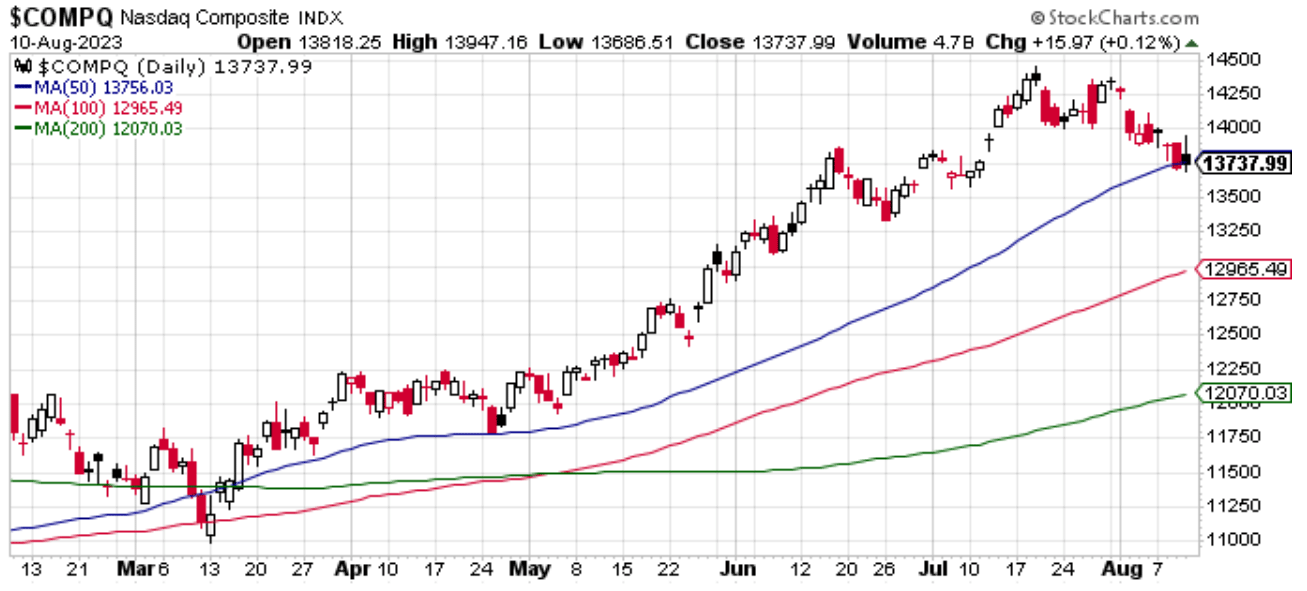
The Nasdaq Composite was hit harder, dropping 1.6%, but still is up 31.3% for the year. It closed today just 18 points below its 50-day moving average, with support at the 100- and 200-day averages pretty far away. I’d like to see this bounce back above the 50dma pretty quickly.
 Click for larger graphic
The small-cap Russell 2000 fell 2.0% and is up 9.1% in 2023.
The fractal dimension looks like it is signaling a consolidation has started that probably will take eight weeks or so to play out. If so, the next trend up should set a new all-time high above 4819 by the end of the year.

Top 5
Changes this week: None
Near-Term – chronological order
TGTX TG Therapeutics – Rapid recovery from overdone pullback
EQT EQT –natural gas price rebound
USL United States 12 Month Oil Fund, LP – crude should rise quickly
FCX Freeport McMoRan – copper shortage this fall
SFTBY SoftBank – for ARM IPO this fall
AKBA Akebia – Vadadustat NDA filing 2023; approval 2024
VLD Velo3D – Rapid revenue growth; low market cap
Long-Term – alphabetical order
EQT EQT – largest US natural gas company
GBTC Grayscale Bitcoin Trust – Bitcoin is headed for $100,000
NVTA Invitae – the winner-take-most of genetic testing
META Meta – a (the?) leader in the metaverse
RKLB Rocket Lab – #2 to SpaceX in space
VLD Velo3D – Return manufacturing to the US
Economy
The Atlanta Fed’s GDPNow model raised its September quarter real GDP forecast to +4.1% due to strength in private domestic investment growth. Once again, it is far above the +0.9% consensus, setting us up for another “surprisingly strong” GDP growth announcement on October 26.
 Click for larger graphic
Coming Events
All times below are ET, and most presentations and slides are archived on the companies’ websites so you can listen to them.
Monday, August 14
QUIK – QuickLogic – 5:30pm – Earnings conference call
Big Tech: The Biotech & Digital Dominators MegaShift
There are at least four ways to make money in the stocks of these large, growing, dominant companies. You can:
* * Buy a stock and hold it
* * Buy a stock and write a call option against it
* * With a Level IV options account, write an out-of-the-money put option
* * With a Level IV options account, write an out-of-the-money put option and use part of the premium to buy an out-of-the-money call option
Apple (AAPL – $177.97) fell after Rosenblatt downgraded the stock from Buy to Neutral with an unchanged price target of $198. They said the June quarter “mixed” results “highlights the slowdown phase in which Apple now sits.”
The debate on Wall Street is whether Apple’s over one billion hardware devices can generate enough high-margin services revenue to grow the company even if smartphone sales stall. I am looking at next month’s iPhone 15 introduction, China and especially India sales, and the early-2024 launch of the Vision Pro spatial computing platform to surprise Wall Street to the upside. AAPL is a Buy under $150 for new iPhone rollouts and augmented/virtual reality products.
SoftBank (SFTBY – $23.62) reported June quarter revenues down 0.9% from last year to $10.85 billion.
On the conference call (SLIDES HERE and TRANSCRIPT HERE), management said the Vision Funds had a quarterly gain on investments for the first time in six quarters, and they are cautiously resuming investments:
 Click for larger graphic
Softback still sells at a substantial discount to net asset value:
 Click for larger graphic
ARM is targeting a $10 billion IPO in mid-September that will give the company a $60 billion capitalization, of which Softbank would own $50 billion. Nvidia and Intel are expected to be anchor investors, and possibly Amazon. The bankers are Goldman Sachs, J.P. Morgan, Barclays and Mizuho Financial. A successful IPO will mark up Softbank’s stock. SFTBY is a Buy under $25 for a first target of $50 in the next two years.
Small Tech
QuickLogic (QUIK – $7.29) reports June quarter results next Monday. Analysts expect $5.0 million in revenues and a loss of two cents a share. They expect September quarter guidance for $5.6 million and breakeven. QUIK is a Buy up to $10 for my $40 target as their sensor hub is widely adopted in smartphones, tablets and wearables.
Primary Risk: New sensor hub competitor emerges.
Rocket Lab USA (RKLB – $6.23) reported June quarter revenues up 11.0% from last year to $62.05 million, just above the $61.79 million consensus estimate. They had a GAAP loss of 10¢ a share, which was in-line.
On the conference call (SLIDES HERE and TRANSCRIPT HERE), management said Neutron testing is underway. They’ve optimized the legs for a barge landing to increases launch availability.
The July Electron launch was #39, more than five times the successful missions of all the new small rocket companies combined.
They guided September quarter revenues to $73 million to $77 million, well below the $82.86 million Wall Street consensus. They expect Launch Services revenue of $30 million from four launches, with Space Systems revenue between $43 million and $47 million. Space Systems uses very conservative accounting for realization of revenues on multi-quarter projects. They expect yo realize those revenues in the December quarter.
On Tuesday, BlackSky contracted for five more Electron launches in 2024. Rocket Lab already has done six successful launches for them. BlackSky finds things from Space, like a near-complete Chinese military naval station in Cambodia or two planes linked to Prigozhin seen at Belarusian airbase.
RKLB is a Buy up to $13 for my $30+ target as low earth orbit satellites and space exploration grow.
Primary Risk: A new competitor emerges.
Velo3D (VLD – $1.81) reported June quarter results after the close today. Revenue was up 28.0% from last year to $25.13 million, but that was short of the $27.22 million estimate. The pro forma loss of 10¢ a share was two cents worse than the 8¢ loss expected.
Although they had record new customer demand in the quarter, they only booked $16 million in new orders due to delayed bookings from existing customers. As a consequence, they reduced their 2023 revenue guidance to $105 million to $115 million compared to the consensus expectation for $121.64 million. The September quarter should be between $25 million and $29 million. Analysts were at $30.22 million.
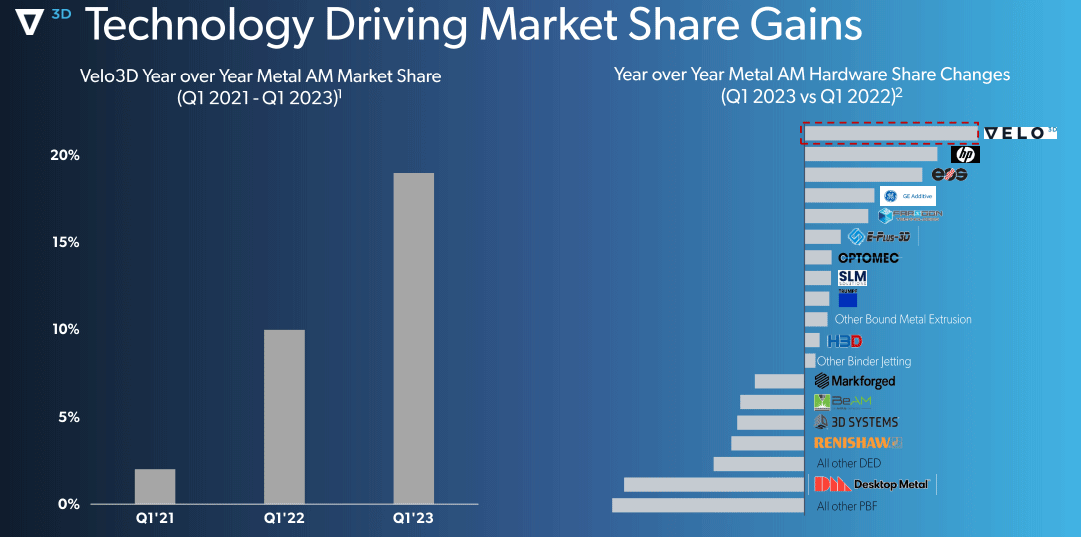
On the conference call (AUDIO HERE and SLIDES HERE), management said they are gaining market share rapidly:
Click for larger graphic
They now have over 100 systems in the field at more than 40 customers. The installed base has grown over 400% in three years. About half of the customers have multiple systems, including 20% with four or more printers. The customer base is well-diversified:
 Click for larger graphic
They announced a $70 million registered direct offering of notes convertible at $2.10 a share that will add to the $47 million in cash they had at the end of the quarter. Wall Street did not like the light guidance and the direct offering, and knocked the stock down over 15% in the aftermarket. This is a gift! VLD is a Buy up to $6 for my $50 target as Velo3D’s high-tolerance metal parts printing business grows.
Primary Risk:A new 3D metal printing competitor emerges.
Biotech MegaShift: The $20-For-$1 Stocks
Say you put $2,000 into a stock that goes from 50¢ a share to $10. The $2,000 turns into $40,000. Then you put the $40,000 into another stock that goes from 50¢ to $10. That turns the $40,000 into $800,000. You did it with two stocks and never risked going negative more than $2,000. (Not that you won’t be mad at me if the first one works and then the second one doesn’t, taking your $40,000 to Money Heaven.)
If you can afford it – and it would not be too big a position in your portfolio – putting $2,000 into each of these speculative biotechs might be a good way to start. Buying these out-of-favor, fallen, or forgotten companies that can get important products through the FDA at very low market capitalizations seems like a good strategy to me.
Risks
Development-stage biotechs are subject to investor sentiment swings from wildly optimistic to excessively pessimistic – mostly the latter recently. After the Primary Risk for each company, I’ve added the clinical stage of their lead product, the probable time of their first FDA approval, and the probable time of their next financing.
As always, you need to think about an appropriate position size. You could buy a full position upfront and then just hold on, or buy some upfront and leave room to add more on the inevitable financings, transient clinical trial setbacks, and the like.
Akebia Therapeutics (AKBA- $1.47) filed a new 10-Q. They reaffirmed 2023 net product revenue guidance of $175 million to $180 million. They said their cash resources will fund the current operating plan through at least the next twelve months. They still expect to resubmit the New Drug Application (NDA) for vadadustat in the current quarter. Buy AKBA up to $2 for the vadadustat lunches in the EU, UK, and (after FDA approval in 2024) the US.
Primary Risk: Vadadustat not approved in the US.
Clinical stage of lead product: Vadadustat NDA to be refiled
Probable time of next FDA approval: Mid-2024
Probable time of next financing: Late 2024 or never
Aptose Biosciences (APTO – $4.00) reported a June quarter GAAP loss of $2.27 per share, worse than the expected $2.01 loss. On the conference call (AUDIO HERE), management said they’ve seen a 44% response rate to the tuspetinib/ventoclax doublet therapy in relapsed or refractory acute myelogenous leukemia (AML) patients who failed prior therapy with venetoclax. These patients have no treatment option.
They finished the quarter with $23.3 million in cash. During the quarter, they entered into a committed equity facility with Keystone Capital that gives Aptose the right to sell Keystone up to $25 million of stock over the next 24 months. They’ll also get $3 million from Hanmi Pharmaceutical, the inventors of tuspetinib, at the end of August and another $4 million after achieving certain manufacturing and data milestones they expect to hit by yearend. APTO is a Buy under $2.50 for a $30 target in a buyout.
Primary Risk: Either drug fails in clinical trials.
Clinical stage of lead product: Phase 2
Probable time of first FDA approval: 2025
Probable time of next financing: Late 2025
Inovio (INO – $0.46) reported a 13¢ loss in the June quarter, a penny better than the consensus. On the conference call (TRANSCRIPT HERE), management said they will start a pivotal Phase 3 trial of INO-3107 in adult recurrent respiratory papillomatosis (RRP) in the March quarter. They are “scaling resources and headcount to align with strategic focus on INO-3107 and late-stage clinical candidates closest to market and with the greatest opportunity to deliver on the promise of DNA medicines for patients.”
Therefore, following a biomarker analysis from the Reveal2 trial, they are stopping investment in VGX-3100 for cervical High-Grade Squamous Intraepithelial Lesion (HSIL) for the US market. They remain committed to supporting their partner ApolloBio’s non-biomarker strategy for the Chinese market. Inovio continues to develop VGX-3100 for anal HSIL.
They further reduced their workforce by 58 employees, or 30%, which will provide annual savings of approximately $9.9 million. They finished the quarter with $194.9 million in cash. This round of headcount reduction extends their cash runway unto the September 2025 quarter. INO is a Buy under $7 for a very long-term hold.
Primary Risk: Their drugs fail in the clinic.
Clinical stage of lead product: Phase 3
Probable time of first FDA approval: 2024
Probable time of next financing: Early 2025
Invitae (NVTA – $1.07) reported June quarter revenues down 11.8% from last year to $120.5 million due to discontinued businesses and geographies. Adjusting for that, revenues grew 1% and were just ahead of the $120.18 consensus. The pro forma loss of 30¢ a share was seven cents better than the -37¢ expected.
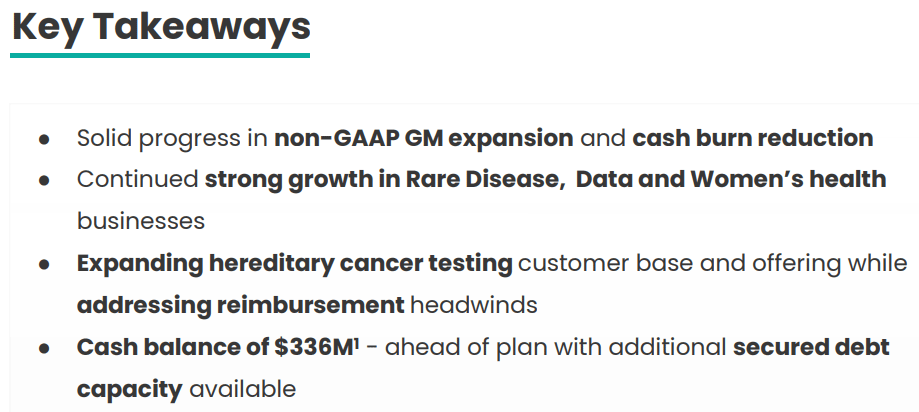
On the conference call (SLIDES HERE and TRANSCRIPT HERE), management said they’ll use even less cash this year than previously expected. They’d previously guided for a $250 million to $275 million burn, and now are forecasting $220 million to $245 million. Both numbers include the $135 million repayment of their term loan in the March quarter, so the change in operating cash burn is even more dramatic, from a range of $115 million to $160 million down to a range of $85 million to $110 million. The new management is really delivering on their promise to slash the cash burn, and Wall Street doesn’t see it yet. They ended the quarter with $336 million in cash.
They did trim their revenue guidance from “over $500 million” to a range of $480 million to $500 million, slightly below the $497.55 million consensus. It was a solid call.
Click for larger graphic
The company got an updated profile from the widely-followed Biotech2k.
Profile
Invitae is a company that does genetic testing using kits. They test for things like Cancer Genetics, Rare Genetic Disease and Women’s Health. They generate over 3 million samples per year and continue to grow. This makes them like the Google of Genomics information.
They allow patients to share their information which can lead to patients getting matched with doctors or scientists who are doing clinical trials that might apply to them. This can provide powerful population level genetics to scientists and researchers alike who are doing research on these diseases.
Management
They just replaced their CEO last year with Ken Knight. So far I like his strategy to cut costs and focus on growing the company in key markets. They have a lot of debt so he has a huge challenge ahead of him. They just did a refinancing of their debt to 2028. They cut costs significantly from $850 million a year in cash burn down to a projected $235 million for 2023. He has really turned around this company while maintaining a good growth rate. They continue to grow revenues while cutting costs.
Science
The Oncology space of genetic testing is expected to grow to over $30 billion a year market size. There is a huge genetics market for oncology as every tumor for every patient is unique. There is a need for multiple tests per patient throughout their course of treatment. There is a high level of relapse rates in cancer which will drive continued testing.
The more we understand oncology the more important the need for genetic profiling of tumors becomes. This space will only continue to grow as personalized cancer treatments become more popular. One of the major current drivers of oncology is the Minimal Residual Detection (MRD) of cancer.

Click for larger graphic
It’s estimated that the Women’s Health space is about a $2.5 billion market. It’s not the reason I would own this company or any other testing company. The key focus is on oncology. The Rare Disease market is one of the primary needs for genetic testing, but it’s not even remotely as big as the oncology market.
 Click for larger graphic
Valuation
Cash is $335 million. They project a 2023 run rate of $480 million a year in sales. At 5x sales for a typical price-to-sales ratio for biotech companies, that comes to $2.4 billion in valuation based on current sales. They have about $1.42 billion in debt. That is a negative to the valuation and has to be deducted. All in, that is a $1.315 billion market cap. Based on the 263.9 million shares outstanding, that comes to $4.98 a share.
h/t @Biotech2k1
Buy NVTA under $10 for a first target of $50 and eventually $100+ when they become the Amazon of genetic testing.
Primary Risk: A competitor starts taking significant market share.
Clinical stage of lead product: NM
Probable time of first FDA approval: NM
Probable time of next financing: Not needed
Medicenna (MDNA – $0.40) completed the MDNA11 dose escalation and began monotherapy dose expansion in their Phase 1/2 ABILITY trial. A late-stage pancreatic cancer patient achieved 80% tumor shrinkage with complete regression observed in two of three metastatic lesions in the liver in response to single-agent MDNA11. They’ve seen durable anti-cancer activity during monotherapy dose escalation in patients with advanced, treatment-refractory cancer without dose-limiting toxicities. Buy MDNA under $3 for a first target of $20, then maybe $40.
Primary Risk: Their drugs fail in the clinic.
Clinical stage of lead product: Entering Phase 3
Probable time of first FDA approval: 2024
Probable time of next financing: March 2024
Inflation MegaShift
Gold ($1,945.90) rejected an attempt to push it under $1,900 and bounced right back to the $1,950 area today. I think it finally is ready to break out to new all-time highs. But the fractal dimension has stalled and may be signaling an early end to the upturn. We shall see. We may have to wait for all-time highs early next year.

Miners & Related
Coeur Mining (CDE – $2.37) reported a disappointing June quarter. Revenues fell 13.2% from last year to $177.2 million, a dramatic $42.83 short of the $220.04 million consensus estimate. The pro forma loss of six cents a share was a penny worse than the five-cent loss estimate.
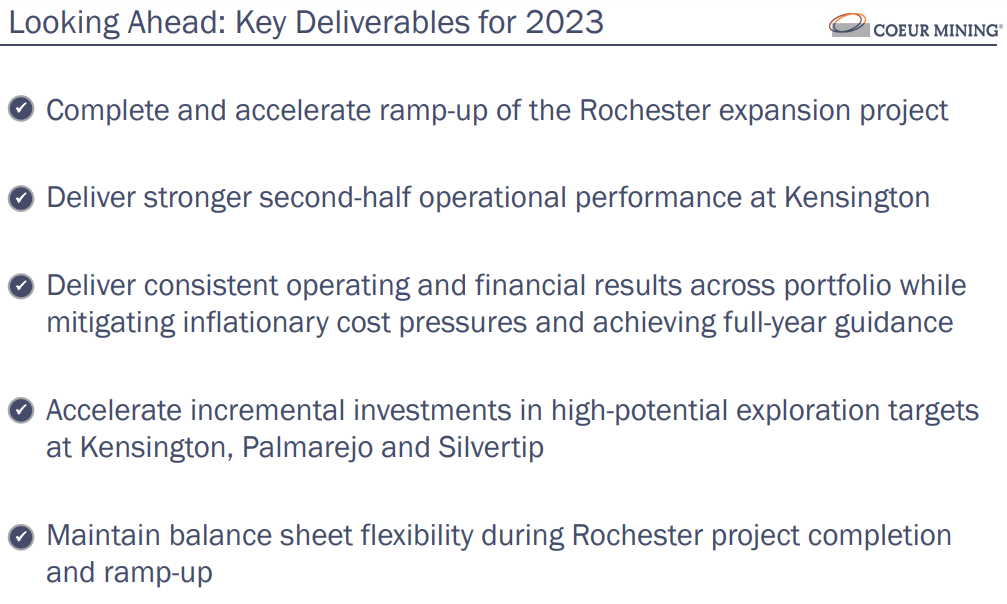
On the conference call (SLIDES HERE and TRANSCRIPT HERE), management said the problem is at the big Kensington gold mine. Excessive water flows and paste backfill issues delayed the timing of production. While they maintained 2023 silver production guidance at 10 million to 12 million ounces, they had to cut this year’s gold production guidance by 5% to 304,000 to 352,000 ounce. At Kensington, the company now expects gold production of 84,000 to 95,000 ounces, down from its previous outlook for 100,000 to 125,000 ounces.
The Rochester Mine expansion project was 97% complete at the end of July with first production expected in August. It will be one of the largest open-pit heap leach mines in the world and deliver low-cost silver and gold at 2.5x higher rates than before the expansion. This is a major game-changer for Coeur.
Click for larger graphic
CDE is a Buy under $5 for a $20 target as gold goes higher.
Primary Risk: Prices of precious metals fall due to US dollar strength.
Sandstorm Gold (SAND – $5.31) reported June quarter revenues up 38.4% from last year to a record $49.8 million, in line with estimates. They earned a penny a share on 24,594 attributable gold equivalent ounces. Their average cash cost per attributable gold equivalent ounce of $228 resulted in cash operating margins of $1,744 per ounce.
On the conference call (INVESTOR PRESENTATION HERE and TRANSCRIPT HERE), management said attributable gold equivalent ounces for 2023 are forecasted to be between 90,000 and 100,000 ounces. Their production forecast is expected to reach approximately 125,000 attributable gold equivalent ounces within the next five years, with a sustainable average annual production of approximately 110,000 attributable gold equivalent ounces over the next 15 years.
That’s way low. Their portfolio includes 250 royalties, of which just over 40 are cash flowing. This year, they decided for forward guidance to only include mines that are permitted or effectively permitted in the hands of companies that will definitely build or are actually building the mines, and who have almost certain access to the capital to build those mines. For example, if it’s a permanent mine, but it’s sitting in a company with only a $100 million market cap and the capital required for the mine is $300 million, they will not include that production in their guidance. SAND is a Buy under $10 for a $25 target.
Primary Risk: Prices of precious metals fall due to US dollar strength.
Sprott Inc. (SII – $34.25) reported June quarter revenues up 101.8% – you read that right – from last year with GAAP earnings of 70¢ a share. Assets under management (AUM) at the end of the quarter were $25.1 billion, down $0.2 billion from the end of March but up $1.7 billion from the end of 2022.
On the conference call (SLIDES HERE and TRANSCRIPT HERE), management said AUM shows steady growth:

Click for larger graphic
They expect a weaker dollar and central bank buying to benefit precious metals prices in the second half of 2023. Buy SII under $40 for a $70 target price.
Primary Risk: Prices of precious metals fall due to US dollar strength.
Cryptocurrencies
Cryptocurrencies are a diversifying asset that offer a unique opportunity to make (or lose!) a lot of money quickly. You can easily buy bitcoin and other cryptocurrencies at Coinbase, Block, or Robinhood.
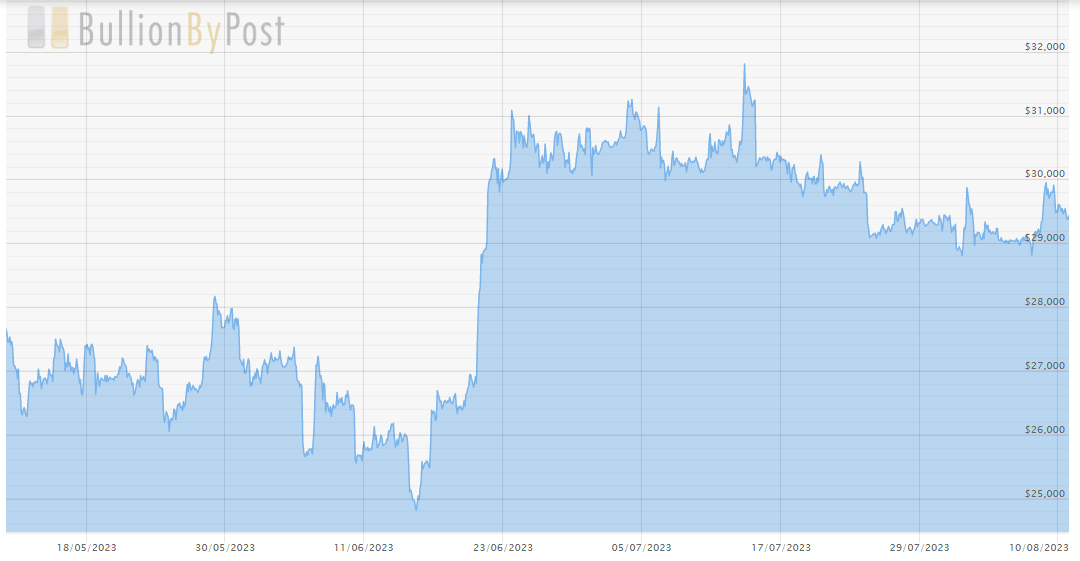
Bitcoin (BTC-USD on Yahoo – $29,462.39) is holding firmly over $29,000. The Fed just announced an oversight program for cryptocurrencies. I suspect that means exchange-traded funds are a done deal.
 Click for larger graphic
BTC-USD, ETH-USD, GBTC, and ETHE are Strong Buys.
Primary Risk: Bitcoin falls due to over-regulation or is surpassed by another cryptocurrency.
Grayscale Bitcoin Trust (GBTC- $19.80) will shoot up when exchange-traded spot bitcoin funds are approved. GBTC is a Buy under net asset value.
Primary Risk: Bitcoin falls due to over-regulation or is surpassed by another cryptocurrency.
Commodities
Oil – $82.87
Oil is well above the 50, 100, and 200 day moving averages. The 50dma is about to cross the 100 day moving average. There’s probably resistance at 86 and 88 to chew through, but oil bottomed out just when hedge funds puked it.

Click for larger graphic
As I expected, demand for oil is accelerating in the second half of 2023.

Click for larger graphic h/t @HFI_Research
At the same time, supply is falling as OPEC+ cuts production and exports:

Click for larger graphic h/t @HFI_Research
The July 2026 Crude Oil Futures (CLN26.NYM – $69.77) are a Buy under $65 for a $200+ target. Only buy futures for all cash; do not use margin.
The United States 12 Month Oil Fund, LP (USL – $37.71) is a Buy under $35 for a $100+ target.
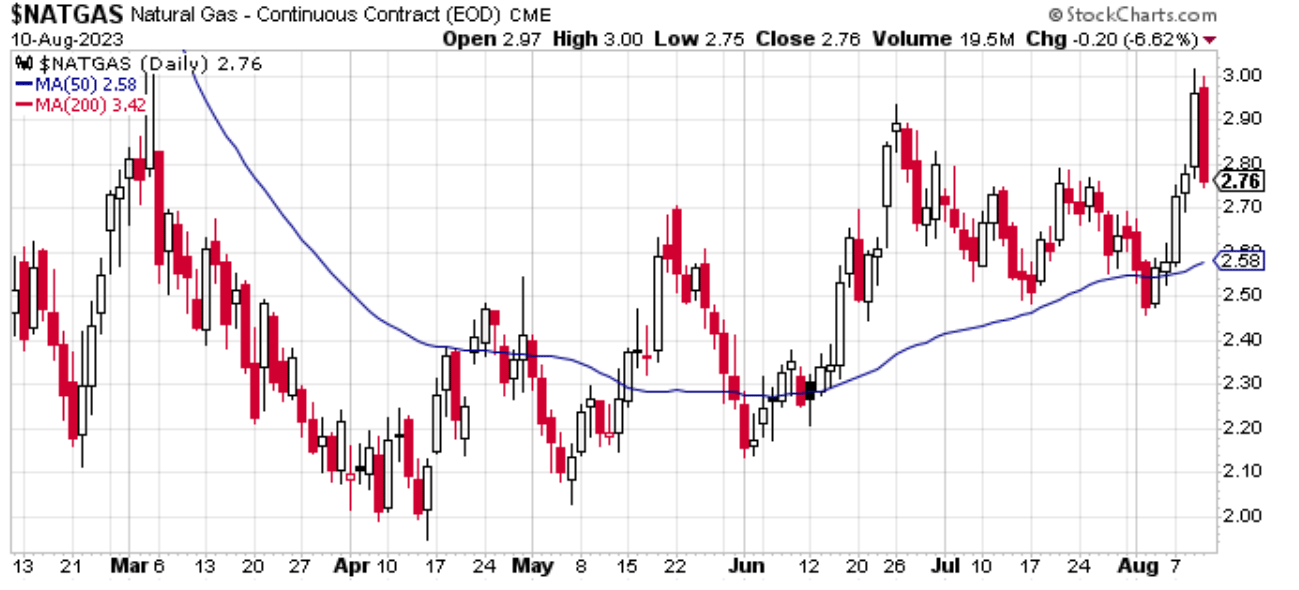
EQT (EQT – $42.80) is going up with natural gas prices, now well above the 50-day moving average and headed for the 200dma at $3.42. Germany’s state-controlled firm, Securing Energy for Europe, signed a 20-year deal with Venture Global LNG to import 2.25 million tons of liquefied natural gas. Other European countries will follow.
Click for larger graphic
EQT is a buy under $35 for a first target of $70 and a long-term hold for much higher prices.
Primary Risk:Natural gas prices fall.
Energy Fuels (UUUU – $6.39) and Vladimir Putin got a gift from the Biden Administration as it blocked development of nearly a million acres of land that includes some of America’s richest uranium deposits. The Antiquities Act of 1906 lets Presidents set aside Federal land for national monuments to protect historic objects. President Obama used the law to remove millions of acres of Federal land from oil and gas development, but he resisted calls to set aside uranium-rich land outside the Grand Canyon. The land includes America’s only source of high-grade uranium ore that is economically competitive on the global market.
Currently, the US imports about 95% of the uranium used for nuclear power reactors, mostly from Kazakhstan, Canada, Russia, and Australia. Russia is the US’s third biggest uranium source. President Biden banned imports of Russian fossil fuels by executive order last spring, but US nuclear plants continue to rely on Russian uranium for 12% of their fuel supply.
UUUU will skyrocket if uranium goes over $100, and even more if it goes over $1,000, as Harris Kupperman thinks is possible. Kuppy answered some questions at an Undervalued Shares lunch in London.
Q: From listening to your videos, Kuppy, it feels like your preferred portfolio would be a massive allocation to physical uranium. What is your plan and thought process for when to sell your physical uranium holdings?
A: I am going to sell when the supply and demand go one of two ways. One way is the price goes up, then we will sell because I was proven right. The other way is a bunch of new mines comes online, and it turns out I was wrong.
I am tracking the mines that are coming online, and I am tracking demand numbers. There is a deficit that is basically funded through depleting warehouse stocks. Eventually, you will have drawn the inventories down, and hopefully the thesis works.
And if, along the way, something changes the supply-demand balances, I hope we would see it in real time and adjust our position.
Right now, there are pretty large deficits. As far as I can tell, the deficits are actually expanding. I am just watching it, but if the facts change, we’ll get out of it. About a quarter of my book right now is specifically uranium, and it is our largest exposure.
Q: Do you have an eventual “dream price,” an eventual target price for uranium?
A: I think if it gets to “escape velocity,” which is above $65. I genuinely think the price will go to at least a few hundred, potentially a few thousand. I think it’s like GameStop (GME), due to the massive functional short interest amongst utilities, the deficits, and the likelihood that retail gets involved and front-runs the utilities.
I believe that retail will be part of the market in uranium. And if it was not retail, it would be family offices. It is very easy to set up a custody account and buy a few million pounds.
Everyone knows the utility companies are functionally short. They need a couple hundred million pounds just to get their inventories back to historical levels. I have never seen a commodity with this kind of deficit. When the price starts to “work,” everyone will pile in and front-run the utilities.
UUUU is a buy under $8 for a $30 target.
Primary Risk: Uranium prices fall.
* * * * *
RIP The Great Robbie Robertson
* * * * *
Try Box Breathing
* * * * *
Your learning 6 Fibonacci types Editor,

Michael Murphy CFA
Founding Editor
New World Investor
All Recommendations
Check out the complete Portfolio page HERE.
Buys
These are the stocks everyone needs to own because transformative events are happening over the next year or two, and I expect to hold them long-term.
Tech Dominators
Apple Computer (AAPL – $177.97) – Buy under $150 for new iPhones
Corning (GLW – $32.65) – Buy under $33, target price $60
Gilead Sciences (GILD – $80.00) – Buy under $80, target price $120
Meta (META – $305.74) – Buy under $250, target price $400
SoftBank (SFTBY – $23.62) – Buy under $25, target price $50
Small Tech
Enovix (ENVX – $16.53) – Buy under $20; 4-year hold to $100+
First Trust NASDAQ Cybersecurity ETF (CIBR – $45.09) – Buy under $40; 3- to 5-year hold
Fastly (FSLY – $19.31) – Buy under $20; 2- to 5-year hold to $80+
PagerDuty (PD – $24.03) – Buy under $30; 2- to 5-year hold
QuickLogic (QUIK – $7.29) – Buy under $10, target price $40
Rocket Lab (RKLB – $6.23) – Buy under $13, target price $30+
Velo3D (VLD – $1.81) – Buy under $6, target price $50
$20-for-$1
Akebia Biotherapeutics (AKBA – $1.47) – Buy under $2, target $20
Aptose Biosciences (APTO – $4.00) – Buy under $10, ultimate target $300
Compass Pathways (CMPS – $8.19) – Buy under $20, hold a long time for a 10x return
Inovio (INO – $0.46) – Buy under $7, hold a long time
Invitae (NVTA – $1.07) – Buy under $10, first target $50, then $100+
Medicenna (MDNA – $0.40) – Buy under $3, first target $20, then maybe $40
ScyNexis (SCYX – $2.99) – Buy under $3, target price $20, then $50
TG Therapeutics (TGTX – $9.70) – Buy under $12 for buyout at $30+
Inflation
A Short-Sale or REO House – ($415,400) – Hold
Bag of Junk Silver – ($22.75/oz.) – hold through silver bull market
Sprott Gold Miners ETF (SGDM – $24.67) – Buy under $28, target price $50
Sprott Junior Gold Miners ETF (SGDJ – $27.76) – Buy under $39, target price $100
Sprott Physical Gold and Silver Trust (CEF – $17.90) – Buy under $18, target price $30
Global X Silver Miners ETF (SIL – $25.76) – Buy under $30, target price $50
Coeur Mining (CDE – $2.37) – Buy under $5, target price $20
First Majestic Mining (AG – $6.09) – Buy under $11, next target price $23
Paramount Gold Nevada (PZG – $0.32) – Buy under $1, first target price $10
Sandstorm Gold (SAND – $5.31) – Buy under $10, target price $25
Sprott Inc. (SII – $34.25) – Buy under $40, target price $70
Cryptocurrencies
Bitcoin (BTC-USD – $29,462.39) – Buy
Grayscale Bitcoin Trust (GBTC – $19.80) – Buy
Ethereum (ETH-USD – $1,851.08) – Buy
Grayscale Ethereum Trust (ETHE – $11.51) – Buy
Commodities
Crude Oil Futures – July 2026 (CLN26.NYM – $69.77) – Buy under $65; $200+ target
United States 12 Month Oil Fund, LP (USL – $37.71) – Buy under $35; $100+ target
EQT (EQT – $42.80) – Buy under $35; $70 first target
Energy Fuels (UUUU – $6.39) – Buy under $8; $30 target
Freeport McMoRan (FCX – $42.38) – Buy under $44; $65 target within two years
International & Other Recommendations
EMQQ Emerging Markets Internet & Ecommerce ETF (EMQQ – $32.38) – Buy under $38 for a $66 target in 12 to 18 months
KraneShares Bosera MSCI China A Share Fund (KBA – $24.47) – Buy under $40 for a three- to five-year hold
Morgan Stanley China A-Shares Fund (CAF – $13.17) – Buy under $18 for a three- to five-year hold
KraneShares CSI China Internet ETF (KWEB – $30.03) – Buy under $40 for a double over the next three years
Acreage Holdings (ACRDF – $0.23) – Buy under $2 for the Canopy Growth merger
Mongolia Growth Group (MNGGF – $0.94) – Buy under $1.30; long-term hold
Holds
These are holds but not sells – yet. They could get moved back to one of the buy categories if their prices drop or outlook improves, or they could become sell recommendations in the future.
Arch Therapeutics (ARTH – $1.54) – Hold for buyout
Graphite Bio (GRPH – $2.63) – Hold until they update their strategy
Publisher: GwynRose LLC, 5348 Vegas Drive, Suite 868, Las Vegas, NV 89108
New World Investor does not act as a personal investment adviser or advocate the purchase or sale of any security or investment for any specific individual. The recommendations and analysis presented to members are for the exclusive use of members. Members should be aware that investment markets have inherent risks and there can be no guarantee of future profits. Likewise, past performance does not assure future results. Recommendations are subject to change at any time. Nothing in this presentation should be considered personalized investment advice. No communication to you by Michael Murphy or any of our employees or contractors should be deemed as personalized investment advice.
Copyright ©GwynRoseLLC 2023
New World Investor Mastermind Group
1. Post unto others as you would have them post unto you.
2. Keep it clean, like a 1950s family television show. Your alter ego can run free on Twitter.
3. NO PERSONAL ATTACKS! If you don’t like the stock, don’t trash the person. Everyone is responsible for their own due diligence and investments.
4. Don’t post here about politics or religion – you aren’t going to change anyone’s mind. Again, NO PERSONAL ATTACKS!
5. The investment implications of something going on in politics or religion is OK.
6. Of course, there’s never a reason to slur someone based on race, religion, gender, sexual orientation, or country of national origin.
7. Please, no snark!
 Print This Post


1st, in a long time.
2
Raising the interest rates is the FED shooting the rest of the government in the foot. With every raise in the interest rate, the payments on the interest on our debt increase exponentially. If the debt increases 5.2 billion PER DAY, the payments just for the interest (let alone payments to the principal) increase exponentially as well. Fitch is right again with the downgrading of our credit rating. There is talk again of going back to the gold standard on our fiat money. Hallelujah. It’s a sure fire way to finally get control of out of control politicians who know no boundaries when it comes to spending. Great RR , MM. Thanks for all the updates on NWI picks.
MM has had a good June and July, ENVX and AKBA come to mind as big winners.
That was then, this is now.
NVTA has no life and appears to be on the verge of breaking $1 to the downside; VLD is getting crushed after earnings and the always very negative announcement that they will raise funds with a convertible debenture (gift to the shorts). TGTX unable to bounce after the huge collapse and making a new low. ENVX and AKBA continue to surrender a big chunk of their recent gains.
Nvta what a pick,looks like the end is near,reverse split coming,buy up to 50.00,
Nvta,looks like most of the insiders sold there shares at much higher prices,probapricbly to alot of us,I for one did,it’s hard to sell this shit at the current price,I for one will ride it one way or the other hoping for some kind of news in the future,learned alot about myself being so gullible in believing most of mm picks,and not believing in my own research
I picked up VLD today. Even the YMB big bear Lazerator who claims they have no sales (FUD) bought some early today at $1.50. VLD seems to be a real company with growing sales of SOTA products with involvement from Elon Musk, NASA, etc. I’ve been watching VLD since it was recommended by MM 2 years ago at $10.
There are some great NWI picks, but you have to wait until all the optimism dies down, and you can get them at a reasonable price.
Totally agree
On VLD, I plan to watch quarterly announcements of revenue, losses. If some improvements, and a lower stock price, that will be another buying opportunity. This is a good longterm speculation.
VLD may provide a nice recovery bounce but I’d be wary holding a position going into the next quarterly announcement.
Their backlog is declining rapidly (2022-Q3 :$66M; 2022-Q4: $43M; 2023-Q1: $24M; 2023-Q2: $16M). They’ve been guiding revenue lower, GM% isn’t ramping as quickly as hoped & they no longer mention a target date for becoming cash flow positive, which was at one point 2023-Q4. Seems there is a better than even chance they again disappoint on metrics and/or future guidance in next quarter’s call.
MM said that Sept quarter revenue would be $25-29 million, when June quarter was $25 million. This would be flat to up a little. Still, you make a good point that VLD may be good for a bounce now, but then back off before the Sept news.
MM, Being one of the Majority of the invisibly taxed and intentionally enslaved americans serfs, I was wandering if this is original text by you???
I read it somewhere. Doesn’t show up on Google search, though.
Arth 2nd quarter earnings are out late on a Friday afternoon, so you know it’s going to be bad. Sales for Q2 were $13,293 (not in 000’s). Net loss for the quarter was ($1,823,107) or (1.42) per share. Cash on hand at 6/30/23 was $86,542. When you look at the Shareholder Liabilities of $9,579,274 you’ll see a substantial amount of convertible notes as well. Definitely looks bleak.
MM Re:
NVTA
Nice reduction in cash burn. The street isn’t recognizing it because I don’t think that’s the number they are focused on. Let’s face it their growth is in oncology and that is relatively flat. They need a bigger piece of that $30 billion piece of pie you keep alluding to. When is that going to happen? Also, part B, how low can they go with cash burn and still maintain adequate R&D and product development and their market leadership? What sort of revenue/revenue growth at this point is required to turn a real profit. Grow or die–how are they addressing growth in the oncology testing sector? That seems to be the area to watch, don’t you think?
All good points. They said: “Despite solid volume growth in our hereditary cancer tests, oncology sales were impacted by lower-than-expected insurance payments and lower fee-for-service revenue.” So they are focused on improving payment rates and the average payment per test.
Revenues will grow as genetic tests become required for more and more cancers. But they need to double revenues to turn profitable.
APTO – During their Q2 conference call Rafael Bejar mentioned registrational trials a couple times in his portion of the presentation & in all cases those trials were framed as future trials that would be based on the current APTIVATE trials. One of those comments is below:
So to summarize our clinical plans, Tuspetinib with its proven breadth of activity and superior safety profile ultimately may address the most sizable market in AML that we are developing in this section. First, the emerging data are guiding us to a registrational trial for accelerated approval with the TUS/VEN doublet and to target AML patients who have failed Venetoclax therapy, a population with great unmet medical need. We expect the data from this trial will inform additional registrational trials for use in triple combinations in front line therapies and finally, for use in the maintenance therapy setting as well.
There was no indication anywhere in the call that the current mono/doublet APTIVATE trials are registrational trials. I emailed APTO IR a couple times in June to get clarification regarding the confusing slide in the presentation deck but never received a response (isn’t responding to investor inquiries one of their primary functions?!). I know what MM posted when he emailed APTO IR but think they may have misunderstood his question.
Chris–good news about only 5 more patients needed for ACXP’s phase 2b trial? How much more time needed to get 5 more patients?
VLD–1 hour ago YMB post.
“Interesting to look at SLM solution, exact same business, same yearly sales of approx 100M$.
SLM has a better margin on manufactured products and it’s valued 600m$ vs 300m$ for V3d”
I doubt SLM is in the EXACT same business as VLD, mainly due to the quality of the printers/ancillary components. How does SLM rate against VLD in this respect? Also, the quality of the customers?
MM?
SLM is a German company mostly owned by Nikon. They make lower-precision printers used for higher-volume production. Not profitable yet. There’s a good intro at https://finance.yahoo.com/news/top-15-3d-printing-companies-195614832.html
Piper Sandler trims price target to .50 from 1.50 maintains underweight rating on nvta,any comments from up above
The Radar Report for 8.17.23 is posted. Added SCYX to Long-Term Top Buys (now Top 7).