

Dear New World Investor:
I had an interesting exchange about PayPal with a subscriber who has been in financial services for over 40 years. He wrote: “Usually hedge funds and institutional investors hold stocks for a long period of time. Retail investors like myself do not unless it’s an AAPL, GOOGL, CMG, or MDGL. Holding PYPL for 3 years is ludicrous and I have friends who are partners in hedge funds in Manhattan and I wanted their opinion on PYPL. Not one positive comment. They also don’t care for the new CEO Alex Criss. Now with AAPL in competition and EBAY launching VENMO which is a sub of PYPL, PYPL might have been a bad recommendation.”
I disagreed with almost every sentence, and I realized this was an opportunity to clarify what I am trying to do in New World Investor, as well as review what I’ve done right and wrong. Let’s go through this sentence by sentence.
Usually hedge funds and institutional investors hold stocks for a long period of time.
I’ve worked in two large institutions and run a hedge fund, and this is the complete opposite of what I’ve experienced. The last institution I worked for, Capital Research/American Funds did try to hold stocks for a long time and, like Warren Buffet (“My favorite holding period is forever”), they were considered oddballs. My sense is the typical institution has about 50% annual turnover, which equals a two-year holding period. Hedge funds have much higher turnover – sometimes days.
Their problem is that the pension funds and wealthy investors want to see quarterly performance and detailed annual reviews. I’ve sat through many of those annual reviews, and the way they go is the pension exec has a list of your year-end holdings, ranked from worst performer to best. All the focus is on the worst performers: “Why did you buy this?” “What went wrong?” “Why haven’t you sold it?”
And God help you if the same name appears at the top of the losers list two years in a row. You are very likely to lose the account or not get further funding. This is why stocks that have underperformed get hit at the end of October (mutual funds’ fiscal years) and December (hedge funds), plus individuals selling for tax losses.
Retail investors like myself do not unless it’s an AAPL, GOOGL, CMG, or MDGL.
That, unfortunately, is partly true. Retail investors often sell quickly or at the first sign of stock weakness. They’ll get a double in Apple from $28 to $56 and sell, then watch the stock sail over $200.
Holding PYPL for 3 years is ludicrous
There are many ways to make money in the market. If you are a great trader like Paul Tudor Jones or Stanley Druckenmiller, who just sold his Nvidia because “I’m not Warren Buffet,” do that. If your point-and-figure charts can outperform Renaissance Technologies’ 700 PhDs with a supercomputer hardwired to the exchanges, do that. But for most retail investors, having a longer time horizon is a Superpower that hedge funds/institutions can’t afford, for the reasons above. Retail investors can.
I have friends who are partners in hedge funds in Manhattan and I wanted their opinion on PYPL. Not one positive comment.
Good! That’s why the stock is cheap. Nobody likes it. Nobody thinks the turnaround will work. Once it is underway, they will turn positive – at higher prices.
They also don’t care for the new CEO Alex Criss.
If they have evaluated Criss’ record at Intuit and don’t think he’s up for the job, of course they shouldn’t buy the stock. My read was (1) he did a GREAT job at Intuit; (2) the strategy he laid out for PayPal made a lot of sense; and, (3) the new hires he’s made have been excellent. What I want to see is, first and foremost, transaction volume growing and, second, building a significant, high-margin digital advertising business from scratch.
Now with AAPL in competition and EBAY launching VENMO which is a sub of PYPL, PYPL might have been a bad recommendation.
This kind of threw me because Apple Pay has been in competition for several years and having Ebay use PayPal’s Venmo is a good thing.
I said above I’d review what I’ve done right and wrong. My strength always has been identifying technology winners, especially Big Tech companies that have been beaten up and can turnaround. That’s why I recommended Apple at $28 in December 2015 and Meta at $160 in April 2018. That’s why I’m recommending Corning, Gilead, and PayPal today. I also am pretty good on pouncing on growth stocks that are (sometimes briefly) undervalued, like SoftBank and Palantir.
I tend to be too early on smaller tech companies like Enovix, Fastly, PagerDuty, Rocket Lab, and especially QuickLogic, which finally has hit the rapid upswing of the S-curve. These are companies that are very well positioned for the future and can be huge winners, but buying them is like venture investing – they’ll win, but it’s hard to tell when.
Then there’s Velo3D. When I recommended the stock, they had $470 million in cash to execute their growth plan.
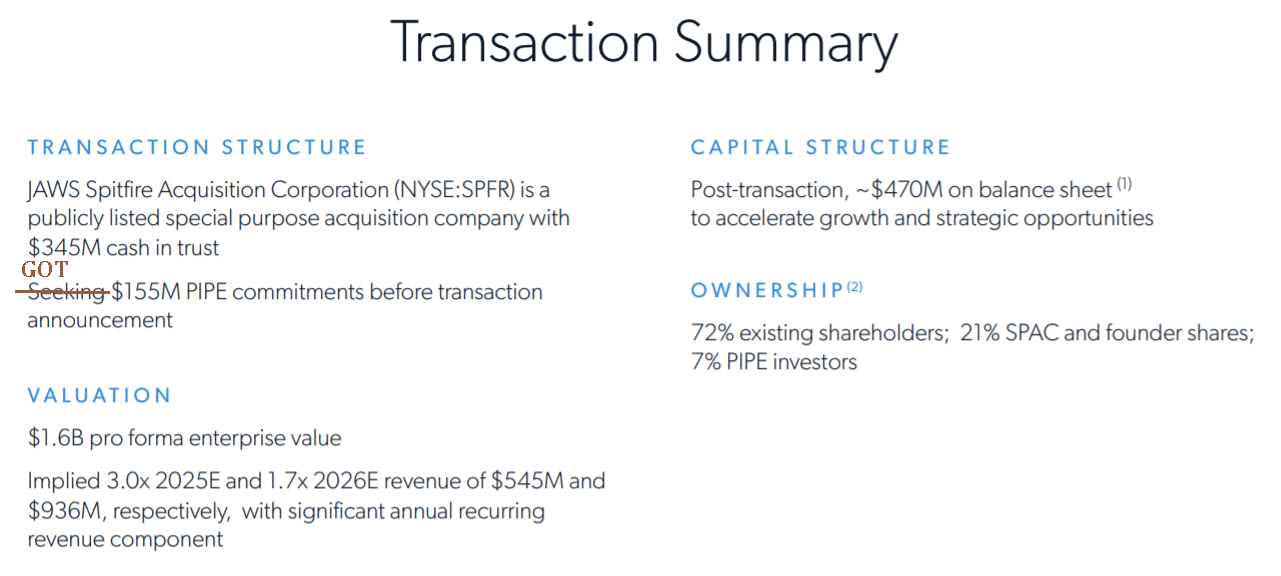 Click for larger graphic
Where I went wrong was not stepping back when their revenue growth fell below plan:
 Click for larger graphic
2022 revenues were $78.7 million – short of the $89 million forecast, but not disastrously so. But 2023 went off the rails at $77.4 million, less than half the $162 million forecast and even below 2022. The former CEO kept spending money and even built a whopping $60.8 million inventory, anticipating sales that never came. There were internal problems outsiders can’t see with their service and installation that caused the sales shortfall and ultimately the dismissal of the CEO.
But I should have realized the sales shortfall – whatever its cause – required slashing spending to preserve cash. The new CEO has done that and Velo3D still has by far the best additive technology, but it remains to be seen if current shareholders will benefit from it. Much depends on them selling down inventory as fast as they’ve projected to generate much-needed cash.
Which brings us to the biotech stocks. I had early success in predicting FDA approvals when Wall Street didn’t believe it with Arena Pharmaceuticals and Dendreon, so I thought I had an advantage. But neither company could turn approval into a growing business – the same is true of Arch Therapeutics – and the initial Akebia turndown made me realize I probably don’t have any better idea of what the FDA will do than the next guy.
So my last two recommendations – AbCellera and Editas – have been of companies that don’t need an FDA product approval to be successful, although in both cases that would be a bluebird. I’m not going to recommend any more biotechs here.
I’ve also spread myself too thin by recommending commodity stocks, including oil, natural gas, uranium, and copper. And bitcoin and ethereum. And international stocks, cannabis, and Mongolia Growth. These areas take a lot my time to analyze and stay current on, which takes away from technology. I still think they are all headed higher, or at least in the case of Acreage Holdings to better times, and they almost all are showing substantial profits. My plan was to follow them until it’s time to sell, probably in 2025 or 2026, and then drop coverage.
But after I’d written the above, Kuppy (Harris Kupperman) wrote The Culling. In it he said: “Eventually, the clutter becomes overwhelming, and I have a culling. I know I need to be ruthless. If I wouldn’t buy more today, then it needs to go. If it’s been there for more than a few quarters, and it’s not playing out, then it needs to go. If the trend has been pushed back by yet another quarter, then it needs to go. It doesn’t matter if it’s cheap, or if I like the CEO. Nothing matters, except freeing up capital and freeing up mental bandwidth. I want to be focused on positions with raging tailwinds, not the dregs of the book.”
So I decided to start culling now. The commodity stocks are headed much higher and need to be held. Bitcoin and ethereum have the ethereum exchange-traded fund SEC approval catalyst dead ahead, so they stay. I’m selling Acreage Holdings, where they screwed the shareholders by changing the terms of the Canopy Growth merger deal, and Mongolia Growth Group, where Federal tax laws prevent Kuppy from continuing to make winning investments or it would be classified as an investment company.
I’ve listed the reasons for each biotech keep or sell below.
One area besides technology that I do know well is insurance. When American Express acquired Fireman’s Fund Insurance I was part of the team integrating Fireman’s Fund’s investment operations into American Express Investment Management. It was an eyeopener for me. Every other industry has a cost of capital to operate. Insurance companies get paid to do business.
And it’s a pretty simple business in theory. You have to pay out for losses less than you take in in premiums – that’s the loss ratio. The expense ratio is calculated by dividing the incurred underwriting expenses by the earned premiums. Adding the two together gives you the combined ratio. Like golf, the lower, the better – you certainly want to see it under 1.0.
For the conservative end of your retirement Barbell Portfolio, insurance companies and big, cash-flowing, dividend-paying tech companies are as good as it gets. I will be recommending both.
* * * * *
There are an awful lot of pundits calling for (wishing for?) a 1929- or 2000-style crash. But…
 Click for larger graphic
Or saying the Fed can’t cut with the S&P setting records. Really, was 1995 that long ago?
 Click for larger graphic
The Magnificent 7 are highly valued but many of the other 493 S&P stocks are not and can pick up the baton to broaden the rally. It feels more like 1997 than 1999, so until something dramatic changes – probably in US or geopolitics – we should stay invested. I do expect a ~150 point drop in the Index at some point before the election, but it will be hard to trade that and be positioned for a resumption of the bull market.
Market Outlook
The S&P 500 added 0.7% since last Thursday to a new record close yesterday and a record intraday high over 5500 today. The Index is up 14.7% year-to-date. The Nasdaq Composite gained 0.3% and also set a new record close yesterday and a record intraday high today. It is up 18.1% for the year. The SPDR S&P Biotech Exchange-Traded Fund (XBI) fell 4.2% as the biotech bear market rolled on. It is still up 0.7% year-to-date, though. The small-cap Russell 2000 dropped another 1.1% and is down 0.5% in 2024, underperforming even the biotechs.
If there’s a 150-point drop ahead, should we have sold in May? It’s a good idea in a bear market. Otherwise, not so much.
 Click for larger graphic
Markets don’t top when retail investors are fearful.
 Click for larger graphic
Nor when institutions are scared to buy.
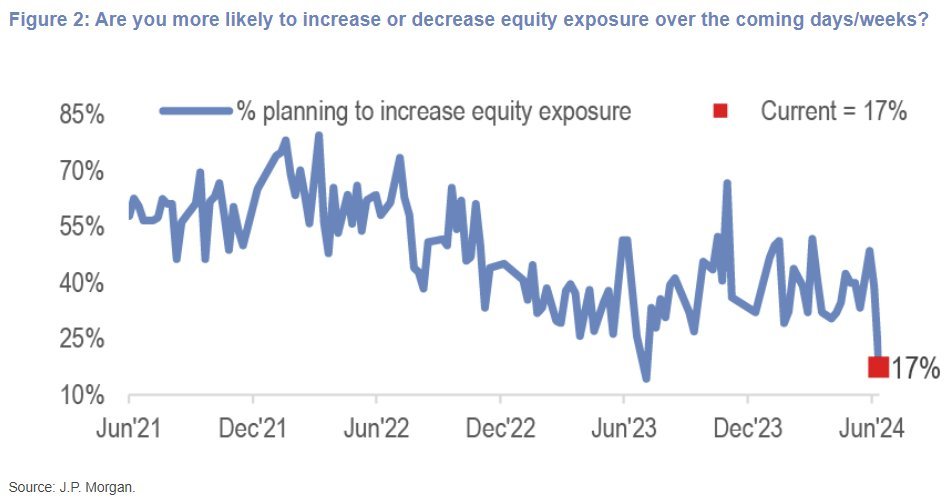 Click for larger graphic
The fractal dimension is setting all-time records for low levels without a consolidation. I don’t expect to see a move this persistent ever again. A ~150 point retracement wouldn’t even fully consolidate the fractals unless it happened in a day or two. Wow.

Top 5
Changes this week:
Near-Term – chronological order
SCYX – ScyNexis – Data releases and resolution of the manufacturing problem
TGTX TG Therapeutics – Rapid recovery from overdone pullback
AAPL Apple – AI announcements at June WWDC and September iPhone 16 introduction
EQT EQT –natural gas price rebound
USL United States 12 Month Oil Fund, LP – crude should rise quickly
FCX Freeport McMoRan – copper shortage
Long-Term – alphabetical order
ABCL AbCelllera – Will become a huge pharma royalty company
EQT EQT – largest US natural gas company
IBIT iShares Bitcoin Trust – Bitcoin is headed for $100,000
META Meta – a (the?) leader in the metaverse
PLTR Palantir – a (the?) leader in AI applications software
RKLB Rocket Lab – #2 to SpaceX in space
SCYX ScyNexis –First new antifungal in 20 years
VLD Velo3D – Return manufacturing to the US
Economy
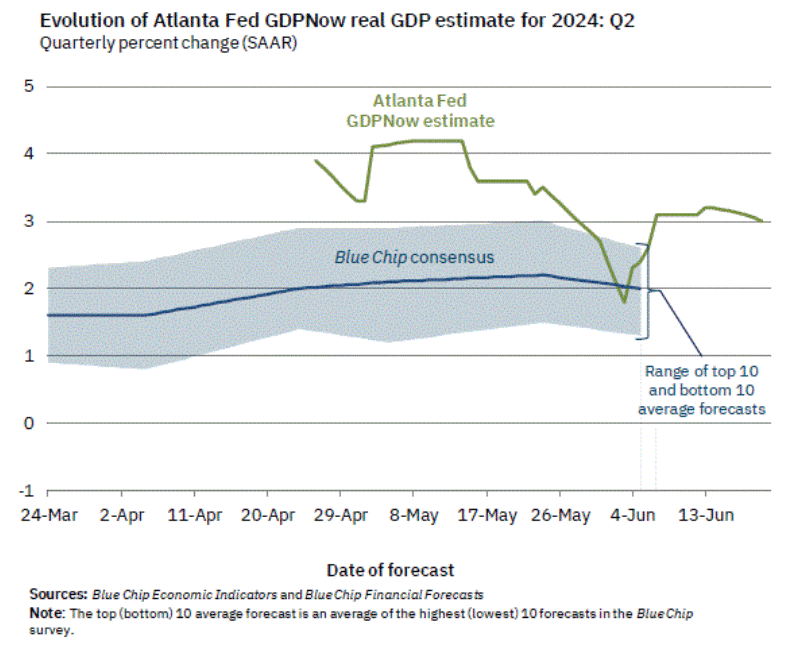
The Atlanta Fed’s GDPNow model forecast for March quarter real GDP growth dropped a tick to 3.0% after the soft housing starts report. They still are a full percentage point above the Blue Chip economists. Get ready for a “surprisingly strong” report on July 25. We’ll find out then if good news is good news – “The economy is strong!” – or good news is bad news – “The Fed won’t cut!”
The demand for temporary help is collapsing. That’s often an early warning of coming economic weakness.
 Click for larger graphic h/t GameofThrones
Coming Events
All times below are ET, and most presentations and slides are archived on the companies’ websites so you can listen to them.
Tuesday, June 25
RKLB – Rocket Lab – Unspec. – Roth London Conference
Wednesday, June 26
Short Interest – After the close
Thursday, June 27
March quarter GDP – 8:30am – Third estimate
Friday, June 28
Personal Consumption Expenditures Index – 8:30am – The Fed’s favorite inflation measure
Big Tech: The Biotech & Digital Dominators MegaShift
There are at least four ways to make money in the stocks of these large, growing, dominant companies. You can:
* * Buy a stock and hold it
* * Buy a stock and write a call option against it
* * With a Level IV options account, write an out-of-the-money put option
* * With a Level IV options account, write an out-of-the-money put option and use part of the premium to buy an out-of-the-money call option
Apple (AAPL – $209.68) is introducing some new features to Apple Services this fall with iOS18. Updates will include US national park hikes and custom walking routes in Apple Maps; the ability to pay with rewards and installments with Apple Pay; new accessibility features in Apple Music; and a redesigned Apple Fitness+ experience to help users make the most of its library of workouts and meditations.
The Information wrote: “Apple has told at least one supplier that it has suspended work on its next high-end Vision headset, an employee at a manufacturer that makes key components for the Vision Pro said. The pullback comes as analysts and supply chain partners have flagged slowing sales of the $3,500 device.
“The company is still working on releasing a more affordable Vision product with fewer features before the end of 2025, the person involved in its supply chain and a person involved in the manufacturing of the headsets said. Apple originally planned to divide its Vision line into two models, similar to the standard and Pro versions of the iPhone, according to people involved in its supply chain and former Apple employees…”
Given the weakening economy, this move makes sense to me.
Dan Ives at Wedbush said Apple “will now own AI in the consumer” and hit a $4 trillion market capitalization in a year. Well…maybe. Wedbush’s job is to write trading tickets and Dan’s optimism has really paid off over the last few years. He thinks the tech bull market will last another two or three years, which is very possible. AI, robotics, and the metaverse are going to transform almost every sector of our lives over the next 10+years, and Apple certainly will grow in that environment.
JPMorgan raised their target price from $225 to $245 and kept their Overweight rating. They raised their iPhone 16 and 17 volume expectations to 250 million units in 2025 and 275 million in 2026 following the Worldwide Developers Conference, which laid out several AI features that will drive an upgrade cycle starting with the iPhone 16 launch this September followed by a cycle peak with the launch of iPhone 17 next year.
They raised their September 2025 fiscal year estimate to $8.10, well above the consensus at $7.26. They also raised their fiscal 2026 estimate to $9.69, far above the $7.64 consensus.
In a dramatic contrast, PhillipCapital (who?) downgraded Apple to Neutral from Accumulate citing recent share price increases. But get this – they raised their target price from $194 (oops) to $220, raised their iPhone unit estimates by 8%, and raised their fiscal 2025 revenue estimates by 5% to account for higher upgrade demand for products. They said they believe the newly announced AI features will likely trigger a new round of replacement cycle, as Apple Intelligence is only compatible with the iPhone 15 Pro/Pro Max and iPads and MacBooks with M series chips. So – downgraded? AAPL is a Buy under $175 for new iPhone rollouts and augmented/virtual reality products.
Corning (GLW – $39.85) was cut to Equal Weight at Morgan Stanley, although the raised their target price from $35 to $38. They still see upside to results through 2024, and remain positive on Corning’s exposure to various megatrends over the long term. However, they think the stock rising about 25% year-to-date discounts the expected demand improvement, so due to a more balanced risk-reward, they downgraded the shares.
They noted that demand from AI datacenter build-outs is an area of near-term upside to Corning’s Optical business. The company said that recent orders imply low single-digit hundreds of dollars of fiber per GPU, and management is expecting 25% growth in the Enterprise business over the next couple of years from the AI opportunity. PhillipCapital thinks demand for AI datacenter builds could add about $300 million to $400 million of revenue to Corning’s Optical business. GLW is a Buy under $33 for the 5G cellular buildout, followed by the smartphone upgrade to use 5G services. My target is $60 in 2025 .
Gilead Sciences (GILD – $68.49) moved up $5.34 today after after announcing that a Phase 3 trial for lenacapavir succeeded when used as a twice-yearly option to prevent HIV infection. Interim data showed lenacapavir as an injectable outperformed Truvada, its once-daily oral PrEP therapy, meeting the trial’s key goals in more than 5,300 women and adolescent girls aged 16–25 in South Africa and Uganda. Lenacapavir demonstrated 100% efficacy in HIV prevention, leading to zero infections.
After reviewing the data, the Data Monitoring Committee recommended an early conclusion to the blinded phase of the trial and that lenacapavir be offered to all trial subjects in an open-label phase. This almost always means FDA approval is assured. GILD is a Long-Term Buy under $80 for a first target of $120.
Meta Platforms (META – $501.70) publicly released five new AI models, including image-to-text and text-to-music generation models, a multi-token prediction model, and a technique for detecting AI-generated speech. Meta releases these under a research-only license and will be able to negotiate royalties on any commercial products that are developed.
The company is rumored to be flattening their structure even more by laying off a number of Vice Presidents, which got the stock above $500 today. Meta had as many as 300 vice presidents last year, but Zuckerberg wants to reduce the number to about 250.
This morning, KeyBanc Capital Markets reiterated their Overweight rating and raised their target price from $475 (oops!) to $540, citing a “meaningful uptick” in ad prices. They said the increase in ad prices is likely due to artificial intelligence-linked progress, with engagement, ad relevance and advertiser return all being boosted. Based on the increase in ad prices, they think Meta is likely to report second-quarter revenue around $38.9 billion, near the high-end of its $36.5 billion to $39 billion range. META is a Buy under $345 for a $400 target in 2024.
Palantir (PLTR – $25.56) CEO Alex Karp did a really good interview with Joe Lonsdale almost a year ago – possibly his best one ever.
PLTR is a Buy under $22 for a $100+ target.
PayPal Holdings (PYPL – $59.80) announced this morning it has hired Srini Venkatesan, one of Walmart’s top tech executives, as its new Chief Technology Officer to head up the company’s push into artificial intelligence. He led a team of 14,000 under Walmart’s US Omni Platforms and Tech organization, which is responsible for building platforms to support the retailer, including elements of the Walmart+ subscription service.
At PayPal, he will oversee technology across the whole company, including AI and machine learning, information security, and product engineering. This is another great hire for the new team.
There were a couple of interesting new articles as investors start to wake up to the PayPal opportunity: PayPal: Is It Dying?
(Spoiler Alert: Far from it!) and I Sold My PayPal Stock in April. I’m Already Second-Guessing That Decision; Here’s Why. PYPL is a Buy under $68 for a double in three years.
SoftBank (SFTBY – $31.88) holds their annual meeting tomorrow in Japan (tonight EDT). We’ll catch up next week. SFTBY is a Buy under $25 for a first target of $50 in the next two years.
Small Tech
PagerDuty (PD – $20.91) was upgraded at Craig-Hallum from Hold to Buy. They raised their target price from $21 to $30, citing improving fundamental trends. They said the company has made material improvements that should bear fruit going forward, while lessening tech layoffs and headwinds should eventually improve topline, customer count, churn, and other metrics.
They wrote: “More importantly, on the Enterprise side, far from taking the Enterprise headwinds sitting down, the team has made meaningful progress in the business. We see the progress in SMB [small and medium business] and Enterprise manifesting in accelerating top line growth in H1 and a more compelling position for the company long term. We believe the current discount to peers is not appropriate and see that gap closing. Our price target of $30 is based on a 27x FCF [free cash flow] or 4.9x revenue multiple.”
PD is a Buy up to $30 for a 2- to 5-year hold as their digital operations management Software-As-A-Service gains market share.
Primary Risk: Digital operations management is a competitive area.
QuickLogic (QUIK – $10.16) joined Intel Foundry’s Accelerator IP and USMAG (US Military/Aerospace/Government) Alliances. The company’s eFPGA Hard IP technology will be available on Intel Foundry’s state-of-the-art 18A process technology. This is important because I expect most military and defense contractor semiconductors to migrate to Intel Foundry over the next 5 to 10 years. QUIK is a Buy up to $10 for my $40 target as their earnings repeatedly surprise Wall Street.
Primary Risk: Customers’ product introductions and associated royalties are unpredictable.
Rocket Lab USA (RKLB – $4.80) hit a four-month high after they signed their biggest launch deal ever for 10 Electron launches in 2025 through 2027 for Japanese Earth observation company Synspective. Rocket Lab has launched four missions for them since 2020 and has two more scheduled for 2024. RKLB is a Buy up to $13 for my $30+ target as low earth orbit satellites and space exploration grow.
Primary Risk: A new competitor emerges.
Velo3D (VLD – $2.80) interim CEO Brad Kreger was appointed permanent CEO. The Board of Directors cited the success of Velo3D’s re-alignment initiatives as well as his implementation of strategic initiatives that have resulted in business momentum over the last six months. He’s done a great job of righting the ship, but he needs to sell some of the bloated inventory to raise non-dilutive cash.
He said: “We are successfully rebuilding our backlog and pipeline as we booked $27 million in new orders from mid-December 2023 through the first quarter of 2024, with $22 million of backlog going into the second quarter of 2024. I am especially encouraged by our increasing opportunities in the defense sector as we are the only US-based AM manufacturer that can meet the high quality and complexity requirements of this industry. Also, our efforts to improve system reliability are paying off as we are seeing increased orders from existing customers as well as continuing to execute on our cost realignment programs to improve margins and cash flow.”
VLD is a Buy up to $10 for my $100 target as Velo3D’s high-tolerance metal parts printing business grows.
Primary Risk:A new 3D metal printing competitor emerges.
Biotech MegaShift
If you can afford it – and it would not be too big a position in your portfolio – putting $2,000 into each of these speculative biotechs might be a good way to start. Buying these out-of-favor, fallen, or forgotten companies that can get important products through the FDA at very low market capitalizations seems like a good strategy to me.
Risks
Development-stage biotechs are subject to investor sentiment swings from wildly optimistic to excessively pessimistic – mostly the latter recently. After the Primary Risk for each company, I’ve added the clinical stage of their lead product, the probable time of their first FDA approval, and the probable time of their next financing.
As always, you need to think about an appropriate position size. You could buy a full position upfront and then just hold on, or buy some upfront and leave room to add more on the inevitable financings, transient clinical trial setbacks, and the like.
AbCellera Biologics (ABCL- $2.94) is a keeper because they will become a huge pharma royalty company as their partners’ drugs get approved over the next 5 to 10 years. Buy ABCL up to $6 for a long-term hold to $30 or more.
Primary Risk: Partnered and owned drugs fail in the clinic.
Clinical stage of lead product: Partnered: Various Owned: Preclinical
Probable time of next FDA approval: 2027-2028
Probable time of next financing: 2026-2027 or never
Akebia Therapeutics (AKBA- $0.94) is a keeper because the Vafseo launch in January will be very successful and transform the company. Buy AKBA up to $2 for the vadadustat launches in the EU, UK, and (after TDAPA approval in December) the US.
Primary Risk: Vadadustat doesn’t sell in the US.
Clinical stage of lead product: Approved
Probable time of next approval: TDAPA January
Probable time of next financing: Never
Aptose Biosciences (APTO – $0.80) is a sell because even though the tuspetinib/venetoclax/hypomethylating agent (TUS/VEN/HMA) triplet is likely to work, get early approval, and be a commercial success, the company will have to steadily dilute current shareholders to get over the finish line. Sell APTO.
Primary Risk: Either drug fails in clinical trials.
Clinical stage of lead product: Phase 2
Probable time of first FDA approval: 2027
Probable time of next financing: Mid-2024
Arch Therapeutics (ARTH – $1.00) is a sell because even though I was right about FDA approval after a very low cost of development, and right about the power of AC5 technology, they can’t sell it. The VA would rather pay to have vets’ feet amputated and ongoing rehab than spend $400 on AC5. ARTH is a Sell.
Primary Risk: AC5 fails to sell or the internal trial fails.
Clinical stage of lead product: External approved. Internal trial 2024
Probable time of first FDA approval: External done. Internal 2025
Probable time of next financing: September 2024 quarter
Compass Pathways (CMPS – $6.32) is a keeper. Question: If a competitor with a sketchy Phase 3 trial of a completely different drug for a completely different problem gets an FDA advisory turndown, how much should CMPS decline?
Answer: 17.6%, because that’s been the wisdom of the market after Lykos Therapeutics was turned down 9-2 for MDMA for post-traumatic stress disorder (PTSD) on June 5. Of course, it was the computerized bots selling the headline that knocked CMPS down, but there’s been no recovery.
Compass has very carefully brought COMP-360 psilocybin for treatment-resistant depression (TRD) through development with FDA guidance every step of the way. It works. They’re going to get approval. They’re putting an extensive distribution network in place as they complete their two Phase 3 trials. If you think weight-loss drugs were exciting, wait until you see the market uptake of an effective TRD drug. CMPS is a Buy under $20 for a very long-term hold to a 10x.
Primary Risk: Their drugs fail in the clinic.
Clinical stage of lead product: Phase 3
Probable time of first FDA approval: 2026
Probable time of next financing: Late 2025
Editas Medicine (EDIT – $5.04) is a keeper because they hold the basic patents on gene editing and will collect large royalties for years.
At the European Hematology Association (EHA) Annual Congress, they presented new safety and efficacy data from the EdiTHAL trial of reni-cel in seven patients with transfusion-dependent beta thalassemia. All patients maintained hemoglobin levels above the transfusion threshold and are transfusion-free after reni-cel infusion. 100% success.
They also reported new safety and efficacy data from the RUBY trial of reni-cel in 18 patients with sickle cell disease. All patients are free of vaso-occlusive events after reni-cel infusion. Patients had early normalization of total hemoglobin with a mean within the normal range and rapid and sustained improvements in fetal hemoglobin well above levels of 40%. Again, 100% success. Of course, reni-cel was safe and well-tolerated.
As I said above, Editas doesn’t need approval of reni-cell to be a winning stock, but it’s looking good so far. EDIT is a Buy under $6 for a double in 12 months and a long-term hold to much higher prices.
Primary Risk: Other companies’ gene-sequencing drugs fail in the clinic.
Clinical stage of lead product: Partnered: Approved; Owned: Preclinical.
Probable time of next FDA approval: 2025
Probable time of next financing: 2026 or never
Inovio (INO – $8.07) is a keeper because the are finally going to get approval for a DNA drug in 2025 and have an extensive pipeline behind it. INO is a Buy under $14 for a very long-term hold.
Primary Risk: Their drugs fail in the clinic.
Clinical stage of lead product: Phase 3
Probable time of first FDA approval: Mid-2025
Probable time of next financing: After FDA approval in 2025
Medicenna (MDNAF – $1.21) is a keeper for two reasons. First, MDNA11 is a much better drug than Proleukin and will get approval. Second, management was so smart they did not do a reverse split, told Nasdaq to stuff it, and made their Canadian listing the main market. Buy MDNAF under $3 for a first target of $20, then maybe $40.
Primary Risk: Their drugs fail in the clinic.
Clinical stage of lead product: Entering Phase 3
Probable time of first FDA approval: 2025
Probable time of next financing: 2025
ScyNexis (SCYX – $1.88) is a keeper for an announcement of the new manufacturing agreement for ibrexafungerp, the the resumption of Brexafemme sales by GSK, and approvals for hospital use. Buy SCYX under $2.50 for a first target price of $20 after ibrexafungerp is approved for hospital use and a buyout at $50.
Primary Risk: Ibrexafungerp fails to sell.
Clinical stage of lead product: Approved
Probable time of next FDA approval: 2024
Probable time of next financing: Never
TG Therapeutics (TGTX – $16.98) is a buy for continued growth in Briumvi sales and a buyout. Buy TGTX under $12 for a target price in a buyout of $30 or more.
Primary Risk:Briumvi, the MS drug, fails to sell.
Clinical stage of lead product: Approved
Probable time of next FDA approval: NM
Probable time of next financing: Never
Inflation MegaShift
Gold ($2,373.60), as you know, has been heavily bought by central banks. They don’t plan to slow down. “The highest percentage of central bankers in at least six years expect their holdings of gold to increase, according to a closely watched survey released Tuesday. The World Gold Council’s annual survey, which polled 70 bankers, found 29% of the central bank respondents plan to increase their gold reserves in the next 12 months, the highest level since the survey began in 2018.”
 Click for larger graphic
There’s a Bloor Street Capital virtual gold conference on Saturday at 10:00am EDT sponsored by Sprott. If you’re interested, REGISTER HERE.
Silver seems firmly over $29, its breakout level.
 Click for larger graphic
The fractal dimension is consolidating rapidly to the 55 level without a big hit to the price of gold. This is a healthy way to build up energy for the next uptrend.

Miners & Related
Sandstorm Gold (SAND – $5.48) has a significant gold stream on Ivanhoe Mines’ platinum group metals (PGM) Platreef Project, located in northeast South Africa. It is within the Bushveld Igneous Complex’s northern limb, which is the world’s largest source of platinum group metals. Sandstorm has a 37.5% gold stream at $100 an ounce until 131,250 ounces are delivered. They then get 30% of the gold, still at $100 an ounce, until 256,980 cumulative ounces are delivered. After that they get 1.875% of the gold at 80% of the spot price.
Platreef is a development-stage project which contains a large new discovery of PGM, nickel, copper, and gold. The project is owned by Ivanhoe Mines (64%), a Japanese consortium of Itochu, JOGMEC and Japan Gas Corporation (10%), and a group of local communities organized through the Broad-Based Black Economic Empowerment Initiative (26%). The project contains thick zones of high-grade mineralization located at depths of 800–1,200 meters below surface that will be developed as an underground mine, initially with two vertical production shafts. The deposit currently ranks as one of the largest precious metals deposits being developed in the world.
SAND is a Buy under $10 for a $25 target.
Primary Risk: Prices of precious metals fall due to US dollar strength.
Sprott Inc. (SII – $42.64) closed their initial public offering of the Sprott Physical Copper Trust (COP.U), raising $100 million. The Trust is a closed-end trust that will hold substantially all of its assets in physical copper. Buy SII under $40 for a $70 target price.
Primary Risk: Prices of precious metals fall due to US dollar strength.
Cryptocurrencies
Cryptocurrencies are a diversifying asset that offer a unique opportunity to make (or lose!) a lot of money quickly. You can easily buy bitcoin and other cryptocurrencies at Coinbase, Block, or Robinhood.
Bitcoin (BTC-USD on Yahoo – $64,936.30) has been weak since the halving, which has happened in the past for a bit before the next upleg begins. I am hearing that etherum exchange-traded funds could be approved before the July 4 holiday. That would boost both etherum and bitcoin.

Click for larger graphic
BTC-USD, ETH-USD, IBIT, and ETHE are Strong Buys.
Primary Risk: Bitcoin falls due to over-regulation or is surpassed by another cryptocurrency.
iShares Bitcoin Trust (IBIT- $37.04) remains the cheapest and easiest way to buy bitcoin. IBIT is a Buy for the 2028, 2032, and 2036 halvings.
Primary Risk:Bitcoin falls due to over-regulation or is surpassed by another cryptocurrency.
Ethereum (ETH-USD on Yahoo – $3,496.90) will jump when the spot exchange-traded funds are approved. ETH-USD is a Buy.
Primary Risk: Bitcoin extensions outperform Ethereum.
Grayscale Ethereum Trust (ETHE- $32.77) is now trading at a discount to net asset value of only about 1.5%, but it’s still a timely buy for the fund approvals. ETHE is a Buy under net asset value.
Primary Risk:Ethereum falls due to over-regulation or is surpassed by another cryptocurrency.
Commodities
Oil – $82.34
The crude draw this week was reported at 2.55 million barrels, but the Energy Information Administration’s badly flawed “modified adjustment” understated the draw (again), this time by about 3.5 million barrels. Rumor has it that President Biden is about to start another round of Strategic Petroleum Reserve releases to depress gasoline prices. The Saudis have a different idea:
 Click for larger graphic h/t @HFI_Research
There’s no weakness in US demand:
 Click for larger graphic h/t @HFI_Research
The July 2026 Crude Oil Futures (CLN26.NYM – no trades – ref price $69.85) are a Buy under $70 for a $200+ target. Only buy futures for all cash; do not use margin.
The United States 12 Month Oil Fund, LP (USL – $40.42) is a Buy under $40 for a $100+ target.
Energy Fuels (UUUU – $6.10) hired Debra Bennethum as Director, Critical Minerals & Strategic Supply Chain. She is a chemical engineer who previously served as the EV Critical Minerals Manager in the Global Purchasing and Supply Chain Division of General Motors, and previously as the Program Purchasing Manager for GM’s Battery Electric Vehicles and Crossovers division.
Her job at GM was to execute supply strategies to ensure resilient EV critical mineral supply chains, which included the REEs for production of permanent magnets as well as battery critical minerals. She will focus on Energy Fuel’s REE sales and marketing enterprises, including cultivating relationships with original equipment manufacturer and other customers, negotiating supply, offtake and/or other agreements for their REE products, evaluating REE collaborations in metal-making, alloying, and/or magnet-making, and assisting in evaluating, and potentially pursuing, government funding and other support.
Management said they achieved commercial production of “on-spec” separated neodymium praseodymium (NdPr) at the White Mesa Mill in Utah. This is the first time in several decades that a US company has produced on-spec separated REEs from monazite on a commercial scale. The NdPr meets the applicable product specifications of REE metal-makers, who specialize in the manufacture of REE-based alloys required for the permanent magnets widely used for electric motors in both battery-powered electric vehicles and dual power hybrids.
Following completion of NdPr production at White Mesa, the company expects to begin processing uranium ore and alternate feed materials from current stockpiles, resulting in the expected production of 150,000 to 500,000 pounds of U3O8 during 2024, with production ramping up further in 2025. The Senate just passed the bipartisan ADVANCE Act with a decisive 88-2 vote, aimed at boosting nuclear energy deployment. It’s passed the House and President Biden said he’ll sign it.
Oddly, Roth MKM downgraded UUUU from Buy to Neutral and trimmed their target price slightly from $6.50 to $6.25, citing increased risks as the company diversifies into the rare earths sector through its joint venture deal to earn a 49% interest in the Donald rare earth project in Australia. Roth said the deal is “another step on the road to diversifying the company away from a primary uranium producer and that there may be some uranium-focused investors who prefer alternative uranium investments that are pure plays.”
But they also said the rare earths sector is highly competitive (true) in part due to significant control by China (true), and said rare earths companies lacking ties to China “have found it difficult to compete economically with Chinese-controlled entities due to a range of reasons.”
Hello! Have you heard about people being worried about China’s control of rare earths? And the need for a reliable US supplier? It’s a thing! UUUU is a buy under $8 for a $30 target.
Primary Risk: Uranium prices fall.
International & Other Recommendations
Acreage Holdings (ACRDF – $0.29) is a sell. I did not expect marijuana prices to collapse, but they have. Growers in California and Oregon are giving up and selling properties at a substantial loss.
Although Acreage is a grower, they are vertically integrated with a good retail network and will survive. But they changed the terms of the impending merger into Canopy Growth USA that hurt current shareholders, so I’m out. Sell ACRDF.
Primary Risk: Canopy Growth does not acquire the company.
Mongolia Growth Group (MNGGF – $1.12) was a way to participate in Kuppy’s portfolio management, but he’s now hamstrung by the US tax code. He’s probably going to liquidate Mongolia Growth in a way that will be completely fair to shareholders, but we won’t miss much by selling today. Sell MNGGF.
Primary Risk: Harris Kupperman makes bad investments.
* * * * *
RIP Donald Sutherland
The Best Actor to Never Be Nominated for an Oscar
And goodbye to the great Willie Mays, May 05, 1931-June 17, 2024
* * * * *
The US is projected to gain 3,800 millionaires from overseas in 2024—the second biggest recipient after the UAE.
 Click for larger graphic h/t @WinfieldSmart
* * * * *
Your exploring Chat-GPT for free Editor, Editor,

Michael Murphy CFA
Founding Editor
New World Investor
All Recommendations
Priced 6/20/24. Check out the complete Portfolio page HERE.
Buys
These are the stocks everyone needs to own because transformative events are happening over the next year or two, and I expect to hold them long-term.
Tech Dominators
Apple Computer (AAPL – $209.68) – Buy under $175 for new iPhones
Corning (GLW – $39.85) – Buy under $33, target price $60
Gilead Sciences (GILD – $68.49) – Buy under $80, target price $120
Meta (META – $501.70) – Buy under $345, target price $400
Palantir (PLTR – $25.56) – Buy under $22, target price $100+
PayPal (PYPL – $59.80) – Buy under $68, target price $136
SoftBank (SFTBY – $31.88) – Buy under $25, target price $50
Small Tech
Enovix (ENVX – $11.93) – Buy under $20; 4-year hold to $100+
First Trust NASDAQ Cybersecurity ETF (CIBR – $54.97) – Buy under $40; 3- to 5-year hold
Fastly (FSLY – $7.00) – Buy under $14; 3- to 5-year hold to $80+
PagerDuty (PD – $20.91) – Buy under $30; 2- to 5-year hold
QuickLogic (QUIK – $10.16) – Buy under $10, target price $40
Rocket Lab (RKLB – $4.80) – Buy under $13, target price $30+
Velo3D (VLD – $2.80) – Buy under $10, target price $100
$20-for-$1 Biotech
AbCellera Biologics (ABCL – $2.94) – Buy under $6, target $30+
Akebia Biotherapeutics (AKBA – $0.94) – Buy under $2, target $20
Compass Pathways (CMPS – $6.32) – Buy under $20, hold a long time for a 10x return
Editas Medicines (EDIT – $5.04) – Buy under $6 for a double in 12 months and a long-term hold to much higher prices
Inovio (INO – $8.07) – Buy under $14, hold a long time
Medicenna (MDNAF – $1.21) – Buy under $3, first target $20, then maybe $40
ScyNexis (SCYX – $1.88) – Buy under $3, target price $20, then $50
TG Therapeutics (TGTX – $16.98) – Buy under $12 for buyout at $30+
Inflation
A Short-Sale or REO House – ($415,400) – Hold
Bag of Junk Silver – ($30.77) – hold through silver bull market
Sprott Gold Miners ETF (SGDM – $27.02) – Buy under $28, target price $50
Sprott Junior Gold Miners ETF (SGDJ – $32.73) – Buy under $39, target price $100
Sprott Physical Gold and Silver Trust (CEF – $22.58) – Buy under $18, target price $30
Global X Silver Miners ETF (SIL – $32.51) – Buy under $30, target price $50
Coeur Mining (CDE – $5.87) – Buy under $5, target price $20
First Majestic Mining (AG – $6.39) – Buy under $11, next target price $23
Paramount Gold Nevada (PZG – $0.43) – Buy under $1, first target price $10
Sandstorm Gold (SAND – $5.48) – Buy under $10, target price $25
Sprott Inc. (SII – $42.64) – Buy under $40, target price $70
Cryptocurrencies
Bitcoin (BTC-USD – $64,936.30) – Buy
iShares Bitcoin Trust (IBIT – $27.04) – Buy
Ethereum (ETH-USD – $3,499.11) – Buy
Grayscale Ethereum Trust (ETHE – $32.77) – Buy
Commodities
Crude Oil Futures – July 2026 (CLN26.NYM – no trades) – Buy under $70; $200+ target
United States 12 Month Oil Fund, LP (USL – $40.42) – Buy under $40; $100+ target
Vermilion Energy (VET – $11.29) – Buy under $11; $24 target
EQT (EQT – $37.76) – Buy under $35; $70 first target
Energy Fuels (UUUU – $6.10) – Buy under $8; $30 target
Freeport McMoRan (FCX – $49.36) – Buy under $44; $65 target within two years
Sell
Aptose Biosciences (APTO – $0.80)
Arch Therapeutics (ARTH – $1.00)
Mongolia Growth Group (MNGGF – $1.12)
Acreage Holdings (ACRDF – $0.29)
Publisher: GwynRose LLC, 5348 Vegas Drive, Suite 868, Las Vegas, NV 89108
New World Investor does not act as a personal investment adviser or advocate the purchase or sale of any security or investment for any specific individual. The recommendations and analysis presented to members are for the exclusive use of members. Members should be aware that investment markets have inherent risks and there can be no guarantee of future profits. Likewise, past performance does not assure future results. Recommendations are subject to change at any time. Nothing in this presentation should be considered personalized investment advice. No communication to you by Michael Murphy or any of our employees or contractors should be deemed as personalized investment advice.
Copyright ©GwynRoseLLC 2024
New World Investor Mastermind Group
1. Post unto others as you would have them post unto you.
2. Keep it clean, like a 1950s family television show. Your alter ego can run free on Twitter.
3. NO PERSONAL ATTACKS! If you don’t like the stock, don’t trash the person. Everyone is responsible for their own due diligence and investments.
4. Don’t post here about politics or religion – you aren’t going to change anyone’s mind. Again, NO PERSONAL ATTACKS!
5. The investment implications of something going on in politics or religion is OK.
6. Of course, there’s never a reason to slur someone based on race, religion, gender, sexual orientation, or country of national origin.
7. Please, no snark!
 Print This Post


Glad to see we are finally pulling the plug on ARTH.
On AKBA – it seems like we’ll have a chance to buy at lower prices during the December period when YTD losers are culled from portfolios since there isn’t really a near term catalyst to drive the price. I sold a portion of my AKBA holdings after the move up over $2.00 – in retrospect I should have sold more.
Thanks for the updates.
I expect AKBA to move up as we get closer to TDAPA approval. Even though that’s a done deal, short-termers and computer bots won’t buy until it’s imminent.
Very interesting your comments Michael in response to the PayPal queries and that “retail investors can hold”. I agree.
I have some Berkshire – a few Baby Bs I bought in the late 90s and early 20s – I have a note next to it “never sell”. I don’t have time to trade and don’t want to.
Years ago in CTSL you recommended Apple and mentioned that one the Saudi Sheiks had just bought in big, when Apple was about $2 and on its knees. I was in Hawaii not long afterwards and passed an Apple Store cram packed with people buying the 1st iPods and the odd Mac.
So I decided to buy Apple stock – partly based off your recommendation, partly the Sheik story, partly on the store being full, partly my experiences with Apple and these new products.
I’m just a small time investor but I have never sold these 2 stocks.
I guess what I’m trying to say is length of time in years in the market is the only big advantage the retail investor has. If something is clicking along at 10+% per year, I’m happy with that.
Best wishes, and thank you.
MM–I appreciate your introductory admission about your mistakes. Still, a few blind spots. Buffett buys high quality stocks that can be held forever almost all the time. This is NOT true of any of your small stock recommendations. They must be traded intelligently. Even if we are not good traders, that is better than buying at your rec prices. There are high risks that the financial situations will deteriorate. Big case in point–VLD. All of the YMB posters, most of whom are amateurs, recognize bad financial facts which you still ignore. I am now one of the biggest bulls there, but yesterday even they didn’t support my posts. Due to all the dilution, your reduced buy and target prices are still way out of line with current financial realities. The odds of ever getting to even your buy price up to $10 is dropping to small numbers, and the risk of bankruptcy is real. You still are telling pie in the sky stories about how they are going to get all those defense contracts. I believe in due time, they will come, but not before bankruptcy happens or they have to settle for buyout at very low prices. Currently with PPS at $2.80 (8 cents pre reverse split), I call VLD a buy below $5.00 at the most, with a highly optimistic target about $50. If they ever hit $50, that will still be an 86% loss from your recommended price at $350 (adjusted for the reverse split). Whatever stocks you recommend, do realistic financial analysis every step of the way, so that 99.5% losses don’t merely become 90% losses. For me, at my average cost of $15.40 (pre split at 44 cents), I will be lucky to breakeven, if not make a modest gain eventually in a few years, after long suffering and much waste of time with little to show for it. Other subscribers have possibly had financial stress-induced heart disease and cancer. If not, greatly reduced life expectancy. This is serious. GET WITH IT. PLEASE. Culling will help.
Your general market analysis is excellent. You do an excellent job of financial analysis of the macro picture, but why don’t you do the same quality financial analysis of VLD and other risky stocks?
At the risk of repeating myself yet again, the ONLY thing that matters at VLD is revenues. They have a huge amount of inventory that can be turned into cash. Even though the GAAP profits won’t be great, because these systems were built with higher-cost parts due to supply chain issues, the CASH FLOW is crucial. If they can hit their revenue guidance in the June, September, and December quarters, they will be out of the woods.
True, except that even you questioned whether they would be cashflow even at end 2024. You think it will be 2025. And you are STILL not recognizing that high dilution that will be necessary and the severe cash crunch will cut target prices considerably. If cashflow even is in 2025, they will have to dilute even more severely, creating a high risk of bankruptcy or a survival target of near nothing, and a nearly 100% loss for nearly all subscribers. All this will happen because they accumulated too much debt. Which state of affairs is worse–VLD or the US? VLD for sure. Both are bad, but VLD is like a banana republic within the US. Subscriber Brent long ago recognized this with VLD and APTO–where were you? Finally, you are selling APTO, but up until your sell decision, you had a $300 target for APTO. On NVTA you bought more at the last minute, even after you knew bankruptcy was likely. PLEASE recognize reality and revise your target prices, before it is too late.
so we now hear all the Meghas including APTO are sells . For folks like me it is the end of the long hope and wait – sad to say but ends in disaster.
TO:M. MURPHY
Are your VLD targets (Buy under 1, target 10) pre split or after split?
I thought you had a target of 10 prior to split. Current value is 2.80. Do you think it will go below 1? Since I have 1 share for every 35, I would have hoped the target would have been up.
If the Aug Q2 earnings report shows few bookings, the stock will crater even from here to $1 or below, followed by bankruptcy soon after that. At $1, that would be a loss of $349 from the original buy price of $350 after the reverse split. That’s a 99.71% loss DISASTER. Instead of life changing returns for the better, that’s a life SHORTENING result. Your money will outlive you—haha NOT!!
MM’s VLD buy below/target is now $10/$100. Pre reverse split this was $0.2857/$2.857. MM’s target pre split was $10, or $350 now. Study my post from today, and Brent’s recent financial analysis. Brent has been the most realistic contributor on NWI. He recently called the severe dilution that APTO would have to take soon in order to survive. MM listened and is now selling APTO at a YUGE loss. Suffering after many years.
Pre split. Now $10 and $100. Fixed, thanks.
MM–repost of your post and my reply about AKBA. At 91 cents this AM, the stock is plunging even faster. While they sit on their asses doing pre-launch work that should have been done months before, there likely will be opportunities to buy at as low as 60 cents. Please address.
MM says–They are doing all the necessary pre-launch work, talking to doctors and getting insurance coverage. I expect they want a big launch so by the end of the TDAPA period they are the first choice, They have plenty of money: “Cash and cash equivalents as of March 31, 2024, were approximately $42.0 million. Akebia expects its existing cash resources and cash from operations will be sufficient to fund its current operating plan, including a U.S. Vafseo launch, for at least the next two years.”
0
Reply
JGMD
Reply to Michael Murphy
June 19, 2024 9:10 pm
Thanks. All that is good. But we and they knew Vafseo would be approved way back in October 2023, and they had plenty of time since then to do pre-launch work. They could have launched by now, getting payments before the TDAPA bonus kicks in after Jan 2025. Launch on Jan 1, 2025 won’t be any bigger than it would have been if launch started on approval 3 months ago. Is there anything in TDAPA that would have shortened the bonus period (now maybe up to 3 years) if they had launched in the Fall, as originally planned? Why did they throw away the opportunity to get more cash from V sales in 2024? There is no guarantee that V sales will get the company profitable within 2 years of launch. It is stupid to turn down sales opportunities. Since at least Oct 2023 or before, they have been sitting on their asses taking losses, since Auryxia is a money loser. That’s why the stock has cratered since V approval.
“Launch on Jan 1, 2025 won’t be any bigger than it would have been if launch started on approval 3 months ago.” On the contrary, without TDAPA hardly any dialysis clinic would start using Vafseo and Vifor would not take it into the Fresenius clinics. Wall Street would have callled it a failed launch.
Auryxia produced a gross profit of $19.4 million in the March quarter.
But Wall Street would have applauded their efforts to get some cash in 2024 from even reduced payments before TDAPA kicks in. AKBA has to make this clear that when TDAPA kicks in, they will get even more payments. Wall Street has killed the stock since Vafseo approval, precisely because of what I said.
Please answer my question about whether the TDAPA period of 3 years would have been shortened by 6 months if AKBA started selling V 6 months before TDAPA kicks in.
So I posted this a month ago and now the SP is at .91. So this same trader mentioned on Friday to wait for the SP to go below .80 to load up.
MM, in the previous newsletter you mentioned in one of the comments that the drop in AKBA’s price was due to the launch being delayed until January 2025.(which is true) I follow another trader who recommended AKBA before approval and sold once they released that they were delaying the launch until 2025.(which is what I did as well, thankfully) He mentioned that the price could go down close to $1.00 and wait to re-enter.
You may want to wait until they report Q2 earnings as the stock may be even cheaper.
Q1 sales of Auryxia missed badly, it was the lowest in over 2 years. AKBA reiterated their 2024 sales guidance but now hitting that number is a stretch. If Auryxia sales are at all weak again in Q2 they’ll be forced to lower their 2024 guidance, Auryxia sales will be confirmed to be in decline with 2022 the peak, and the stock will take a hit.
Right. Auryxia is already a net loser. Auryxia (ferric citrate) is an ordinary substance. No innovation, no surprise that it has been a loser. But Vafseo is a real innovation. Still, with the history of lousy marketing of Auryxia, it won’t be surprising if V gets lousy marketing as well. Bulls may want to wait until Q2 earnings in 2025, not 2024. If Q2 V sales are lukewarm in 2025, the stock could hit its all time low of 27 cents, which occurred Nov 2022. Today’s low of 89.5 cents shows the plunge is continuing. A new CFO? So what, who needs him if the sales team does a shitty job.
No, the TDAPA period starts from the day a drug is approved. Akebia wants to be so dominant at the end of the TDAPA period that they can go into the bundle, lower the price, and keep/increase their market share.
I’m sure they have thought carefully about the delayed launch strategy and decided they will build more shareholder value this way.
You said the TDAPA period starts from the day a drug is approved. Is that right? Approval was in mid March, 3 months ago. So, by the launch of Vafseo in Jan 2025, that’s over 9 months less of TDAPA. Subtract that from the new extended time of TDAPA of 3 years, and you get a little over 2 years. It would have been smarter to do the pre-launch planning even before the approval in March. We all knew there was a 90% chance of getting approval way back in Oct, so they could have been ready for TDAPA to begin on approval 9+ months before it will actually begin. Now suppose that it takes 6 months for the TDAPA application to be approved. In that case, the application could have been submitted on approval in mid March for a launch mid Sept this year, or over 3 months sooner than it will be. Therefore, Wall Street is angry that they sat on their asses and will start at least 3 months later than originally planned.
It seems that Wall Street is angry that the TDAPA period will be shortened by their procrastination. If this is incorrect, and the real TDAPA begins after the application is approved, lasting for 3 years anyway, then they delayed getting the revenue, still justifying Wall Street anger.
This AKBA situation is analogous to VLD. Both companies have potentially great business prospects, but VLD in particular delayed re-structuring their business strategy too long. That is the cause of their severe financial problems and why the risk of bankruptcy is much higher as a result of their delays.
Building shareholder value? Wall Street hates CEO Butler. Under his reign, the stock has been clobbered by about 90%, all the while Butler has collected his outlandish $multimillions in salary for sabotage.
Also, what happens when the 3 year TDAPA is done? Will Vifor abandon it when payments get reduced? A new drug like Vafseo, even if excellent, will have an uphill battle trying to dethrone the ESA’s like IV Epogen and Procrit which have been entrenched for decades. Vafseo will need many years beyond the TDAPA period to establish itself as the standard of care.
After placing an asymmetric bet on a Trump victory by purchasing shares of NAK, I am still looking for an asymmetric bet on a Biden victory. Any ideas?
I would say puts on DJT stock although it’s been killed pretty badly already.
TSLA should have a tremendous second half of the year as the Cybertrucks roll out. It should have a nice bump with a Biden win. Solar stocks as well.
Thanks, Michael. Anyone else have an idea for a bet on a Biden win in November? Another play for a Trump win might be CXW,
SWBI and RGR
Guns? I hope you mean buy puts because both of these stocks have been sliding down badly under Biden.
SWBI and RGR could work well. Although SWBI beat expectations when it reported last week, it announced that sales in the current quarter are weak, so it could drop from here. However at this time 4 years ago share price was just about the exact same as now (14.73) but the Biden win in November of 2020 caused a flurry of gun buying and when S&W reported in June of 2021, shares had more than doubled to over $30 and near $40. At that time Ruger was also peaking at a price double the current price.
Those who thought they had to arm themselves when Biden got elected may not feel the same impetus if he gets re-elected, but the popular saying in American gun culture is, “How many guns is enough? … No such thing.”
If only there were a pure play in bumpstocks.
For those interested, VIVOS (RDGL) is supposed to submit IDE to the FDA next week. My last RDGL message the SP was .155. In anticipation of submission it is currently at .25. Could be a bump when submission is made next week, and another if/when FDA approval of human trial is announced and Mayo Clinic starts trials which they are already prepared and ready to go. This product has already proven to work in animals and is currently being sold. Company expects humans to follow suit. Hope they’re right!
Thanks MM. Great RR with all the stock updates.
Your top pick for near term move, SCYX, got a negative review from Simply Wall Street:
“Turning to the outlook, the next three years should bring diminished returns, with revenue decreasing 10% per year as estimated by the five analysts watching the company. There’s no guarantee the P/S has reached a floor yet with revenue going in reverse. There’s potential for the P/S to fall to even lower levels if the company doesn’t improve its top-line growth.
Our examination of SCYNEXIS’ analyst forecasts revealed that its outlook for shrinking revenue is contributing to its low P/S. As other companies in the industry are forecasting revenue growth, SCYNEXIS’ poor outlook justifies its low P/S ratio. Unless there’s material change, it’s hard to envision a situation where the stock price will rise drastically.”
Are they wrong about projected lack of revenue growth? Do you still think they’ll be announcing a resolution to their manufacturing problems by the end of this month? Thanks!
Yes and yes, or shortly thereafter.
Chaikin now rates SCYX a strong buy with solid financials and earning performance, and good technicals and expert opinions.
That said, I’ve lost more $ on this stock than any other rec by MM, since it seemed to be a good longer-term pick for a different type of epidemic.
The clinical trials for Brexa for VVC showed only modest improvements over cheap generic azole drugs in VVC. I put too much trust in opinions of analysts including MM who don’t have practical clinical experience. I had an average cost of almost $14. After I bought more at $1.70 in Oct, I got it down to $4.70. I changed my mind after thinking that the trials for Brexa in serious fungal infections are better designed. I still don’t expect to break even for a long time.
Simply Wall Street is AI generated rubbish, akin to Zacks. Both merely discuss elementary technicals. There is no analysis of fundamentals and specifics of company business. I ignore them most of the time.
Thanks, much appreciated!
VLD – MM, didn’t Velo’s press release regarding CEO Brad Kreger becoming the permanent CEO raise any red flags with you?
The purpose of the press release was to tout just how much he’s turned the business around & showcase all the business metric improvements since becoming interim CEO, yet not a peep about bookings or any other metric for Q2. The text was practically a copy/paste of their Q1 earnings release. Velo didn’t miss an opportunity in Q1 to provide the latest update on bookings since mid-December. But so far in Q2, crickets.
And what about their $10.5 million note payment due in less that 10 days? No concern about how they’re going to fund that?
It’s hard to know what the lawyers will let them say, especially during the blackout period at the end of the quarter. I am concerned that they need to sell down that inventory to make the note payment.
Selling down inventory is far better than having to raise cash via more dilutions at this low stock price. The inventory probably consists of parts only. It is listed at $60M at cost, which at a 30% markup for retail selling of finished printers, is $78M.
Raw Materials $45.6 million (bloated due to supply chain worries)
Work-in-progress $15.5 million
Finished goods $1.7 million
Thanks for the clarity. All this $62.8 million is valued at cost (I think, according to a YMB poster a few days ago). This will get 30% markup for retail selling price, for a retail value of about $81 million, effectively a nice cash cushion which should increase the odds that they can make their timetable of cashflow breakeven in 2024.
Positive news today about the sale of a 3rd Sapphire XC printer to Mears Manufacturing, a defense contractor. Someone on YMB thought the price of this large printer is $750,000 plus. This may be using old data when printers were not as advanced. Somewhere on YMB I believe I read many months ago that the regular Sapphire printer is $5 million, and the XC is over $7 million. If $750K were correct, VLD would have to sell 33-40 per quarter to get $25-30 million per quarter of revenue, farfetched. Do you have any idea of the actual costs? The company should disclose this info.
They don’t disclose, and the mix of Sapphire XC, 1MZ, abd XC 1Mz, which have very different prices, makes it hard to calculate per-printer prices.
What do you ballpark estimate the retail prices are for each model of printer? There might be variations according to customer request for features.
Thanks for the Alex Karp video, MM. Cool bobcat.
He is the real deal.
Thanks for ENVX. Up 39% as of 11:34 a.m.
If anyone bought this and has a profit, get out now and buy back lower!!
Not sure about that. They signed a contract with a California based VR headset company. Now could that be? Apple, Google or Meta?
Most likely Meta.
Whether it is Apple, G or M, how could any of them or another OEM place a significant order unless they had already done site acceptance testing (SAT)? Is there any evidence that any company other than ENVX has verified the claimed performance of the batteries? The bearish YMB poster named Tint Weezl thinks Amprius is the better company and that ENVX is a fraud. Read his posts and let’s see what you think.
A few days ago here, I posted something from TintWeezl.
Also, we know that ENVX has lots of patents. I believe that patents are granted on the basis of some new, plausible application of technology. Whether the invention actually works according to claimed specs is open to question. Chris, I know that patent law is not your specialty, but what do you think of this?
MM?
I have an answer to my own question about patents. All drug candidates are new chemical entities and are patented. They go through the long process of clinical trials and FDA review. Most fail to gain FDA approval for safety and efficacy. The few that get FDA approval are then marketed. Many fail in the marketplace, and the stocks take total losses. This is the case with most NWI biotechs. We all know too well about this.
Similarly, ENVX has a patented battery. Like clinical trials for patented drug candidates, it has to go through OEM testing. Testing by ENVX doesn’t count, just as internal drug company testing doesn’t count. The battery has to go through OEM customer site acceptance testing. Is there any reporting that OEM SAT has already been done? I doubt it. Any statements from Apple, Google, Meta to the contrary?
MM?
ENVX has not yet reported any customer placing a firm order, which will happen after testing.
Thanks. Agree.
This will become one of Michael Murphy’s best ever picks. There’s been some beauties, but this will be right up there with them.
Word on the dirty internet street is it’s Meta. I’m not currently invested but if true, could be huge
TintWeezl on YMB today noted that the PR states that both samples and production units will be sent. He views this as a red flag because once production units are sent, why would an OEM customer need samples?
I think the stock is due for a significant pullback very soon.
Perhaps the statement that both samples and production units will be sent is misleading language. It could be that there is no firm order at present. The samples might be sent first for OEM site acceptance testing (SAT). Thus, SAT is not presently a done deal. If results are satisfactory to the OEM, they subsequently place the order for the production units in larger quantities. That would be good validation of the battery performance.
I’m not saying that this stock won’t be a winner, but there’s nothing wrong with taking some profits from time to time. As has been the case with many of MM picks, people end of holding these stocks after big gains and then the stock tanks and you end up taking a loss(mainly because of MM’s unrealistic price targets). Case in point, when MM originally recommended this on April 20th, 2023, the price was $12.64. On 7/18/23 it hit $22.21. Then on 10/31/23 it went down to $8.70.
Good observations, yes.
WATCH OUT. There is a YMB poster named TintWeezl, who believes ENVX’s technology is not state of the art, and that Amprius has better specs with scalability. He believes that ENVX’s greatest strength is their “creative writing” expertise in misleading investors. Read his posts and my response to them this evening. What do you think?
Kind words for RKLB at SA:
https://seekingalpha.com/article/4700964-rocket-lab-stock-weakness-is-opportunity?mailingid=35832639&messageid=2800&serial=35832639.2363&source=email_2800&utm_campaign=rta-stock-article&utm_medium=email&utm_source=seeking_alpha&utm_term=35832639.2363
I might have wiffed on RIVN, VW just took a billion dollar stake in Rivian. Good for Rivian, desperate for VW.
MM or anyone, what are your thoughts on ALT(Altimmune) and their weight loss drug?
My thoughts: Weight loss is a crowded field with no moat.
SCYX Late with news or on or about end of month/quarter?
New World Investor for 5.27.24 is posted.