

Dear New World Investor:
The global sell-off that began late last week on fears about US economic growth continued to start the new week. Japan’s Nikkei slumped 12% overnight on Monday, contributing to a cautious feeling in the US market. The price action in Japanese stocks was related to an unwinding of the yen carry trade following a rapid strengthening in the yen against the dollar.
Was the drop overdone? The green top panel of the graphic below shows the percentage of newsletters that are bullish. Two weeks ago, on July 23, 64.20% were bullish. This was one of the highest readings back to 1987, 37 years ago. Since then, the S&P 500 corrected just 8%. But as of Wednesday morning, bullish newsletters were down to 46.9%.
As the bottom panel shows, a 17.3 percentage point drop from 64.2% to 46.9% over two weeks is the largest decline since the two weeks after the stock market crash of 1987. Before that, it was November 1980.
 Click for larger graphic h/t @biancoresearch
Is what happened over the last two weeks the biggest thing that happened in the last 37 years? Bigger than anything in the 1990s, the tech bubble in 2000, the financial crisis in 2008, or Covid in 2020? Really?
Or does this show that investment professionals freaked out about the stock market over the last 14 days to a degree not seen in the last 37 years? As we know, the Fractal Dimension has been calling for – screaming for, actually – a consolidation. As I’ve written many times before, markets can consolidate via sharp price drops or churning sideways over time. Or, as seems likely in this case, both.
Since 2011, with the exception of 2020, every time the VIX Fear & Greed Index went over 48 the S&P 500 low was retested within less than two months:
8/8/2011 – 1101 10/3/2011 – 1075
8/24/2015 – 1867 9/28/2015 – 1872
2/9/2018 – 2533 4/2/2018 – 2554
If Monday’s low at 5119 was the bottom, we could see a retest by late September.
 Click for larger graphic h/t @CyclesFan
I expect the consolidation to continue through the election, with periodic sharp moves both up and down against a background of churning. Then the fractals will be fully consolidated to power the next leg up, leaving most of the traders and market timers in cash.
The buyback bid is waking up and should provide some support.
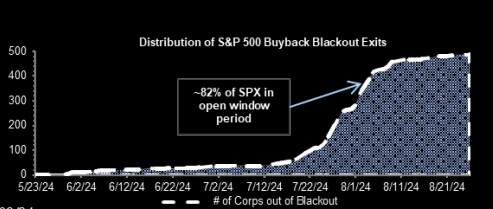 Click for larger graphic h/t The Market Ear
Last Friday’s soft July payrolls report – 114,000 jobs instead of the 175,000 expected – comes as no surprise to you, I hope. I’ve been harping on the real weakness in the labor markets for months, as shown by everything from the Job Openings and Labor Turnover Survey (JOLTS) data to the Business Employment Dynamics quarterly reports. And, of course, June was revised down by 13% from 206,000 to 179,000.
At the same time, every measure of inflation is slowing:
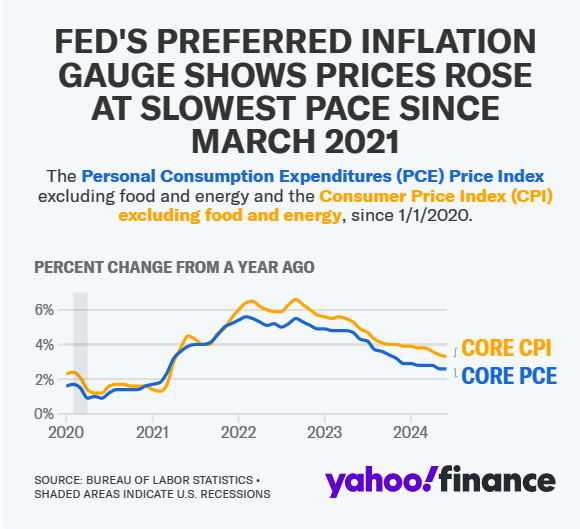 Click for larger graphic
A September Fed cut seems to be a done deal, and Wall Street now has a 70% chance of a 50 basis point (½ of 1%) cut. I doubt that will happen – we’re not in a crisis, just another Fed-caused recession to be followed by just another Fed-caused inflation. As John Mauldin said: “Why is it that we believe 12 human beings can sit around a table and decide the price of the most important commodity in the world—interest rates on the world’s global reserve currency? The market is perfectly capable of setting that rate on its own.”
Market Outlook
The S&P 500 lost 2.3% since last Thursday. Monday’s retreat had the S&P flirting with down-10% correction territory, but the Index ultimately settled 9.3% below its high close on July 16. It featured the third highest volatility spike in 40 years. The Index is up 11.5% year-to-date. The Nasdaq Composite lost 3.1% and is up 11.0% for the year. The SPDR S&P Biotech Exchange-Traded Fund (XBI) fell 3.7%. It is up 6.4% year-to-date. The small-cap Russell 2000 dropped 4.7% and is clinging to a 2.8% gain in 2024.
The fractal dimension consolidated more this week as the market rebounded from three big down weeks. This is classic consolidation behavior – better get used to it.

Top 5
Changes this week: Moved CMPS to reflect the end of year data release
Near-Term – chronological order
SCYX – ScyNexis – Data releases and resolution of the manufacturing problem
TGTX TG Therapeutics – Rapid recovery from overdone pullback
AAPL Apple – September iPhone 16 introduction
EQT EQT –natural gas price rebound
USL United States 12 Month Oil Fund, LP – crude should rise quickly
CMPS – Compass Pathways – Rebound from negative AdCom review of MDMA and Phase 3 data release in December quarter
FCX Freeport McMoRan – copper shortage
AKBA Akebia Therapeutics – Vafseo TDAPA approval in January
Long-Term – alphabetical order
ABCL AbCelllera – Will become a huge pharma royalty company
EQT EQT – largest US natural gas company
IBIT iShares Bitcoin Trust – Bitcoin is headed for $100,000
META Meta – a (the?) leader in the metaverse
PLTR Palantir – a (the?) leader in AI applications software
RKLB Rocket Lab – #2 to SpaceX in space
SCYX ScyNexis –First new antifungal in 20 years
VLD Velo3D – Return manufacturing to the US
Economy – Worth Your Attention: Growth, Employment and Inflation Cycles With Lakshman Achuthan of the Economic Cycle Research Institute (PODCAST HERE and TRANSCRIPT HERE).
Coming Events
All times below are ET, and most presentations and slides are archived on the companies’ websites so you can listen to them.
Friday, August 9
Short Interest – After the close
Sunday, August 11
Perseid meteor shower peaks ~11:00pm to dawn Monday
 Click for larger graphic
Tuesday, August 13
CMPS – Compass Pathways – 4:30pm – Canaccord Genuity Growth Conference
QUIK – QuickLogic – 5:30pm – Earnings conference call
Wednesday, August 14
Consumer Price Index – 8:30am
AKBA – Akebia – 8:30am – Canaccord Genuity Growth Conference
GILD – Gilead – After the close – Seladelpar FDA approval
QUIK – QuickLogic – 2:05pm – Oppenheimer Annual Technology, Internet & Communications Conference
Big Tech: The Biotech & Digital Dominators MegaShift
There are at least four ways to make money in the stocks of these large, growing, dominant companies. You can:
* * Buy a stock and hold it
* * Buy a stock and write a call option against it
* * With a Level IV options account, write an out-of-the-money put option
* * With a Level IV options account, write an out-of-the-money put option and use part of the premium to buy an out-of-the-money call option
Gilead Sciences (GILD – $75.59) reported after the close today. They hit the trifecta – beating on the top and bottom lines and raising guidance. Revenues rose 5.5% from last year to $6.95 billion, beating (barely) the $6.74 billion consensus. Pro forma earnings of $2.01 a share clobbered the $1.60 estimate. Revenue from both HIV and oncology drugs was strong.
 Click for larger graphic h/t Seeking Alpha
On the conference call (AUDIO HERE and SLIDES HERE and TRANSCRIPT HERE), they raised 2024 pro forma earnings guidance from $3.45-$3.85 per share to $3.60-$3.90. The $3.75 midpoint is just above the $3.71 consensus estimate. CEO Daniel O’Day listed these takeaways:
 Click for larger graphic
The oncology program continues to expand. This is the key to Wall Street re-rating GILD as a successful Big Pharma.
 Click for larger graphic
During the quarter they returned $1.07 billion to shareholders in the form of $972 million in dividends and 1.5 million shares bought back for $100 million. Gilead ended the quarter with $2.8 billion in cash. GILD is a Long-Term Buy under $80 for a first target of $120.
Meta Platforms (META – $509.63) has an asset hidden in plain sight, according to Needham. They attribute about $203 billion of market capitalization to Reels, the short-form video platform Meta introduced as a Tik Tok and YouTube Shorts competitor. On the March quarter conference call, CEO Mark Zuckerberg said when users get on Facebook and Instagram, they’re watching video more than 60% of the time. Reels is driving the growth in Meta’s video consumption and is monetized with ads. META is a Hold – I expect to move it back to Buy under $400.
Palantir (PLTR – $29.27) reported a really good June quarter. Revenues rose 27.2% from last year to $678.13 million, solidly beating the $652.43 estimate.
 Click for larger graphic
Proforma earnings per share of 9¢ were a penny ahead of the 8¢ estimate. CEO Alex Karp wrote: “We generated $134 million in net income in Q2 2024—the largest quarterly profit in our company’s twenty-year history. The steady ascent of our profit reflects the unbridled demand for and understanding of the capabilities of our software.”
 Click for larger graphic
During the quarter, they closed 27 deals worth $10 million or more. The customer count grew an amazing 41% year-over-year and 7% quarter-over-quarter as the AIP Bootcamp marketing strategy paid off. US commercial revenue increased 55% year-over-year, while US government revenue increased 24%.
 Click for larger graphic
Not too long ago, the big question about Palantir was could they expand from defense/military business to commercial. Karp wrote: “It may be easy to forget that only four years ago, we had 14 commercial customers in the United States. We now have nearly three hundred. Our customer count in the U.S. commercial market grew 83% year-over-year, from 161 in Q2 2023 to 295 in Q2 2024, and now accounts for half of all of our customers.”
 Click for larger graphic
On the conference call (AUDIO HERE or on YouTube:
with SLIDES HERE and LETTER TO SHAREHOLDERS HERE and TRANSCRIPT HERE), Alex guided September quarter revenues far above the $680.2 million consensus to a range from $697.0 million to $701.0 million.
For the full year, they raised revenue guidance to between $2.742 billion and $2.750 billion, again above the $2.70 billion consensus. They expect US commercial revenue to grow at least 47% to in excess of $672 million. They continue to expect adjusted free cash flow of between $800 million and $1 billion, and reiterated that they will have GAAP operating income and net income in each quarter of 2024.
In his Letter to Shareholders, Karp wrote: “Our growth across the commercial and government markets has been driven by an unrelenting wave of demand from customers for artificial intelligence systems that go beyond the merely performative and academic…And the persistent and unbridled demand for our software, for an effective enterprise platform that makes artificial intelligence capabilities useful to large institutions, shows no sign of relenting…The growth of our business has been re-accelerating steadily, and we see an unprecedented opportunity ahead to capture and build on that momentum.”
Ryan Taylor, the Chief Revenue Officer, did a great job of summarizing why I recommended Palantir: “Our exceptional results are a reflection of a market that is quickly awakening to a reality that our customers have already known, we stand alone in our ability to deliver enterprise AI production impact at scale. We are delivering these results in the face of an unprecedented enterprise AI opportunity.
“As noted by Sequoia, the revenue expectations from the AI ecosystem’s infrastructure build-out have grown from $200 billion to $600 billion per year in just nine months. The world is struggling with this huge problem. There’s a great bottleneck between prototype and production.
“The world has also come to understand what we’ve been saying all along. The standard playbook does not and will not work. It cannot solve this problem. While many companies can build prototypes, the leap from prototype to production is substantial. Palantir has made that leap.
“Our focus is on deploying enterprise AI in production, solving meaningful problems for our customers. We have the right products at the right time and our history means that we understand the $600 billion opportunity unlike anyone else in this space. We are uniquely situated and you see that in our results now.”
Wendy’s will be using Palantir’s Artificial Intelligence Platform (AIP) for supply chain management, waste prevention, demand allocation, and more to power their entire supply chain network.
Some analysts updated their targets just before earnings. Citi raised to $28 after visiting the company. Jefferies also raised to $28 as it sees a “rare blended AI apps/infrastructure asset.” RBC reiterated their $9 target with a Sell recommendation – someone is about to lose their job. PLTR is a Buy under $22 for a $100+ target.
PayPal Holdings (PYPL – $64.28) expanded Fastlane, their faster, simpler checkout experience to US businesses of all sizes. Users can complete their purchase in as little as one click. Merchants often lose sales due to lengthy guest checkout experiences. Despite the time-consuming process, guest checkout remains a preferred checkout method for many consumers. In fact, market research firm Capterra found that 43% of consumers said they prefer online guest checkout and 72% said they would still use guest checkout even if they have a store account. The same research found that 66% expect online checkout to take less than 4 minutes – creating a need for greater simplification and speed when consumers check out as a guest. PYPL is a Buy under $68 for a double in three years.
SoftBank Group (SFTBY – $25.72) reported June first quarter revenues up 9.3% to $11.56 billion with a loss of 84¢ per share.
On the conference call (SHORT VIDEO HERE and FULL VIDEO HERE and SLIDES HERE), SVP and CFO Yoshimitsu Goto pointed to their net asset value still more than double the current market price. So, on August 7 the Board approved a $3.4 billion stock buyback program.
Getting CEO Masayoshi Son’s business acumen at more than a 50% discount is a no-brainer for me. SFTBY is a Buy under $25 for a first target of $50 in the next two years.
Small Tech
Enovix (ENVX – $11.92) held their Malaysia Fab2 opening event today. The drop in lithium prices means a drop in lithium-ion battery prices to the point that EV costs on track to match gas guzzlers as early as next year as battery prices drop ‘dramatically’. This will not slow down adoption of Enovix’s technology for EVs because dramatically increased range and reduced charging time are major advantages. The company now is working with two global automotive OEMs aimed at scaling the Enovix cell architecture for the EV market. ENVX is a Buy up to $20 for a 4-year hold to $100+ as their BrakeFlow lithium-ion battery takes market share.
Primary Risk: A new competitor invents a better battery.
Fastly (FSLY – $5.61) reported June quarter revenues up 7.8% from last year to $132.37 million, just above the $131.52 million estimate. The pro forma loss of 7¢ was in-line. Enterprise customer count was 601 in the quarter, up 24 from the March quarter. Total customer count was 3,295 in the June quarter, up only five from the first quarter. The last-12-month net retention rate (LTM NRR) decreased to 110% in the second quarter from 114% in the first quarter.
But on the conference call (AUDIO HERE and SLIDES HERE and TRANSCRIPT HERE), CEO Todd Nightingale said: “We continued to drive customer acquisition in the second quarter, achieving 4% sequential growth in Enterprise customer count. This, along with the acceleration of our go-to-market motions, contributed to revenue growth above the midpoint of our guidance. However, we are experiencing demand challenges with some of our largest customers, and we are taking measures to align our cost structure accordingly. This change will enable focused investment in edge cloud innovation and continued go-to-market transformation.”
They reduced 2024 revenue guidance by 5% to $530-$540 million, with a midpoint of $535 million. The Street was at $557.1 million. They also guided low for the September quarter at $130-$134 million. The midpoint of $132 million is well below the $138 million consensus estimate. They expect a 2024 pro forma loss of 11¢ to 16¢, while analysts expected an 11¢ loss. Consequently, the stock was slammed for 18% today.
Piper Sander wrote: “Fastly again cut FY24 guidance by another 5%, citing demand issues with its largest customers, most of which operate on utility-type contracts.” They downgraded the stock from Overweight to Neutral and cut their target price from $10 to $6.
Fastly announced it has released the beta version of Fastly AI Accelerator, which is designed to help developers improve the performance of ChatGPT-powered apps and reduce the considerable cost of using OpenAI’s large language model. In spite of this hiccup, FSLY remains a Buy up to a reduced limit of $10 for a 3- to 5-year hold to $80+ as Compute@Edge drives customer acquisition and revenue growth.
Primary Risk:Content and applications delivery networks are a competitive area.
QuickLogic (QUIK – $9.10) reports next Tuesday. The two publishing analysts expect $4.5 million in revenues and breakeven. Guidance should be for $595 million and 6¢ a share.
They appointed CTG, a division of Blue Raven Solutions, as the sole source distributor for QuickLogic’s eFPGA Hard IP in the Aerospace & Defense sector. CTG President Mike Boyd said: “We are excited to offer an innovative solution that proactively addresses obsolescence challenges. This technology empowers our defense and aerospace customers to customize their systems to meet specific requirements, enhancing flexibility and adaptability in mission-critical applications, and overcoming lifecycle management challenges.”
QUIK is a Buy up to $10 for my $40 target as their earnings repeatedly surprise Wall Street.
Primary Risk: Customers’ product introductions and associated royalties are unpredictable.
Rocket Lab USA (RKLB – $4.79) reported June quarter results after the close today. Revenues grew 71.2% from last year and 15% from the March quarter to a record $106.25 million, but were just under the $107.31 million estimate. The GAAP loss of 8¢ a share was better than the 10¢ loss estimate.
On the conference call (AUDIO HERE and SLIDES HERE and TRANSCRIPT HERE), CEO Sir Peter Beck guided the September quarter to revenues of $100-$105 million, below the $110.54 million estimate. Guidance is for Space Systems revenue between $79 million and $84 million, with Launch Services revenue of approximately $21 million.
The company is getting ready for two weekends in a row of Electron launches Their next mission for Capella Space is scheduled for lift-off from Launch Complex 1 on Sunday, August 11. They finished the quarter with a whopping backlog of $1.067 billion, including 17 launches signed so far this year. For Electron launches, they collect cash as they build the rocket but only realize revenue when it is launched:
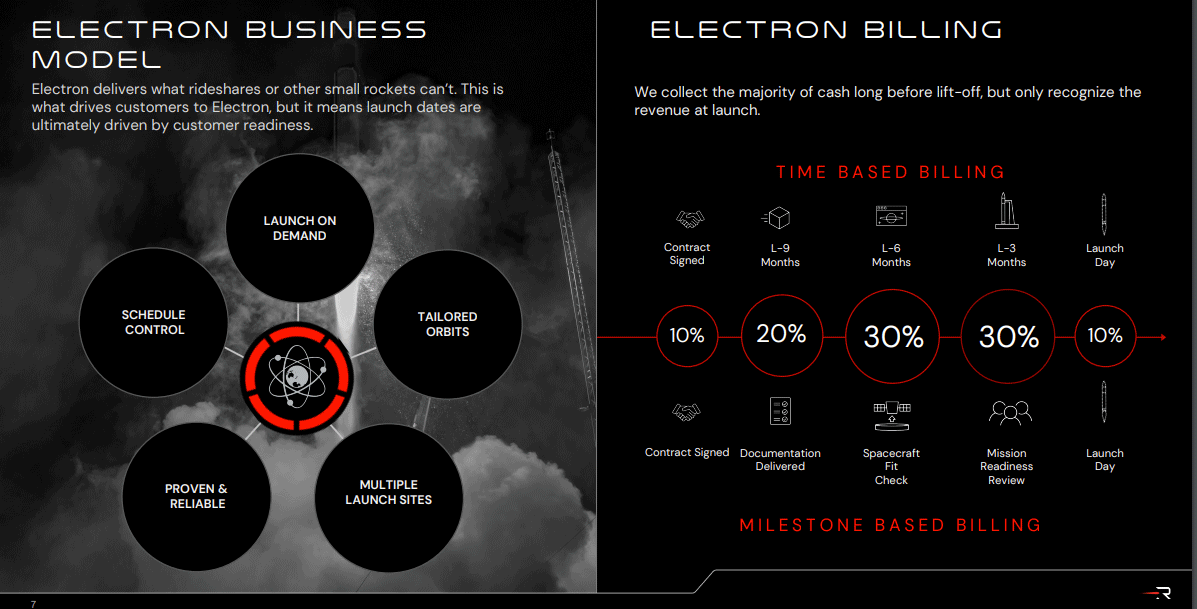 Click for larger graphic
They are the leader in small launch.
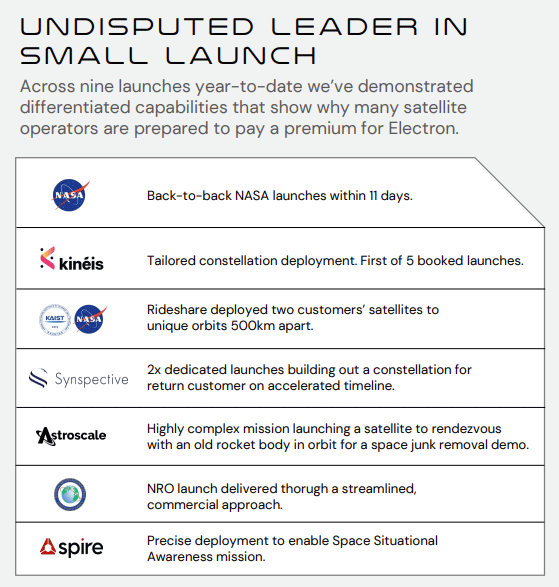 Click for larger graphic
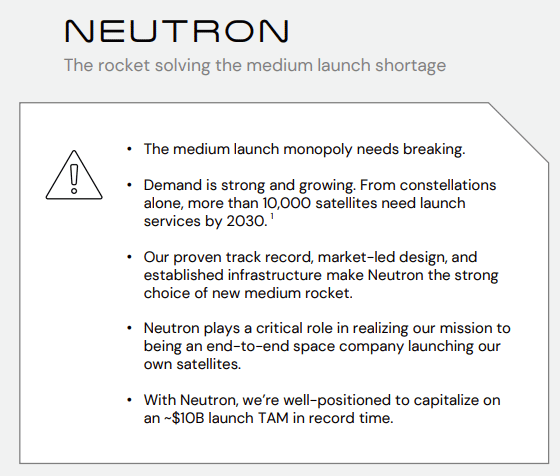
Neutron is next, to take some medium-launch business away from SpaceX:
 Click for larger graphic
At the Small Satellite Conference in Logan, Utah, they introduced their next generation satellite separation system, the Advanced Satellite Dispenser (ASD). The ASD is a cost-effective, versatile, and reliable deployment mechanism for small satellites in the CubeSat form factor and builds upon the company’s heritage Canisterized Satellite Dispenser (CSD) technology, which has successfully deployed more than 60 satellites to orbit across more than 11 years in use.
They partnered with Kongsberg Satellite Services (KSAT), a world leading provider of communication services for spacecraft and launch vehicles, to develop a new global ground station service for Rocket Lab’s operations and customers. The service will enables efficient and reliable communications for future Neutron launches for interplanetary missions , increasingly ambitious Electron launches, and on-orbit operations, spacecraft deorbit, and return-to-Earth missions with Rocket Lab spacecraft. RKLB is a Buy up to $13 for my $30+ target as low earth orbit satellites and space exploration grow.
Primary Risk: A new competitor emerges.
Biotech MegaShift
If you can afford it – and it would not be too big a position in your portfolio – putting $2,000 into each of these speculative biotechs might be a good way to start. Buying these out-of-favor, fallen, or forgotten companies that can get important products through the FDA at very low market capitalizations seems like a good strategy to me.
Risks
Development-stage biotechs are subject to investor sentiment swings from wildly optimistic to excessively pessimistic – mostly the latter recently. After the Primary Risk for each company, I’ve added the clinical stage of their lead product, the probable time of their first FDA approval, and the probable time of their next financing.
As always, you need to think about an appropriate position size. You could buy a full position upfront and then just hold on, or buy some upfront and leave room to add more on the inevitable financings, transient clinical trial setbacks, and the like.
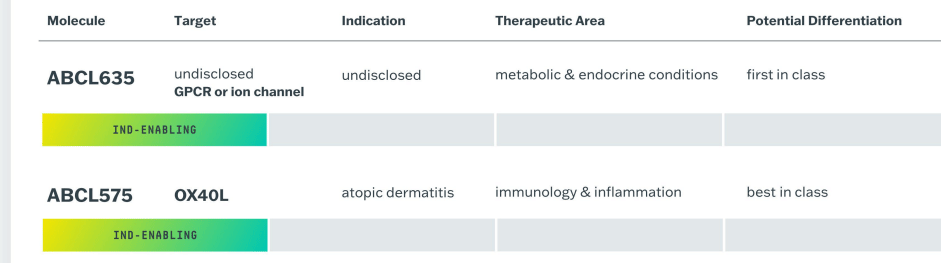
AbCellera Biologics (ABCL- $2.78) reported a June quarter GAAP loss of $36.9 million or 13¢ per share, a penny better than the 14¢ loss estimate. On the conference call (AUDIO HERE and SLIDES HERE and TRANSCRIPT HERE), management said their proprietary drugs, ABCL635 and ABCL575, are on track for human clinical trials in the June 2025 quarter.
 Click for larger graphic
AbCellera expanded their strategic collaboration with Eli Lilly from the original 2020 deal for eight programs for targets selected by Lilly and one exclusive license to a Covid-19 antibody program to multiple programs over multiple years to discover therapeutic antibodies for programs in immunology, cardiovascular disease, and neuroscience. AbCellera got an upfront payment and will get research payments, downstream milestone payments, and royalties on net product sales.
AbCellera has advanced all eight programs under the original agreement, and the licensed program resulted in Emergency Use Authorization by the FDA for two COVID-19 antibody therapies co-developed by the companies.
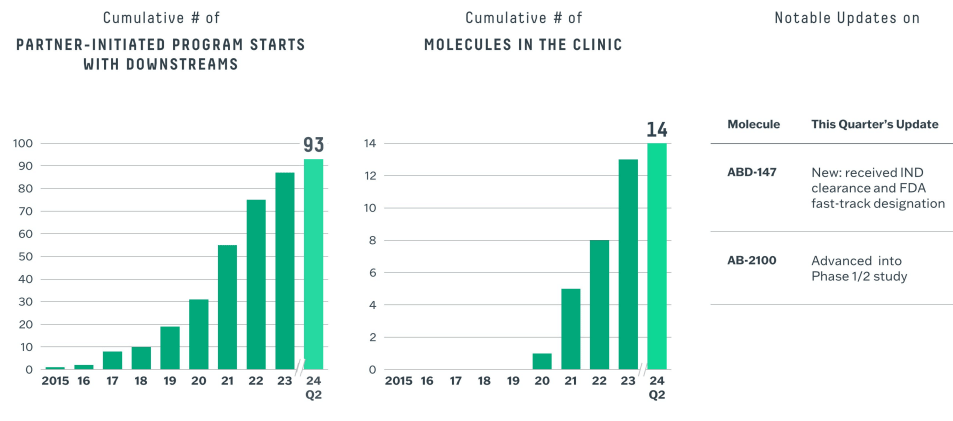
Their partnerships are progressing, with three additional partner-initiated programs with downstreams and one more molecule in the clinic.
 Click for larger graphic
They finished the quarter with $697.6 million in cash plus $220 million in available non-dilutive government funding. Buy ABCL up to $6 for a long-term hold to $30 or more.
Primary Risk: Partnered and owned drugs fail in the clinic.
Clinical stage of lead product: Partnered: Various Owned: Preclinical
Probable time of next FDA approval: 2027-2028
Probable time of next financing: 2026-2027 or never
Akebia Therapeutics (AKBA- $1.19) reported this morning. Revenue was down 22.5% from last year, when they had a one-time $10 million upfront payment related to the Medice license agreement, to $43.67 million. Auryxia product revenues were $41.2 million, compared to $42.2 million last year. They expect Auryxia full year 2024 net product revenues to be in line with 2023. They had a GAAP loss of 4¢ a share.
On the conference call (AUDIO HERE), they again went through the reasons for delaying the launch of Vafseo until after TDAPA approval at the end of December. They are signing contracts with dialysis providers now. Their first targets will be those on home dialysis or the highest levels of ESAs.
Medice, their European partner, launched Vafseo in Germany and Austria in June and in the Netherlands in August.
We’ll get another update on August 14 at the Canaccord Genuity Growth Conference. They finished the quarter with $39.5 million in cash, enough to carry them for at least two years. Buy AKBA up to $2 for the vadadustat launches in the EU, UK, and (after TDAPA approval in December) the US.
Primary Risk: Vadadustat doesn’t sell in the US.
Clinical stage of lead product: Approved
Probable time of next approval: TDAPA January
Probable time of next financing: Never
The Compass Pathways (CMPS – $6.98) June quarter earnings call transcript finally was posted HERE. CMPS is a Buy under $20 for a very long-term hold to a 10x.
Primary Risk: Their drugs fail in the clinic.
Clinical stage of lead product: Phase 3
Probable time of first FDA approval: 2026
Probable time of next financing: Late 2025
Editas Medicine (EDIT – $4.28) reported a June quarter GAAP loss of 82¢ a share, worse than the 69¢ loss consensus estimate. On the conference call (AUDIO HERE and TRANSCRIPT HERE), management said they are on track to present additional clinical data from the RUBY trial and the EdiTHAL trial by year-end. They’ll also have in vivo preclinical proof-of-concept for an undisclosed indication by year-end.
CEO Gilmore O’Neill said: “We made significant progress in all three pillars of our strategy this quarter, particularly reni-cel as we shared a substantial clinical update mid-year and continued to enroll and dose at an accelerated pace. With these data, we are highly confident reni-cel is well positioned to be a differentiated, best-in-class product for the treatment of sickle cell disease.”
We don’t own the stock for reni-cel, where they will be late to a crowded field treating sickle cell disease. We own it for their basic patents on CRISPR technology that will require all the other sickle cell companies – indeed, all the other companies that want to market a CRISPR drug – to pay them royalties.
They used $57.5 million of their cash in the quarter and finished June with $318.3 million, enough to carry them through 2025 into 2026. EDIT is a Buy under $6 for a double in 12 months and a long-term hold to much higher prices.
Primary Risk: Other companies’ gene-sequencing drugs fail in the clinic.
Clinical stage of lead product: Partnered: Approved; Owned: Preclinical.
Probable time of next FDA approval: 2025
Probable time of next financing: 2026 or never
Inovio (INO – $8.90) reported after the close today. The $1.19 GAAP loss was bigger than the $1.10 loss Wall Street expected. On the conference call (AUDIO & SLIDES HERE and TRANSCRIPT HERE), CEO Dr. Jacqueline Shea said: “We continue to make progress with our lead candidate, INO-3107, which has the potential to significantly improve the lives of patients with RRP. We expect all non-device related elements of our BLA package to be completed by year end and our pre-BLA meeting last week with the FDA provided us with confidence that we remain on the right track for the regulatory submission.
“However, as part of the testing process required for BLA submission, we’ve recently identified a manufacturing issue with the single use disposable administration component of our device that we believe is resolvable, but will take additional time to rectify. We’re taking corrective steps to address the issue, and while we have not altered our ultimate expectations for INO-3107 to be a potentially transformative therapeutic option for RRP patients that could be the first DNA medicine approved for use in the United States, we now expect to be able to submit the BLA in mid-2025.
“We will continue to work hard to advance all other elements necessary for INO-3107’s success, including working to initiate our confirmatory trial, advancing plans for our redosing trial, making key regulatory progress in Europe and the U.K., and continuing commercial preparations to be launch-ready if we receive approval. These efforts will help maintain the momentum that’s carried us from Breakthrough Therapy Designation to BLA preparation in less than a year.”
A six-month delay in FDA approval obviously is not good news. They have $110.4 million in cash, enough to get them to the third quarter of 2025, past the BLA submission, but not all the way to approval. The company has been very good at reducing expenses, with operating expenses falling from $37.3 million in the June 2023 quarter to $33.3 million this year. I think they will be able to resolve the manufacturing issue faster than six months.
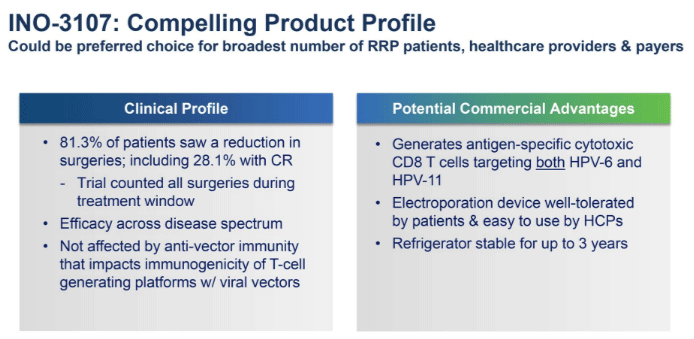
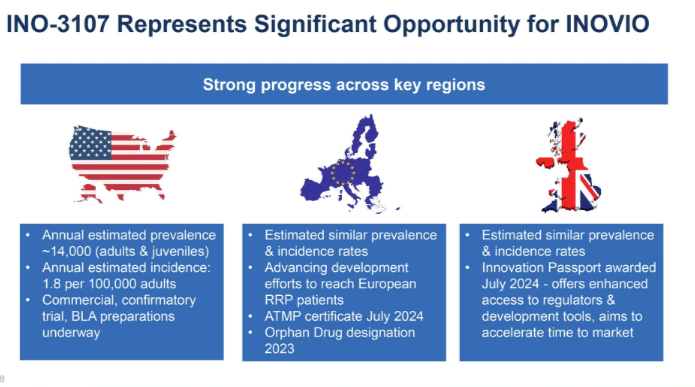
INO-3107 is a big deal. It’s a great product for a terrible disease:
 Click for larger graphic
And will be a huge win financially:
 Click for larger graphic
INO is only down pennies in the aftermarket and remains a Buy under $14 for a very long-term hold.
Primary Risk: Their drugs fail in the clinic.
Clinical stage of lead product: Phase 3
Probable time of first FDA approval: Mid-2025
Probable time of next financing: After FDA approval in 2025
TG Therapeutics (TGTX – $19.98) jumped after they reported June quarter revenues of $73.47 million, well ahead of the $65.89 million consensus and about 45% above the March quarter. Since the Briumvi launch, they’ve had 5,850 new patient prescriptions from over 950 healthcare providers at 525 centers, including more than 1,400 prescriptions received in the June quarter – 12% more than the March period. In the June quarter, they added 150 new prescribers and over 70 new centers.
They reported GAAP earnings of 4¢ a share while the Street thought they would lose 5¢.
Briumvi had net revenue of $72.6 million and TG raised their full year net revenue target from $270-$290 million to $290-$300 million. That’s the second raise this year – in January they guided for $220-$260 million. On the conference call (AUDIO HERE and TRANSCRIPT HERE), CEO Mike Weiss said they were awarded a national contract with the VA for Briumvi to be the preferred anti-CD20 agent listed on the VA National Formulary for patients with relapsing forms of multiple sclerosis that went into effect on June 17. They also got three new US patents that extend their patent protection through 2042.
They also treated the first patients in their Phase 1 trial of subcutaneous ublituximab for multiple sclerosis, designed to assess the bioequivalence of subcutaneous versus IV Briumvi. They got FDA clearance to start a Phase 1 trial of azer-cel (allogeneic CD19 CAR-T) in patients with progressive MS.
TG set up a five-year, $250 million credit line to (1) repay $107 million of existing debt, and (2) buy back $100 million of stock. Not counting the credit line, they finished the quarter with $217.3 million in cash and have no need to sell equity. Buy TGTX under $12 for a target price in a buyout of $30 or more.
Primary Risk:Briumvi, the MS drug, fails to sell.
Clinical stage of lead product: Approved
Probable time of next FDA approval: NM
Probable time of next financing: Never
Inflation MegaShift
Gold ($2,465.50) and silver have historically skyrocketed after an emergency Fed rate cut, with silver outperforming gold and both crushing the S&P 500. I don’t think they should do it, but Wall Street is clamoring for an immediate cut.
 Click for larger graphic h/t @marketplunger1
The fractal dimension seems determined to call this a new uptrend and I’m about two weeks away from believing it.

Miners & Related
Coeur Mining (CDE – $5.46) reported March quarter revenues up a sparkling 25.3% from last year to $222.03 million, although that was a skotch short of the $222.05 million estimate, The pro forma loss of a penny a share was in line.
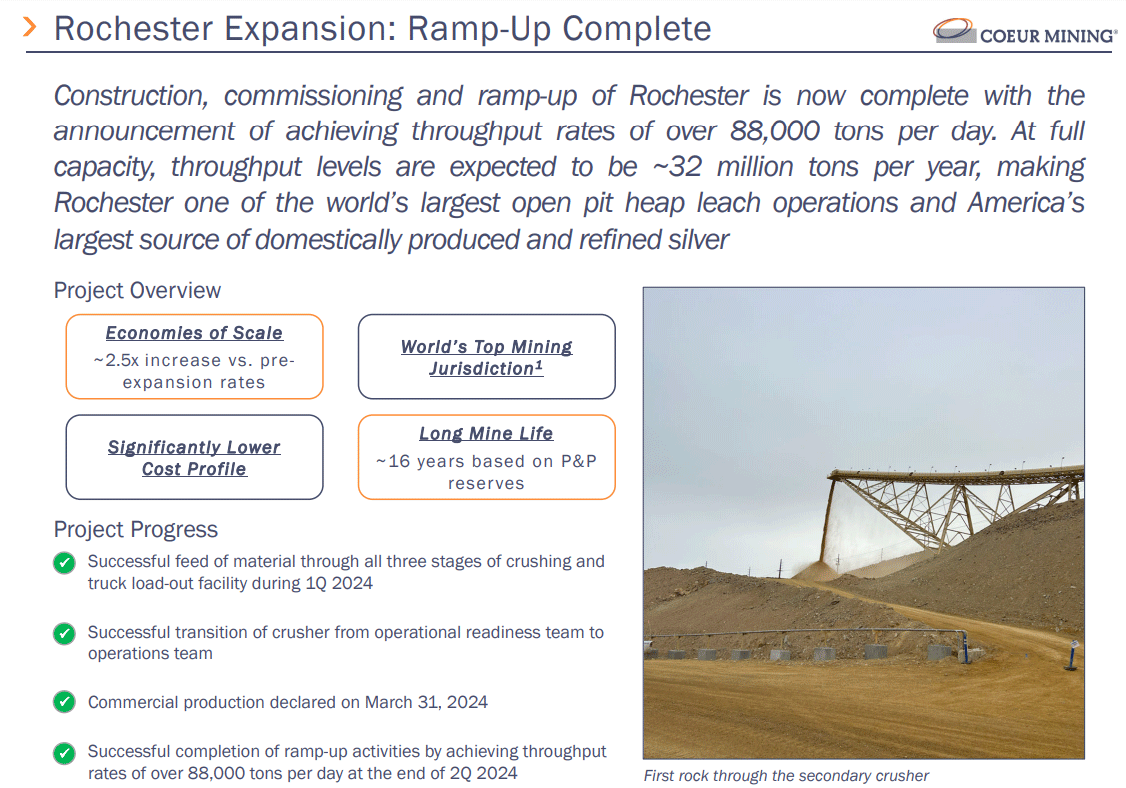
On the conference call (AUDIO HERE and SLIDES HERE and TRANSCRIPT HERE), management said the Rochester mine successfully completed ramp-up activities by achieving throughput rates of over 88,000 tons per day. Annual throughput levels are expected to be approximately 2.5 times higher than historical levels, or roughly 32 million tons per year, leading to expected strong increases in production and free cash flow with substantially lower unit costs. Rochester’s June quarter silver and gold production both increased 39% compared to the March quarter.
Click for larger graphic
CEO Mtch Krebs said: “The entire portfolio is hitting on all cylinders as we approach the second half free cash flow inflection point following the successful mid-year ramp-up of Rochester..Rochester now stands on the threshold of a sustained period of strong free cash flow generation beginning in the second half of this year, while Kensington continues to move toward its own anticipated return to free cash flow generation in the second half of 2025. Coupled with the near-term growth opportunities at Palmarejo East and at our Wharf operation, along with the longer-term potential at Silvertip, Coeur’s portfolio is well-positioned for success. Planned debt reduction efforts are set to further enhance our unique positioning within our sector as a multi-asset portfolio concentrated in top-tier jurisdictions with unmatched leverage to silver and significant cash flow growth driven by elevated levels of investments over the past five years.”
Their gold and silver hedging program during the construction and ramp-up of Rochester was completed during the June quarter. Going forward, Coeur is fully exposed to commodity prices. That’s a good thing! They maintained their full-year production guidance ranges of 310,000-355,000 gold ounces and 10.7-13.3 million silver ounces. CDE is a Buy under $5 for a $20 target as gold goes higher.
Primary Risk: Prices of precious metals fall due to US dollar strength.
Sandstorm Gold (SAND – $5.15) reported June quarter revenues down 16.9% from last year to $41.4 million because attributable ounces of gold fell from 24,504 to 17,414. They beat the $40.49 million consensus estimate. They reported a penny a share loss, missing the consensus estimate for a penny a share profit. On last Friday’s conference call (AUDIO HERE and SLIDES HERE and TRANSCRIPT HERE), CEO Nolan Watson said: “…with respect to…our Q2 production, I would describe it as an uncharacteristically weak and hopefully unlikely to reoccur quarter. During the second quarter, there were a number of temporary effects that caused the quarter to be below our expectations, including Aurizona having problems with its Piaba pit, Cerro Moro and Chapada moderately underperforming, and Greenstone taking longer to begin delivering first gold to Sandstorm than originally budgeted.
“But I would like to reassure everyone that each of these items are all temporary, and not only are we expecting these mines to rebound, the Greenstone mine is now up and running and delivering gold to Sandstorm under our stream. We did not receive any material amounts from Greenstone in Q2. However, even here in July and now into August, we’re seeing the ounces starting to come from that gold stream. So Q3 should be our first quarter with some Greenstone production. And as they continue to commission and ramp up their mine, our gold sales will ramp up correspondingly.”
Regarding their remaining debt, he said: “…we continue to use the majority of our cash flow to pay down our debt. And as I sit here this morning, our debt balance is down to $383 million, and therefore our goal of getting debt down to $350 million by the end of the year is well on track.”
At the same time, they are buying back approximately 10,000 shares per trading day as long as they’re not in the blackout. They renewed their stock buyback program to purchase up to 20 million shares, about 7% of the issued and outstanding common shares.
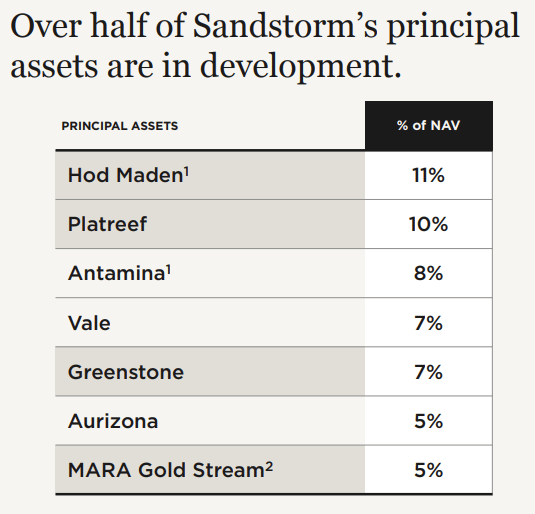
Nolan pointed out that Sandstorm already owns growth assets in Greenstone, Platreef, Robertson, and Hod Maden, and has the right to purchase the MARA stream. These assets will nearly double production. Looking at their current best estimate of their top seven assets by value, four of these seven assets were not even in production yet during the June quarter.
 Click for larger graphic
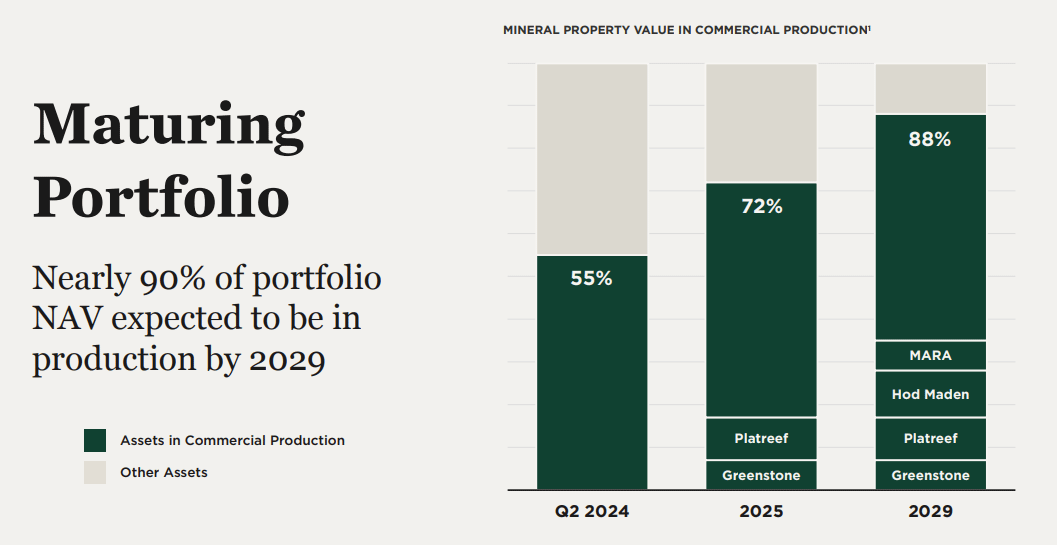
In the June quarter, only 55% of Sandstorm’s NAV was in production. By the end of 2025, that number should be up to 72% as Greenstone ramps up and Platreef comes online. By 2029, they expect 88% of their NAV to be in production. Once those ramp-ups do happen by 2029, the portfolio will be able to generate after-tax cash flows of close to $250,000 a year, up from $140,000 this year.
 Click for larger graphic
Sandstorm signed a definitive asset purchase agreement to sell a collection of non-core, non-precious metals royalties for $21 million plus the retention of the next $10 million in proceeds from the Copper Mountain Royalty. Upon completion of the transaction, Sandstorm will have sold over $50 million of non-core royalty and equity investments since the September 2023 quarter, including approximately $40 million in cash consideration.
They maintained their 2024 production guidance of 75,000 to 90,000 gold equivalent ounces, still expected to increase to approximately 125,000 ounces within the next five years. SAND is a Buy under $10 for a $25 target.
Primary Risk: Prices of precious metals fall due to US dollar strength.
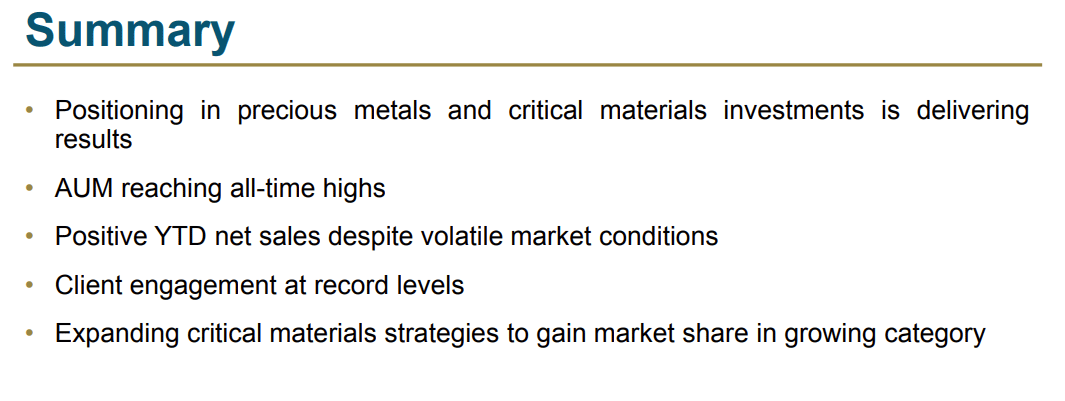
Sprott Inc. (SII – $39.25) reported June quarter GAAP earnings of 53¢ a share. Assets under management (AUM) was $31.1 billion as at June 30, up 6% from $29.4 billion at the end of March, and up 8% from $28.7 billion at December 31. After more than four years of positive net sales, Sprott started 2024 with $284 million of net redemptions in the March quarter. That reversed this quarter, with net sales of $357 million plus an additional $110 million from the IPO of the Sprott Physical Copper Trust.
Management fees grew 16% from last year to $38.1 million. Commission revenues more than doubled to $3.3 million. Finance income also more than doubled from $1.7 million last year to $4.1 million. On the conference call (AUDIO HERE and SLIDES HERE), management pointed to their opportunity as the commodity cycle unfolds:
 Click for larger graphic
Thy finished the quarter with $29.7 million in cash and $97.8 million of co-investments, of which $46.9 million could be monetized in less than 90 days. Buy SII under $40 for a $70 target price.
Primary Risk: Prices of precious metals fall due to US dollar strength.
Cryptocurrencies
Cryptocurrencies are a diversifying asset that offer a unique opportunity to make (or lose!) a lot of money quickly. You can easily buy bitcoin and other cryptocurrencies at Coinbase, Block, or Robinhood.
Bitcoin (BTC-USD on Yahoo – $61,040.95) slumped under $60,000 last weekend, wiping out about $200 million in bullish futures positions. After plunging under $50,000, it rebounded sharply.
 Click for larger graphic
BTC-USD, ETH-USD, IBIT, and ETHE are Strong Buys.
Primary Risk: Bitcoin falls due to over-regulation or is surpassed by another cryptocurrency.
iShares Bitcoin Trust (IBIT- $33.69) remains the cheapest and easiest way to buy bitcoin. IBIT is a Buy for the 2028, 2032, and 2036 halvings.
Primary Risk:Bitcoin falls due to over-regulation or is surpassed by another cryptocurrency.
Ethereum (ETH-USD on Yahoo – $2,681.01) fell under $2,900 in last weekend’s crypto crash, retracing all the gains from its run to $3,400 in July as spot ETH exchange-traded funds were approved for trading in the US. After almost hitting $2,100 on Monday, it’s been slowly rebounding. ETH-USD is a Buy.
Primary Risk: Bitcoin extensions outperform Ethereum.
iShares Ethereum Trust (ETHE- $18.91) remains the cheapest and easiest way to buy ethereum. ETHE is a Buy.
Primary Risk:Ethereum falls due to over-regulation or is surpassed by another cryptocurrency.
Commodities
Oil – $75.95
Oil ticked up from under $73 after the Energy Information Administration reported a 6th straight weekly crude draw, this time of 3.728 million barrels. I honestly don’t know what the bears are thinking unless it’s a severe recession. US oil production is trending lower again with the last four weeks showing ~13.02 million barrels a day. Aris Water Solutions, a Permian basin water handling company. reported June quarter volumes down 5%-6% from the March quarter. They are guiding for flat to further reduced volumes for the September quarter – just one more indication of reduced hydrocarbon production.
 Click for larger graphic h/t @HFI_Research
People have forgotten the massive crude bull markets of the 1970s and 2000s, when West Texas Intermediate (WTI) went from $3.18 a barrel on January 1, 1970, to $34.30 on February 15, 1981. Or when it went from $25.55 on January 1, 2000, to $145.18 on July 14, 2008. Today, we are on the verge of a bull market of similar magnitude.
The July 2026 Crude Oil Futures (CLN26.NYM – $no trades – June 2025 was $71.26) are a Buy under $70 for a $200+ target. Only buy futures for all cash; do not use margin.
The United States 12 Month Oil Fund, LP (USL – $38.18) is a Buy under $40 for a $100+ target.
EQT (EQT – $30.53) moved up a bit with natural gas prices as the Ukrainian Armed Forces captured the Sudzha gas measurement station. Russian gas is exported to Europe through Sudzha and European natty hit a 2024 high. The Goehring & Rozencwajg analysts wrote “On LNG, AI & Shale Supply: We Expect The Turn in US Gas is Here.” You can download the PDF HERE. Like their work on oil, they believe we are on the edge of a major natural gas bull market driven by falling supply and accelerating demand. The best-positioned company to ride this boom is EQT. EQT is a buy under $35 for a first target of $70 and a long-term hold for much higher prices.
Primary Risk:Natural gas prices fall.
Energy Fuels (UUUU – $4.54) reported June quarter revenues up 27.1% from last year to $8.72 million, well ahead of the $7.76 million consensus estimate. They sold 100,000 pounds of U3O8 on the spot market at a realized sales price of $85.90 per pound for total proceeds of $8.59 million. The 4¢ per share loss was in line with estimates.
On the conference call (AUDIO HERE and SLIDES HERE and TRANSCRIPT HERE), management said while they are primarily a uranium producer, having produced 2/3 of all US uranium since 2017, they are developing a high-value product line with rare earth elements (REEs) next.
 Click for larger graphic
Uranium will remain the heart of the company, and is the main reason I recommended the stock.
 Click for larger graphic
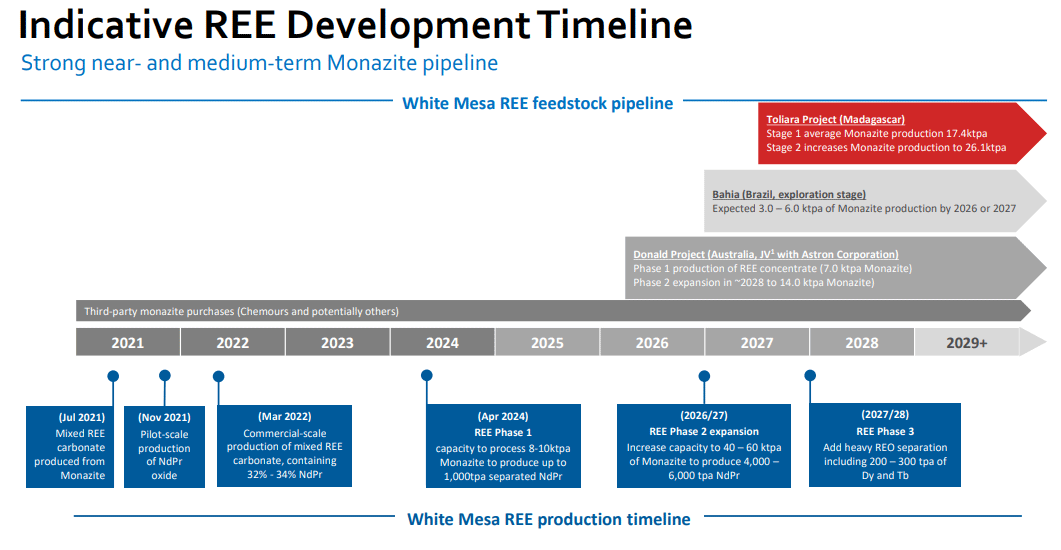
But REEs will be increasingly important. As I’ve written, the world depends on China to process REEs for many advanced electronic products, including military. It’s an untenable situation longer term. Energy Fuels’ White Mesa Mill in Utah is the only facility in the US able to produce advanced REE materials. In April, they completed the Phase 1 expansion to process 8,000 to 10,000 tons of monazite a year, which will produce up to 1,000 tons of separated neodymium and praseodymium (NdPr). Neodymium magnets made from praseodymium alloy are one of the most powerful and widely used rare earth magnets. The magnets are three times stronger, and one-tenth the size of conventional magnets. Every electric vehicle drivetrain requires up to two kilograms of NdPr oxide. A three-megawatt direct drive wind turbine uses 600 kilograms. NdPr also is used in air-conditioning units and to create strong metals for use in aircraft engines.
The Phase 2 expansion in 2026/2027 will process 40,000 to 60,000 tons of monazite per year to produce 4,000 to 6,000 tons of NdPr. A year later, the Phase 3 expansion will add additional REE production.
 Click for larger graphic
Their plate is full for the rest of this year. As they continue to execute, Wall Street will start to notice. We caught this one early! See Energy Fuels: Compelling Buy, With Tailwinds, Ramp Ups, And Insider Buying.
 Click for larger graphic
CEO Mark Chalmers, who has been in this business over 48 years, said: “Energy Fuels is likely one of the biggest building success stories on decarbonization electrifications, while we also emerge as a clear leader in diversified U.S. critical mineral production at a time when this has never been more important. We are a unique investment. There is no other company that has the ability to advance uranium, vanadium, and rare earth production capabilities, while at the same time advancing our medical isotope aspirations, and continuing to maintain a very strong balance sheet.”
All the uranium stocks dipped after Kazatomprom, the world’s largest producer, reported year-to-date production increased 6% from last year to 10,857 tons. The Kazakhstan state-owned company said it now expects to produce 22.5-23.5 million metric tons of uranium in 2024, up from its previous outlook of 21.0-22.5 million tons. That’s not enough to make a significant difference to prices. As Bank of Montreal said of the second-largest producer: “Cameco remains well placed to benefit from expectations of increased contracting activity and improving realized pricing as utility held inventories continue to reduce, despite Kazatomprom’s higher than expected 2024 production guidance.”
Energy Fuels finished the quarter with $171.25 million in cash, large uranium and vanadium inventories, and no debt. UUUU is a buy under $8 for a $30 target.
Primary Risk: Uranium prices fall.
* * * * *
* * * * *
Your tracking the offshore wind scam Editor,

Michael Murphy CFA
Founding Editor
New World Investor
All Recommendations
Priced 8/8/24. Check out the complete Portfolio page HERE.
Buys
These are the stocks everyone needs to own because transformative events are happening over the next year or two, and I expect to hold them long-term.
Tech Dominators
Corning (GLW – $38.60) – Buy under $33, target price $60
Gilead Sciences (GILD – $75.59) – Buy under $80, target price $120
Palantir (PLTR – $29.27) – Buy under $22, target price $100+
PayPal (PYPL – $64.28) – Buy under $68, target price $136
SoftBank (SFTBY – $25.72) – Buy under $25, target price $50
Small Tech
Enovix (ENVX – $11.92) – Buy under $20; 4-year hold to $100+
First Trust NASDAQ Cybersecurity ETF (CIBR – $54.39) – Buy under $40; 3- to 5-year hold
Fastly (FSLY – $5.61) – Buy under $14; 3- to 5-year hold to $80+
PagerDuty (PD – $18.61) – Buy under $30; 2- to 5-year hold
QuickLogic (QUIK – $9.10) – Buy under $10, target price $40
Rocket Lab (RKLB – $4.79) – Buy under $13, target price $30+
Velo3D (VLD – $2.26) – Buy under $10, target price $100
$20-for-$1 Biotech
AbCellera Biologics (ABCL – $2.78) – Buy under $6, target $30+
Akebia Biotherapeutics (AKBA – $1.19) – Buy under $2, target $20
Compass Pathways (CMPS – $6.98) – Buy under $20, hold a long time for a 10x return
Editas Medicines (EDIT – $4.28) – Buy under $6 for a double in 12 months and a long-term hold to much higher prices
Inovio (INO – $8.90) – Buy under $14, hold a long time
Medicenna (MDNAF – $1.50) – Buy under $3, first target $20, then maybe $40
ScyNexis (SCYX – $1.89) – Buy under $3, target price $20, then $50
TG Therapeutics (TGTX – $19.98) – Buy under $12 for buyout at $30+
Inflation
A Short-Sale or REO House – ($415,400) – Hold
Bag of Junk Silver – ($27.47) – hold through silver bull market
Sprott Gold Miners ETF (SGDM – $27.43) – Buy under $28, target price $50
Sprott Junior Gold Miners ETF (SGDJ – $30.70) – Buy under $39, target price $100
Sprott Physical Gold and Silver Trust (CEF – $22.10) – Buy under $18, target price $30
Global X Silver Miners ETF (SIL – $29.95) – Buy under $30, target price $50
Coeur Mining (CDE – $5.46) – Buy under $5, target price $20
First Majestic Mining (AG – $5.00) – Buy under $11, next target price $23
Paramount Gold Nevada (PZG – $0.41) – Buy under $1, first target price $10
Sandstorm Gold (SAND – $5.15) – Buy under $10, target price $25
Sprott Inc. (SII – $39.25) – Buy under $40, target price $70
Cryptocurrencies
Bitcoin (BTC-USD – $61,040.95) – Buy
iShares Bitcoin Trust (IBIT – $33.69) – Buy
Ethereum (ETH-USD – $2,491.77) – Buy
iShares Ethereum Trust (ETHA- $18.91) – Buy
Commodities
Crude Oil Futures – July 2026 (CLN26.NYM – no trades – June 2025 last was $71.26) – Buy under $70; $200+ target
United States 12 Month Oil Fund, LP (USL – $38.18 – Buy under $40; $100+ target
Vermilion Energy (VET – $9.86) – Buy under $11; $24 target
EQT (EQT – $30.53) – Buy under $35; $70 first target
Energy Fuels (UUUU – $4.54) – Buy under $8; $30 target
Freeport McMoRan (FCX – $40.87) – Buy under $44; $65 target within two years
Holds
These are holds but not sells – yet. They could get moved back to one of the buy categories if their prices drop or outlook improves, or they could become sell recommendations in the future.
Apple Computer (AAPL – $213.31) – Expect to move back to Buy under $175 for new iPhones
Meta (META – $509.63) – Expect to move back to Buy under $400
Publisher: GwynRose LLC, 5348 Vegas Drive, Suite 868, Las Vegas, NV 89108
New World Investor does not act as a personal investment adviser or advocate the purchase or sale of any security or investment for any specific individual. The recommendations and analysis presented to members are for the exclusive use of members. Members should be aware that investment markets have inherent risks and there can be no guarantee of future profits. Likewise, past performance does not assure future results. Recommendations are subject to change at any time. Nothing in this presentation should be considered personalized investment advice. No communication to you by Michael Murphy or any of our employees or contractors should be deemed as personalized investment advice.
Copyright ©GwynRoseLLC 2024
New World Investor Mastermind Group
1. Post unto others as you would have them post unto you.
2. Keep it clean, like a 1950s family television show. Your alter ego can run free on Twitter.
3. NO PERSONAL ATTACKS! If you don’t like the stock, don’t trash the person. Everyone is responsible for their own due diligence and investments.
4. Don’t post here about politics or religion – you aren’t going to change anyone’s mind. Again, NO PERSONAL ATTACKS!
5. The investment implications of something going on in politics or religion is OK.
6. Of course, there’s never a reason to slur someone based on race, religion, gender, sexual orientation, or country of national origin.
7. Please, no snark!
 Print This Post


two can be as bad as one, but the loneliest number is the number 1…oh….
Ok. I will take 3
Anything to report about scyx,since they did report after the close today also ,MM
Yes MM, what are your thoughts on their latest update? It seemed vague on the manufacturing hold.
Brexa is a mediocre drug. That’s the big picture. Trials and use in VVC have been mediocre. The FURI and CARES updates and past trials for serious fungal infections show Brexa is mediocre. I don’t care about attractive valuations based on cash payments for royalties and milestones. The stock is “cheap” for good reason–Brexa sucks. Whether 247 is better won’t be known for a few years. This is dead money, with perhaps a small bump when the manufacturing hold is lifted. Subscriber Zman said that IR told him that the hold was lifted but unannounced. MARIO will start one of these days. But Brexa sucks anyway, therefore so what?
Just checking to see if you are holding any scyx JGMD and are you planning on keeping the shares you have,tx Ron have a nice weekend
Maybe MM will respond to scyx earning sooner or later,more garbage at this point
I am holding too much of SCYX. MANY years ago I bought at high prices. Last Oct I bought more at $1.70 to get my average cost down to $4.70. Recently we’ve seen a big continuous drip from $2.25 down to $1.76. The FDA hold is taking much longer to resolve than MM suspected. This is stupid bureaucratic delay. Royalties and milestones make the stock a reasonable hold now.
OK and holding also,tx have a nice day
Can’t restart MARIO unless the FDA has approved the manufacturer, and no point in manufacturing ibrexafungerp unless the FDA has approved; therefore, they must have FDA approval.
MM–on TGTX, what scenario do you see where the stock will go below $12? Your buy below $12 seems outdated. I think now at $20, it is fairly valued.
i still think they get acquired for over $30 and wouldn’t put new money to work over $12.
Is it just me or how is it possible that we are still dealing with device issues with INO? This is what derailed is back in 2020. Shouldn’t they have been on top of this long ago?
I agree. It sounded like they had to do some kind of extreme pressure test on each component and one broke. Never has happened in real life, but it’s possible that the requirements to file a BLA are tougher than for a clinical trial. I don’t think this really will take six months to resolve.
MM or anyone –
CIBR was 1st recommended in August 2017 up to $40 with a 3–5 year target holding period. Now 7 years later at $54.
I haven’t seen anyone mention for a long time. Should we continue to hold, buy more, or sell?
Seems relatively low risk, tracking the CTA cybersecurity index. What say ye?
Certainly a hold and I’d have no problem with nibbling now and then. I still think it’s better to own the ETF than try to pick an individual stock (c.f., Crowdstrike).
Here is an excellent podcast of Ray Dalio by Tom Bilyeu of Impact Theory. It’s titled “Warning for the economic crisis , US recession & world war 3 odds in 2024”. Also one from Arthur Hayes called “This debt crisis will collapse the US economy, prepare for an upcoming recession “
There’s always a great reason to sell everything and go to cash, and it always is the wrong thing to do. We are in a secular bull to 2036.
As the debt crises worsens day by day, recession will get more prolonged. Can the day of reckoning be delayed until 2036? Hyperinflation must occur to reduce the real debt numbers. Today’s low inflation numbers are false and ignore the elephant debt problem.
I bought the 75 November Gild calls today
Let alone,most of the biotech picks from the list are in the tiolet,looking like vld has lost iit footing to stay afloat,is thee end near for vld,anyone out there anymore or has everyone just left,comments
.
MM will probably downgrade VLD to a hold (almost nobody would get more than a pittance by selling now). He will change the target price from $100 to $10, LOL. We should be so lucky.
A few days ago, I bought more AKBA at $1.20. Nice rebound to $1.35. This is one of the few NWI stocks with real potential. Another buying opportunity might be if Vafseo sales are slow out of the gate in early 2025. On SCYX, Brexa sucks. I regard it as dead money for a few years. On TGTX, a buying opportunity in the mid teens may happen when subQ Ocrevus is approved in mid Sept, just a headline risk for Briumvi since the latter is a better drug than Ocrevus.
New World Investor for 8.15.24 is posted. Sell VLD.