

Dear New World Investor:
The headline February Consumer Price Index was +3.2% year-over-year. a skotch higher than the +3.1% expected and the +3.1% in January. The lagging shelter component accounted for about two-thirds of the increase. The month-over-month CPI was +0.4%, right on the consensus but a tenth above January’s 0.3%.
The core CPI excluding food and energy was +3.8%, a bit lower than January’s 3.9% but just above the 3.7% consensus. The month-over-month core also was +0.4%, right on the consensus but a tenth over January’s 0.3%. All in all, it was an unsurprising report that should keep the fed in “High – but not higher – for longer” mode.
Stocks rose because it wasn’t bad, while the dollar rose and gold fell because the Fed won’t be cutting any time soon. I expect headline inflation of 3.1% in March and 3.0% in April as the lagging shelter index very slowly falls. (“Owners equivalent rent” is 26.7% of the headline index and “rent of primary residence” is another 7.7%.) The core rate should be about 3.6% in March and April.
This morning’s Producer Price Index was a better measure of market sentiment than inflation. February wholesale prices rose 0.6% from January, double January’s 0.3% increase from December, mostly due to an increase in wholesale gasoline prices. The S&P 500 dutifully sold off 42 points before recovering. But the core month-over-month increase was 0.3%, down from a 0.5% jump in January. The Fed meets March 19-20. John Mauldin’s Thoughts From The Frontline has a million subscribers and the latest one is headed:
Click for larger graphic h/t @JohnFMauldin
I guess the word is out. Goldman Sachs said Wednesday’s CPI ran hot but the composition “was disinflationary .. with a sharp normalization in non-housing services inflation and a return to the Q4 trend for the owners’ equivalent rent category. .. We also expect the rise in used car prices to more than reverse this spring. .. We continue to expect the FOMC to leave the Fed funds rate unchanged at the March meeting and to begin the easing cycle in June.”
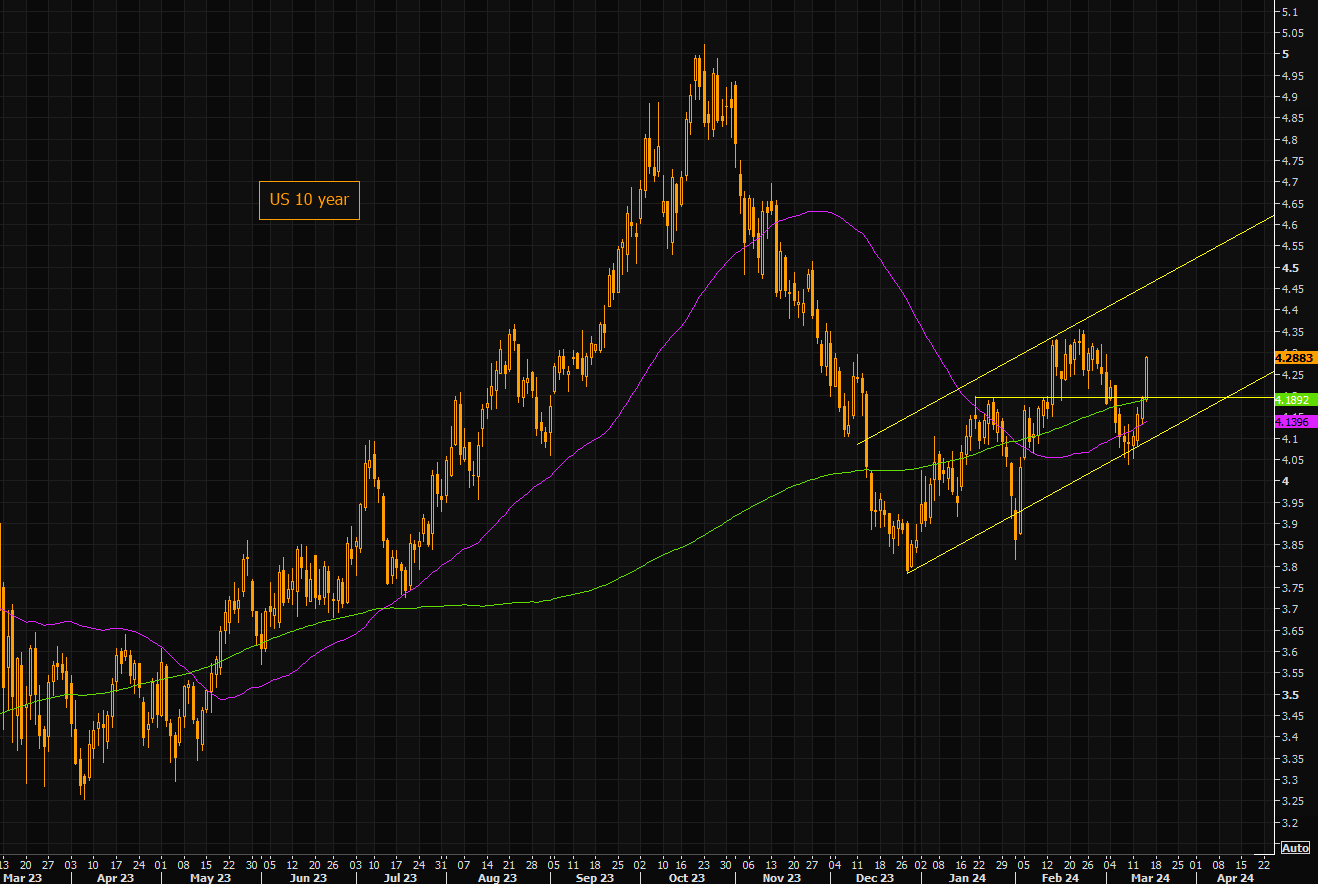
But the 10-year Treasury yield is making a massive up candle as it take out the 4.2% resistance. Note that it now is above the 200-day moving average and closing in on a potential golden cross.
 Click for larger graphic h/t @TheMarketEar
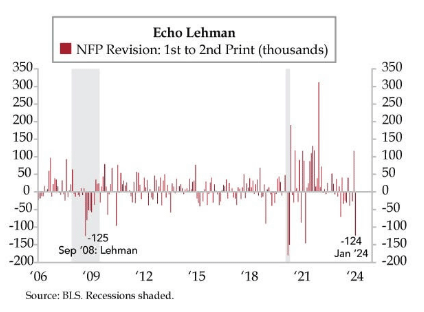
And, as happens during Presidential election years, the initial economic reports are surprisingly good for the administration in power, and then a month later are quietly revised down. The non-farm payroll report is getting especially silly:
Click for larger graphic h/t @DiMartinoBooth
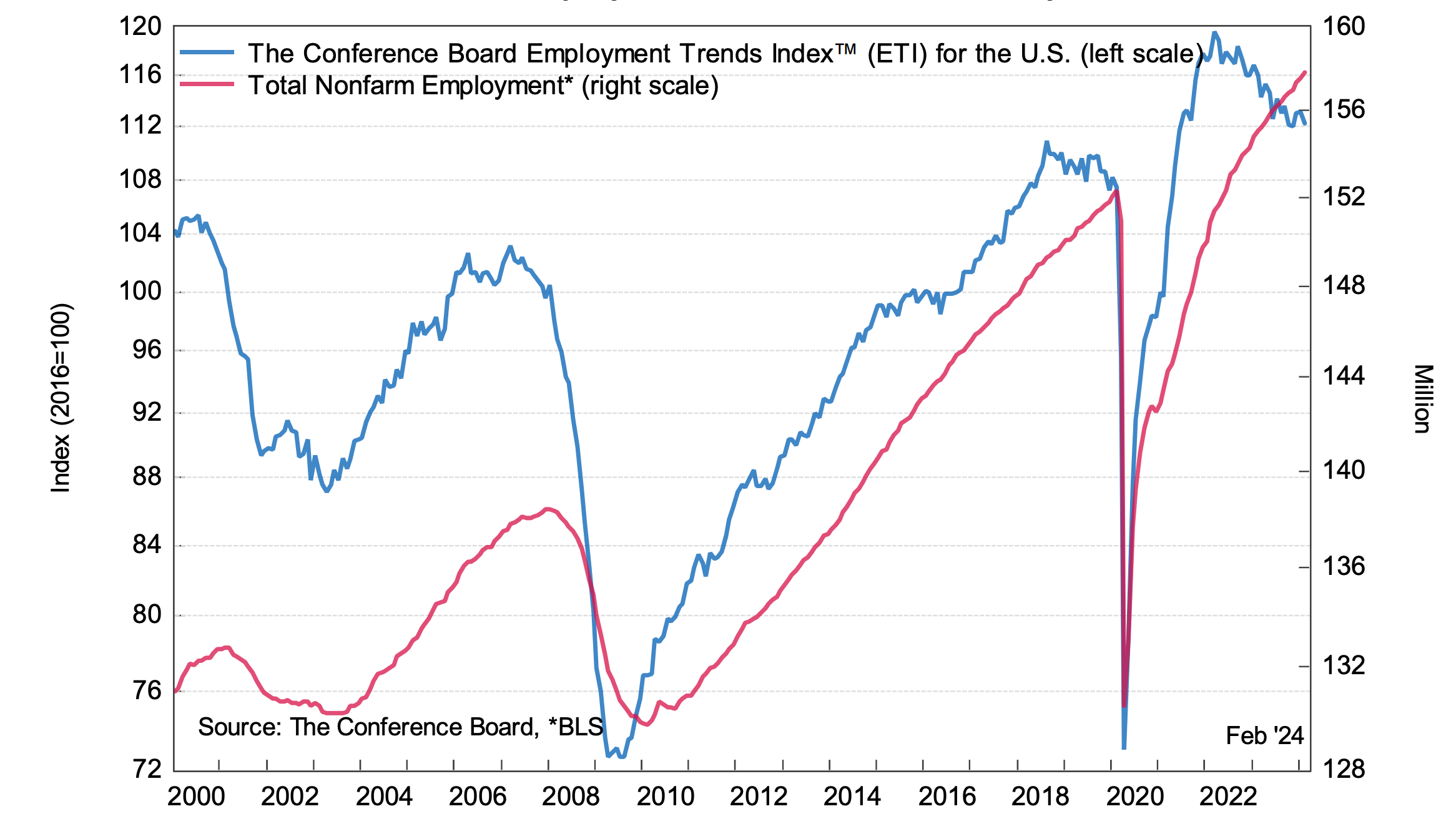
The non-political Conference Board Employment Trends Index “decreased in February to 112.29, from a downwardly revised 113.18 in January…the labor market is likely to cool off, with modest job gains expected through Q3 and Q4 of 2024.”
 Click for larger graphic h/t The Conference Board
The Fed knows all this, of course, and they have said point blank: “The Federal Open Market Committee (FOMC) judges that inflation of 2 percent over the longer run, as measured by the annual change in the price index for personal consumption expenditures, is most consistent with the Federal Reserve’s mandate for maximum employment and price stability.”
The Fed is watching the PCE, which is down to +2.4% overall and +2.8% for the core rate. I still think they won’t cut until they see real GDP weakness. That means a mild recession is coming.
Market Outlook
The S&P 500 dropped a minuscule 0.1% since last Thursday. Remember that 5% pullbacks tend to occur three times a year and 10% corrections have occurred once per year. The Index is up 8.0% year-to-date. The rally is broadening out – 26% of NYSE stocks have made a 52-week high in the past two weeks.
The Nasdaq Composite lost 0.9% as tech funds had the largest outflow ever last week, $4.4 billion. It was the first outflow in nine weeks.
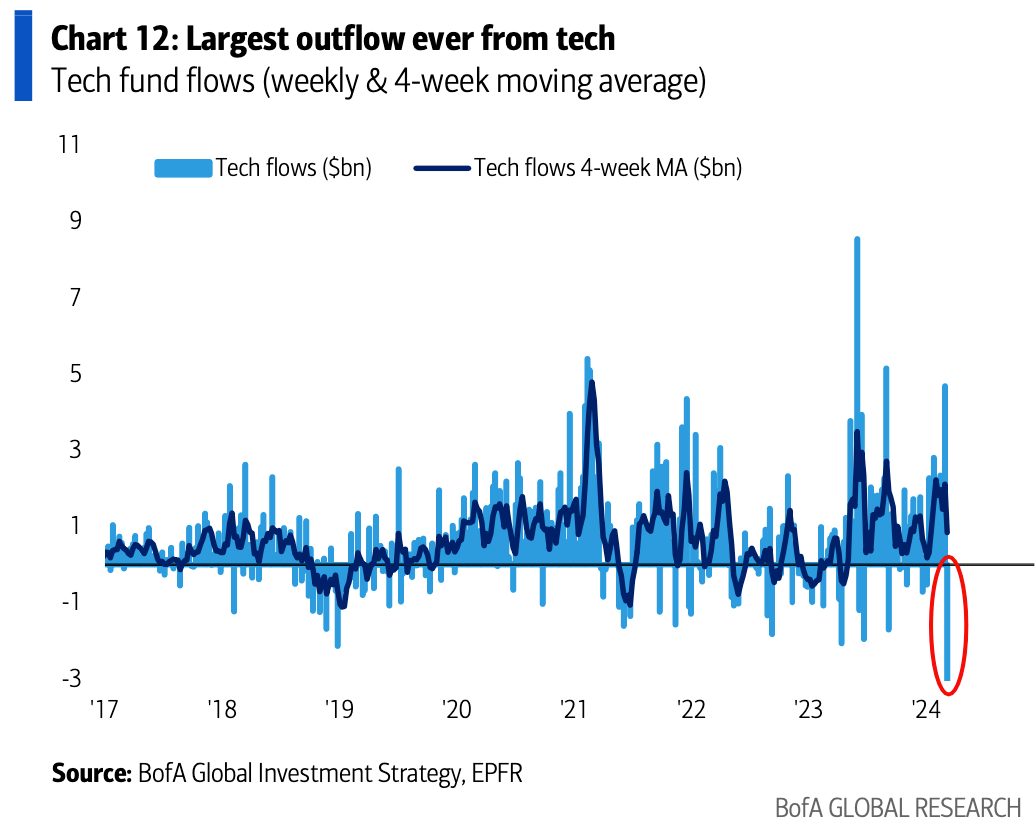 Click for larger graphic h/t BofA Global Research
The Naz is up 7.4% for the year. The SPDR S&P Biotech Exchange-Traded Fund (XBI) fell 4.4% as the biotech rally retraced a bit. It is up 5.8% year-to-date. The small-cap Russell 2000 dropped 2.6% and now is only up 0.2% in 2024.
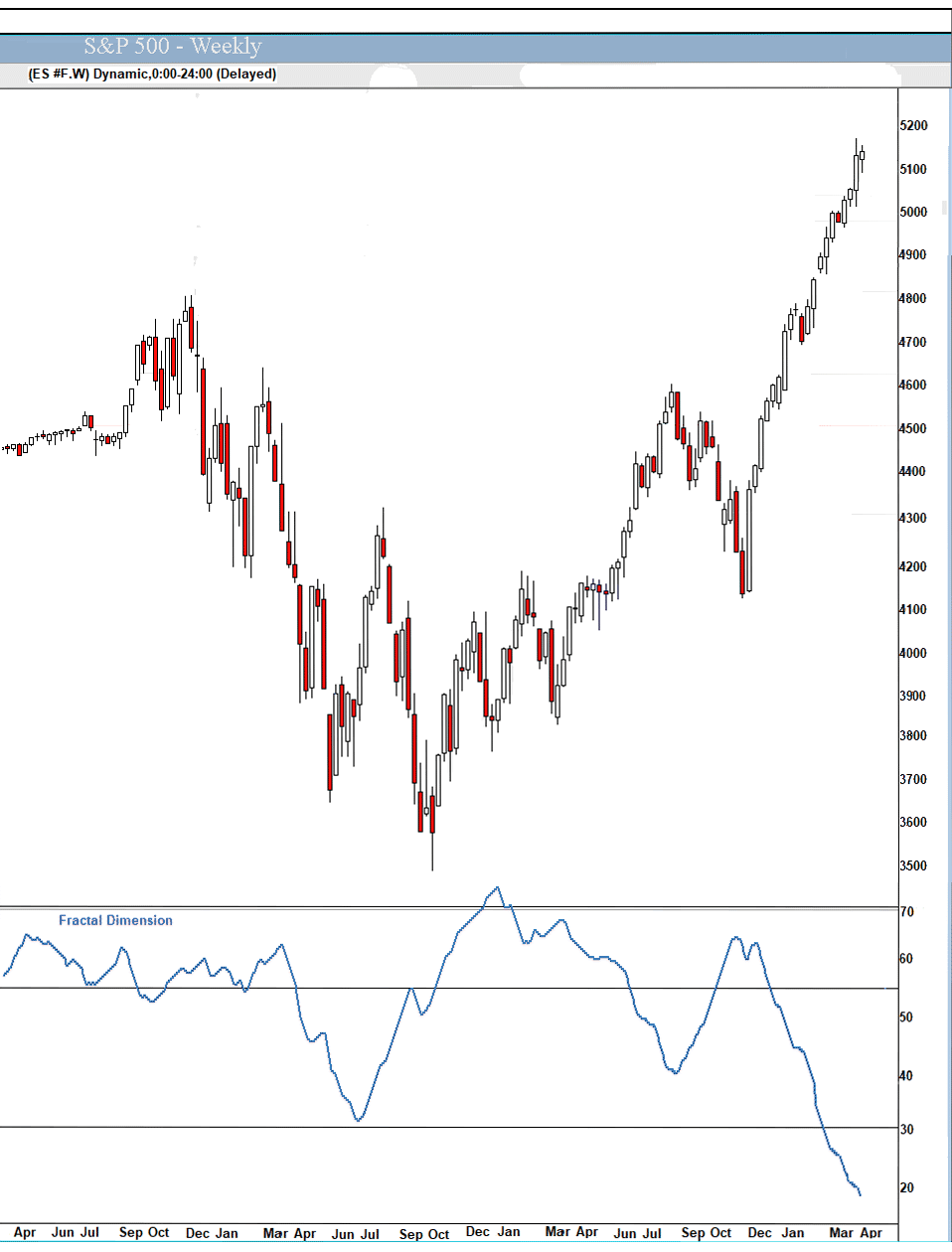
The fractal dimension pushed further into uncharted territory as the pause that refreshes was postponed for another week.
The percentage of the S&P 500 stocks hitting new highs faded for three years into the market top in 2000.
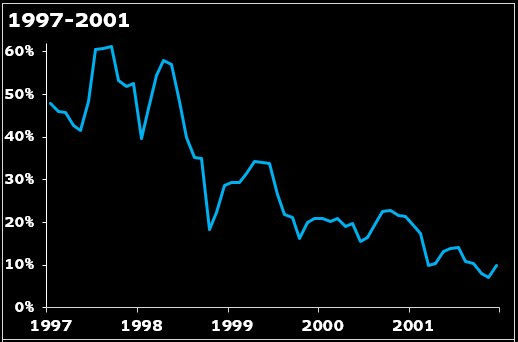
Click for larger graphic h/t @GinaMartinAdams
But the percentage is increasing now.
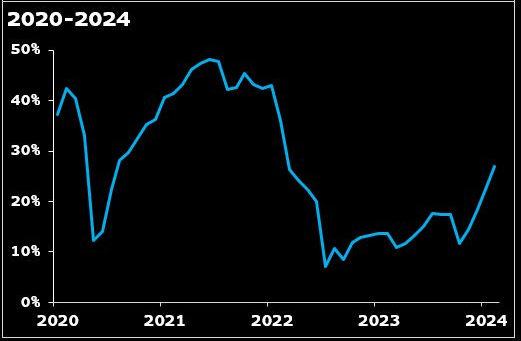 Click for larger graphic h/t @GinaMartinAdams
Still, I am very aware that next-12-months Price/Earnings multiples have stayed elevated even as rate cut expectations have faded.
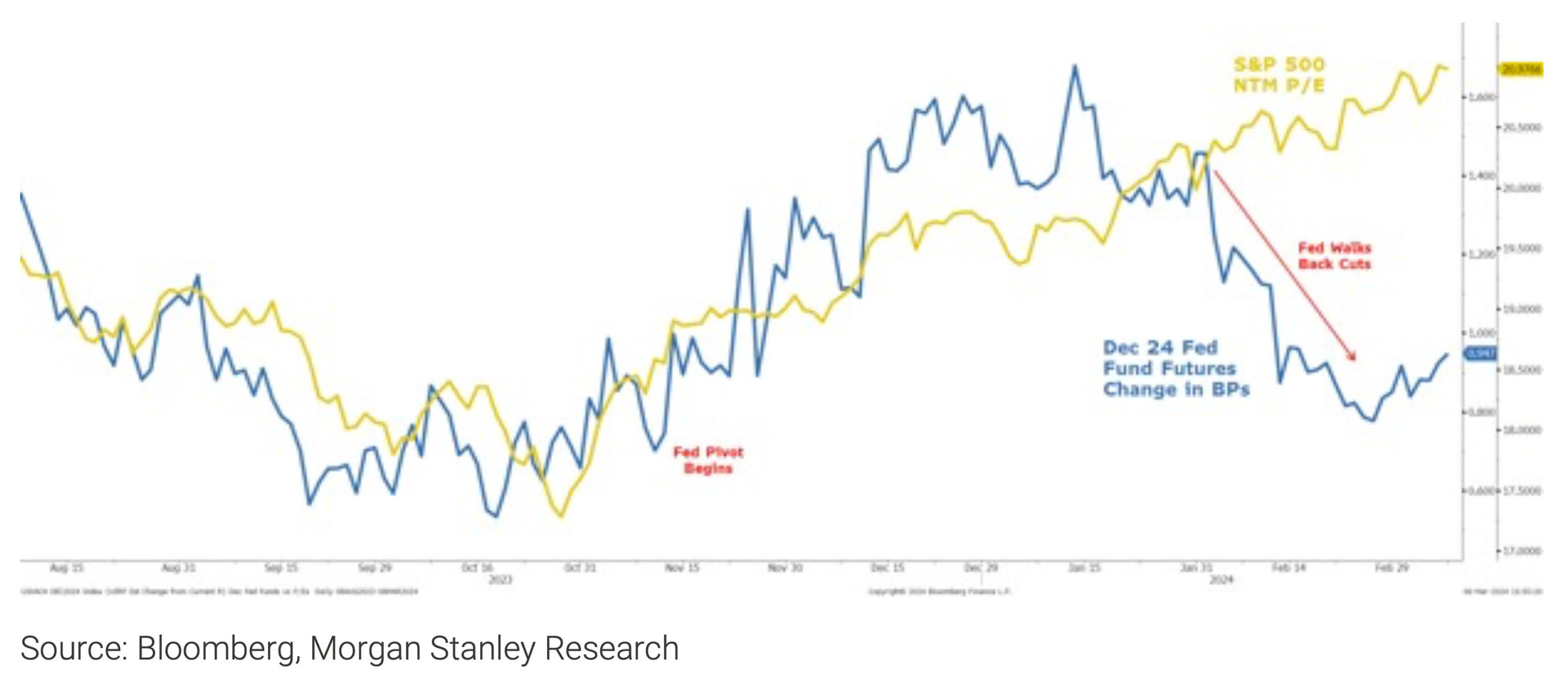 Click for larger graphic h/t Morgan Stanley
And the latest data from Investor’s Intelligence shows the most optimism and the least pessimism since the summer of 2021.
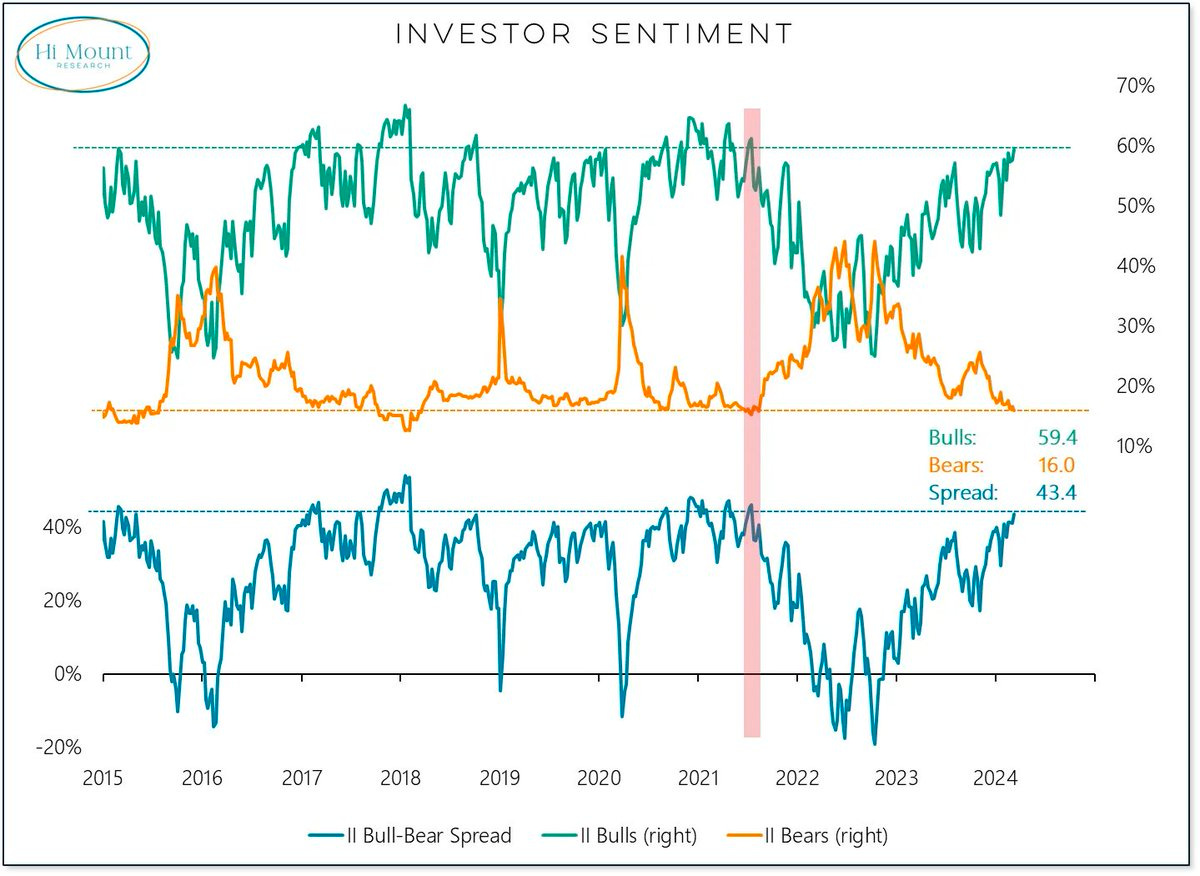 Click for larger graphic h/t @himountresearch
That’s why I suggested portfolio insurance in the February 22 issue – unneeded so far.
Top 5
Changes this week: None
Near-Term – chronological order
SCYX – ScyNexis – Data releases and resolution of the manufacturing problem
TGTX TG Therapeutics – Rapid recovery from overdone pullback
EQT EQT –natural gas price rebound
USL United States 12 Month Oil Fund, LP – crude should rise quickly
FCX Freeport McMoRan – copper shortage
Long-Term – alphabetical order
EQT EQT – largest US natural gas company
IBIT iShares Bitcoin Trust – Bitcoin is headed for $100,000
META Meta – a (the?) leader in the metaverse
RKLB Rocket Lab – #2 to SpaceX in space
SCYX ScyNexis –First new antifungal in 20 years
VLD Velo3D – Return manufacturing to the US
Economy
The Atlanta Fed’s GDPNow model reduced its estimate for March quarter real GDP growth from +2.5% to +2.3% due to slower personal consumption expenditures growth.
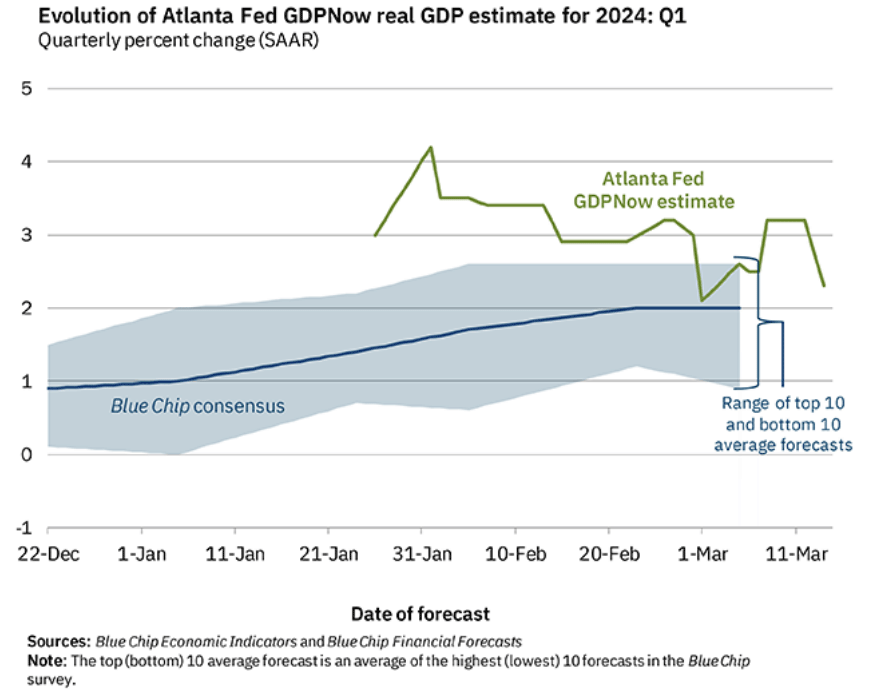 Click for larger graphic
Coming Events
All times below are ET, and most presentations and slides are archived on the companies’ websites so you can listen to them.
Tuesday, March 19
RKLB – Rocket Lab – 11:30am – Roth Conference
Vernal Equinox – 11:06pm
Wednesday, March 20
ABCL – AbCellera – 11:15am – KeyBanc Capital Markets Life Sciences & MedTech Investor Forum
Fed meeting – 2:00pm – Press release; 2:30pm press conference
Big Tech: The Biotech & Digital Dominators MegaShift
There are at least four ways to make money in the stocks of these large, growing, dominant companies. You can:
* * Buy a stock and hold it
* * Buy a stock and write a call option against it
* * With a Level IV options account, write an out-of-the-money put option
* * With a Level IV options account, write an out-of-the-money put option and use part of the premium to buy an out-of-the-money call option
Apple (AAPL – $173.00) began its share buyback program in 2013. Since then, they’ve bought back $650.88 billion of stock. By calendar year:
2013: $22.95 billion in buybacks
2014: $45 billion
2015: $35.253 billion
2016: $29.722 billion
2017: $32.9 billion
2018: $72.738 billion
2019: $66.897 billion
2020: $72.358 billion
2021: $85.971 billion
2022: $89.402 billion
2023: $77.55 billion
This is not just offsetting stock options. By the end of 2024 they had retired 41.27% of their outstanding shares.
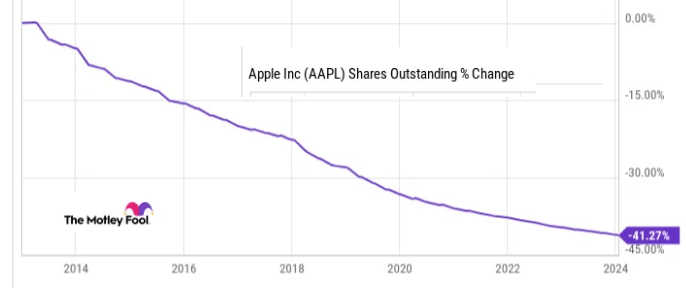 Click for larger graphic h/t @TheMotleyFool
Healthcare developers are creating new apps for the Vision Pro that were not previously possible, transforming areas such as clinical education, surgical planning, training, medical imaging, behavioral health, and more. For example, when surgeons use Stryker’s Mako SmartRobotics for total hip, total knee, and partial knee replacements, it can help lead to better patient outcomes like less pain and shorter recovery times, compared to traditional joint replacement surgeries. With the new myMako Vision Pro app, surgeons can visualize and review patients’ Mako surgical plans at any time in an immersive visual experience. It changes the way surgeons think about preoperative planning and the intraoperative experience.
Apple Services continues to grow with Friday Night Baseball, a weekly doubleheader, available to Apple TV+ subscribers starting March 29 throughout the 2024 regular season. Apple has picked up the Joe Rogan podcast.
Apple is spending $1 billion a year on developing AI products and ad tools. In the December quarter conference call, CEO Tim Cook said: “We continue to spend a tremendous amount of time and effort on AI…I think there’s a huge opportunity for Apple with GenAI.”
We are going to see significant AI features in the iPhone 15 in September that will drive a massive upgrade cycle. Apple already is testing AI-powered ad tools for the App Store. But most of Wall Street is pretending Apple is behind, in hopes you will sell your stock to them at lower prices before June’s Worldwide Developers Conference. After the March quarter report in April, I plan to raise the Buy limit substantially. For now, AAPL is a Buy under $150 for new iPhone rollouts and augmented/virtual reality products.
Gilead Sciences (GILD – $74.21) EVP of the Kite subsidiary presented at the Leerink Partners Global Biopharma Conference (TRANSCRIPT HERE). She said the CAR-T industry only has a 15% to 17% share of treatments. A 15% class share for a curative medicine is not acceptable. Kite has 142 authorized treatment centers (ATCs) today in the US, primarily in academic centers and large hospitals, where CAR-T is being used, although not fully. But only 20% of patients are seen in academic centers. 80% of patients are seen in the community today, and only 30% of them are getting referred into the ATCs. So 50% are not getting the opportunity of CAR-T, and that’s where the major growth opportunity is.
Last year, Kite served 6,000 CAR-T patients and still had capacity for more. By 2026, they’ll be able to treat 24,000 a year. That drives down cost of goods and increases profitability.
The CFO spoke at Barclays Global Healthcare Conference (TRANSCRIPT HERE). He said Gilead is moving into the second stage of the restructuring expansion of the company. They have a number of growth opportunities and expect accelerating growth through the end of the decade.
The Hart-Scott-Rodino waiting period for their CymaBay (CBAY) tender offer has expired, so they will close that deal. They just signed a partnership with Merus, a Netherlands-based biotech company, for a potential $1.5 billion deal for the development of T-cell engagers. Merus will receive an upfront payment of $56 million for initial targets and an equity investment of $25 million from Gilead. The deal also includes the possibility of Merus earning additional payments based on the achievement of development and commercialization milestones.
The collaboration will utilize Merus’s proprietary platform, which is capable of designing antibodies that can bind to three targets simultaneously. It further expand Gilead’s oncology portfolio. GILD is a Long-Term Buy under $80 for a first target of $120.
SoftBank (SFTBY – $28.68) subsidiary ValueCommerce is buying back enough of its shares from SoftBank to cease to be a subsidiary and become an equity method associate. Masa does this to reduce the volatility of SoftBank’s results. SFTBY is a Buy under $25 for a first target of $50 in the next two years.
Small Tech
PagerDuty (PD – $22.93) reported January fourth quarter revenues up 10.1% from last year to $11.12 million, just ahead of the $110.39 estimate. Earnings hit 17¢ a share, beating the 15¢ estimate. But on the conference call (AUDIO HERE and SLIDES HERE), management guided first quarter revenues up 7% to 9% to $110.5 million to $112.5 million with pro forma earnings of 12¢ to 13¢. That is below the consensus estimate for $113.3 million and 18¢.
For fiscal 2025, they guided for revenues to grow 9% to 11% to $470.0 million to $478.0 million, with pro forma earnings of 65¢ to 70¢. Both were under the consensus for $480.7 million and 82¢, and the stock fell 10% in aftermarket trading.
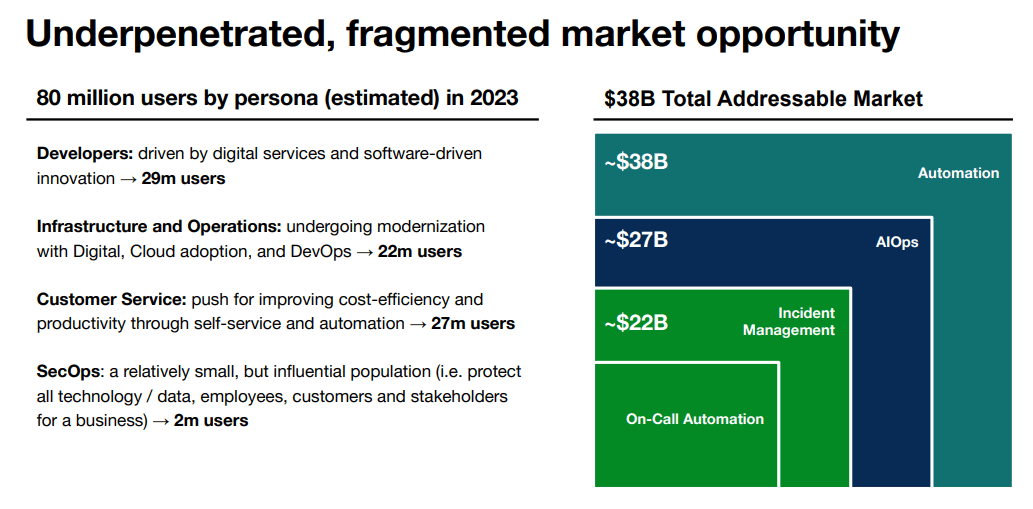
Customer retention rates, although still solid, were down from 120% in last year’s quarter to 107%. Total paid customers were also down by more than 200 to 15,039. They expect both metrics to grow this year. They have a very attractive potential market:
 Click for larger graphic
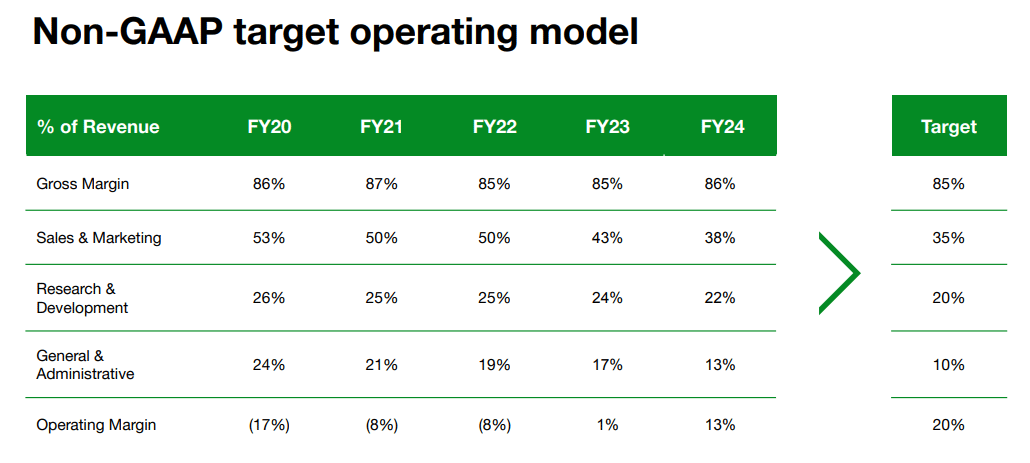
And they are relentlessly closing in on their target 20% operating margin, now with 804 customers generating over $100,000 in annual revenues each.
 Click for larger graphic
The company finished the quarter with $571.2 million in cash. PD is a Buy up to $30 for a 2- to 5-year hold as their digital operations management Software-As-A-Service gains market share.
Primary Risk: Digital operations management is a competitive area.
QuickLogic (QUIK – $17.44) announced a strategic partnership with Zero-Error Systems America, a leading provider of radiation-hardened-by-design semiconductor solutions and intellectual property. This partnership enables the creation of radiation-tolerant eFPGA IP for commercial space applications, targeting application-specific integrated circuits and systems-on-a-chip that require high reliability in flight and space environments. QUIK is a Buy up to $10 for my $40 target as their earnings repeatedly surprise Wall Street.
Primary Risk: Customers’ product introductions and associated royalties are unpredictable.
Rocket Lab USA (RKLB – $4.17) won a contract from Viasat for a 2026 launch to support its NASA Communications Services Project program demonstrations of multi-band space-relay capabilities.
The company launched its 45th Electron rocket, successfully deploying a fourth synthetic aperture radar satellite to Synspective’s Earth-observation constellation.
RKLB has been the sole launch provider for Synspective’s constellation, previously delivering three satellites across launches in September 2022, February 2022, and December 2020.They will launch two more missions for Synspective. RKLB is a Buy up to $13 for my $30+ target as low earth orbit satellites and space exploration grow.
Primary Risk: A new competitor emerges.
Velo3D (VLD – $0.36) said Bechtel Plant Machinery is buying a fully integrated metal additive manufacturing solution to produce parts for the US Naval Nuclear Propulsion Program. The Sapphire XC large format printer, calibrated for stainless steel 415, will produce parts previously produced through casting, reducing lead times for mission critical parts and streamlining their supply chain. VLD is a Buy up to $6 for my $50 target as Velo3D’s high-tolerance metal parts printing business grows.
Primary Risk:A new 3D metal printing competitor emerges.
Biotech MegaShift: The $20-For-$1 Stocks
Say you put $2,000 into a stock that goes from 50¢ a share to $10. The $2,000 turns into $40,000. Then you put the $40,000 into another stock that goes from 50¢ to $10. That turns the $40,000 into $800,000. You did it with two stocks and never risked going negative more than $2,000. (Not that you won’t be mad at me if the first one works and then the second one doesn’t, taking your $40,000 to Money Heaven.)
If you can afford it – and it would not be too big a position in your portfolio – putting $2,000 into each of these speculative biotechs might be a good way to start. Buying these out-of-favor, fallen, or forgotten companies that can get important products through the FDA at very low market capitalizations seems like a good strategy to me.
Risks
Development-stage biotechs are subject to investor sentiment swings from wildly optimistic to excessively pessimistic – mostly the latter recently. After the Primary Risk for each company, I’ve added the clinical stage of their lead product, the probable time of their first FDA approval, and the probable time of their next financing.
As always, you need to think about an appropriate position size. You could buy a full position upfront and then just hold on, or buy some upfront and leave room to add more on the inevitable financings, transient clinical trial setbacks, and the like.
AbCellera Biologics (ABCL- $4.70) and Biogen (BIIB) entered into a strategic collaboration to discover antibodies for a novel target that enables the delivery of biotherapeutics to the brain for indications in neuroscience.
In this article, the authors discuss the increasing popularity of antibody-drug conjugates (ADCs) in the pharmaceutical industry. Pfizer’s strategic prioritization of ADCs for oncology treatments over small molecules is cited as an example of this trend. The article concludes by emphasizing the continued growth and potential of the ADC market in oncology, projecting it to reach $30 billion by 2028. AbCellera is the leading source for new antibodies.
Buy ABCL up to $6 for a long-term hold to $30 or more.
Primary Risk: Partnered and owned drugs fail in the clinic.
Clinical stage of lead product: Partnered: Various Owned: Preclinical
Probable time of next FDA approval: 2027-2028
Probable time of next financing: 2026-2027 or never
Akebia Therapeutics (AKBA- $1.37) announced December quarter results but postponed the conference call until after the FDA’s decision for vadadustaton their March 27 PDUFA date. My read on the initial Complete Response Letter and the subsequent positive decision on their appeal is that approval is a near-certainty, but a knowledgeable Twitter poster thinks they’ll get turned down.
I still think approval is likely, but I wanted you to read an intelligent opposing view. Vadadustat approval will hurt Amgen, and we all know that the FDA reviewers tend to protect their potential future employers. Buy AKBA up to $2 for the vadadustat launches in the EU, UK, and (after FDA approval in March 2024) the US.
Primary Risk: Vadadustat not approved in the US.
Clinical stage of lead product: Vadadustat PDUFA date 3/27/24
Probable time of next FDA approval: March 27, 2024; TDAPA October
Probable time of next financing: Late 2024 or never
Invitae (NVTAQ – $0.02) launched an update to Invitae Generation with Clinical Variant Modeling, Machine Learning designed to aid clinical interpretation of genetic testing results and increase the rate of definitive answers for patients. The first of its kind, developed by a multidisciplinary team of computational biologists, machine learning engineers, clinical experts, and geneticists, Clinical Variant Modeling methodically leverages clinical information received at the time of testing to improve variant classification and reduce variants of uncertain significance. Hold NVTAQ for the April 17 auction.
Primary Risk: Current shareholders don’t own any of the restructured company.
Clinical stage of lead product: NM
Probable time of first FDA approval: NM
Probable time of next financing: Mid-2024.
Inflation MegaShift
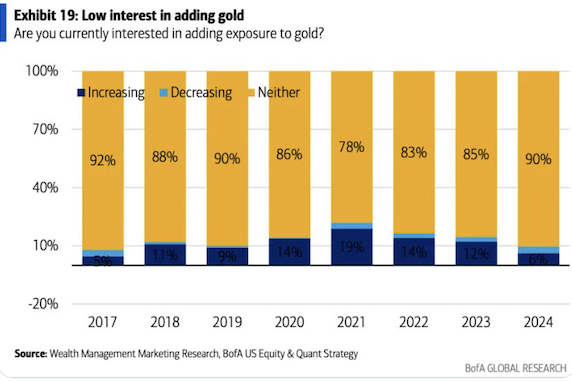
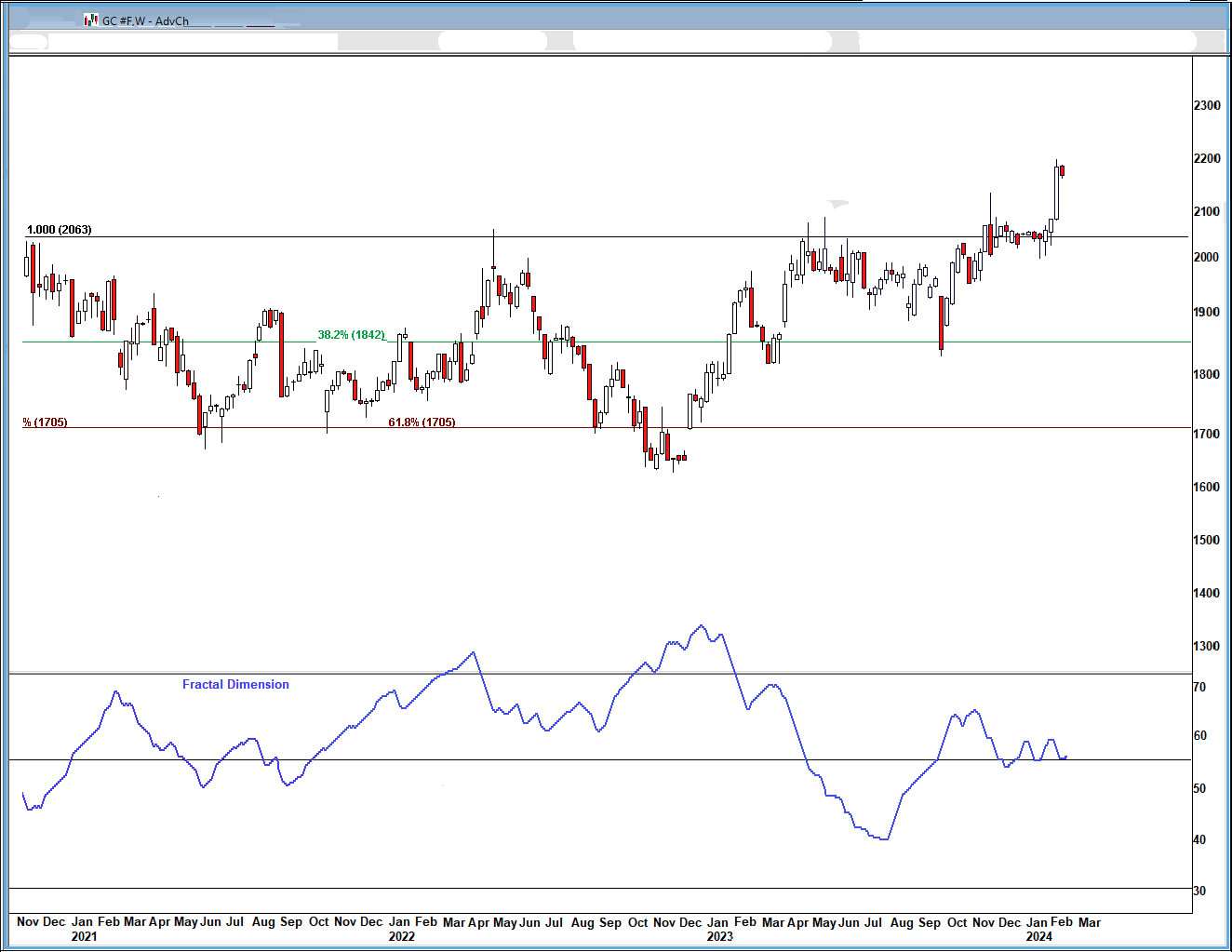
Gold ($2,166.50) has a firm floor at $2,150 after setting a new all-time closing high at $2,182.50. Even so, 75% of advisers have little to no exposure to gold (under 1% of assists), the highest level since 2019. And they have low interest in adding exposure.
 Click for larger graphic h/t @jessefelder
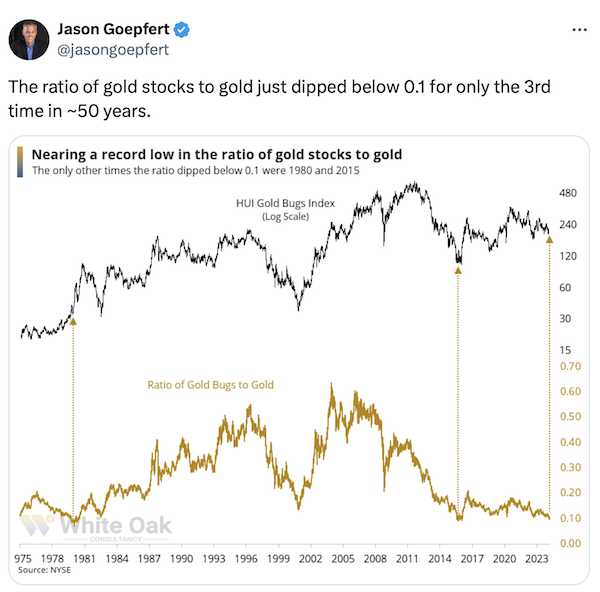
At the same time, gold stocks are at historic lows relative to the price of gold. The ratio of gold stocks to gold just dipped below 0.1 for only the third time in 50 years.
 Click for larger graphic h/t @jasongoepfert
The fractal dimension almost signaled a new trend by breaking under 30, but…nope. Gold’s ability to disappoint is remarkable. Perhaps next week?
Miners & Related
Sandstorm Gold (SAND – $4.89) got a good writeup on Seeking Alpha: A Deep Dive Into the Company and Undervaluation. SAND is a Buy under $10 for a $25 target.
Primary Risk: Prices of precious metals fall due to US dollar strength.
Cryptocurrencies
Cryptocurrencies are a diversifying asset that offer a unique opportunity to make (or lose!) a lot of money quickly. You can easily buy bitcoin and other cryptocurrencies at Coinbase, Block, or Robinhood.
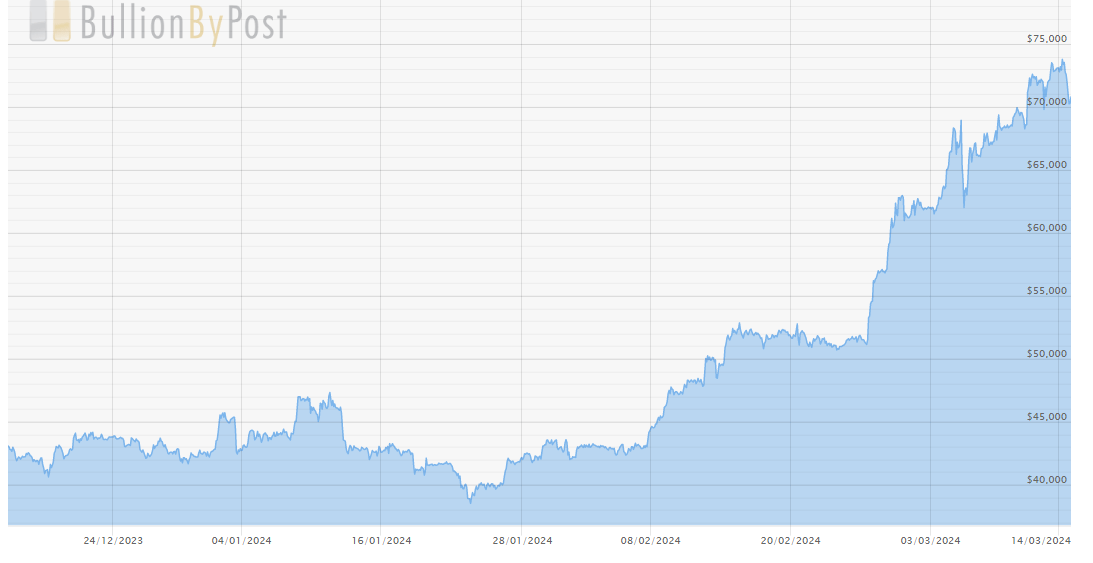
Bitcoin (BTC-USD on Yahoo – $70,793.30) hit a new all-time high today over $73,000 as the UK’s Financial Conduct Authority said it will allow cryptocurrency-backed Exchange Traded Notes for professional investors. The London Stock Exchange said it will accept applications for bitcoin and ethereum ETNs in the June quarter, paving the way for another wave of institutional adoption.
The launch of spot exchange-traded funds (ETFs) in the US on January 11 has led to an average daily demand of 4,500 bitcoins per trading day, while only an average of 921 new bitcoin were minted per day.
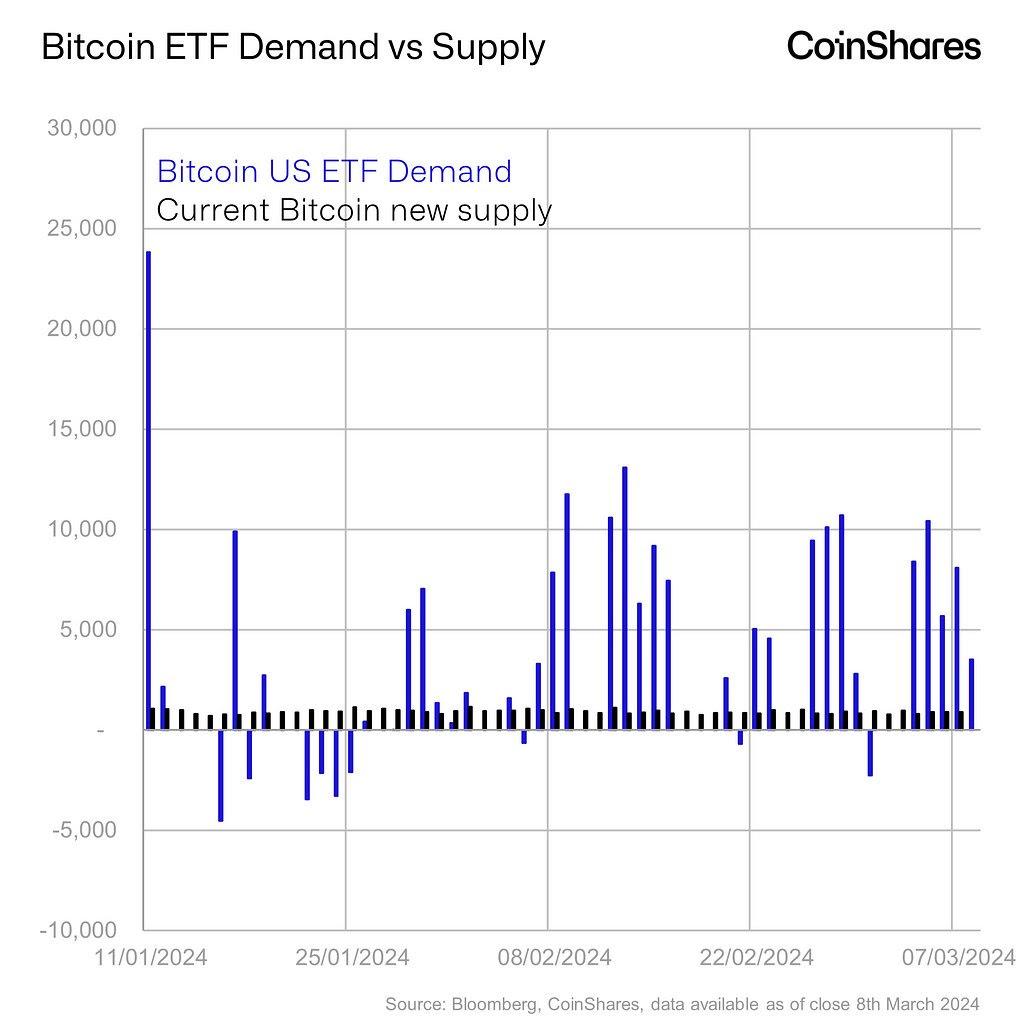 Click for larger graphic h/t CoinShares
According to CryptoQuant Founder Ki Young Ju, if this trend continues: “We’ll see a sell-side liquidity crisis within six months.” A sell-side liquidity crisis would mean that there are not enough sellers to suppress the price of bitcoin while the ETFs are obligated to buy. This would send the price soaring above my $100,000 near-term target. VanEck, an ETF manager, has a “medium-term” target of $350,000.
MicroStrategy bought another 12,000 coins for $821.71 million and is offering its second convertible note this month to buy more bitcoin. This one is to institutional investors for $500 million, due in 2031. They had announced a $600 million private offering of convertible notes on March 5. As of March 10, they held 205,000 bitcoin with an average purchase price of $33,706 per coin.
 Click for larger graphic
BTC-USD, ETH-USD, IBIT, and ETHE are Strong Buys.
Primary Risk: Bitcoin falls due to over-regulation or is surpassed by another cryptocurrency.
iShares Bitcoin Trust (IBIT- $39.51) has grabbed the crypto crown with more than $12 billion under management and already owns more coins than MicroStrategy.
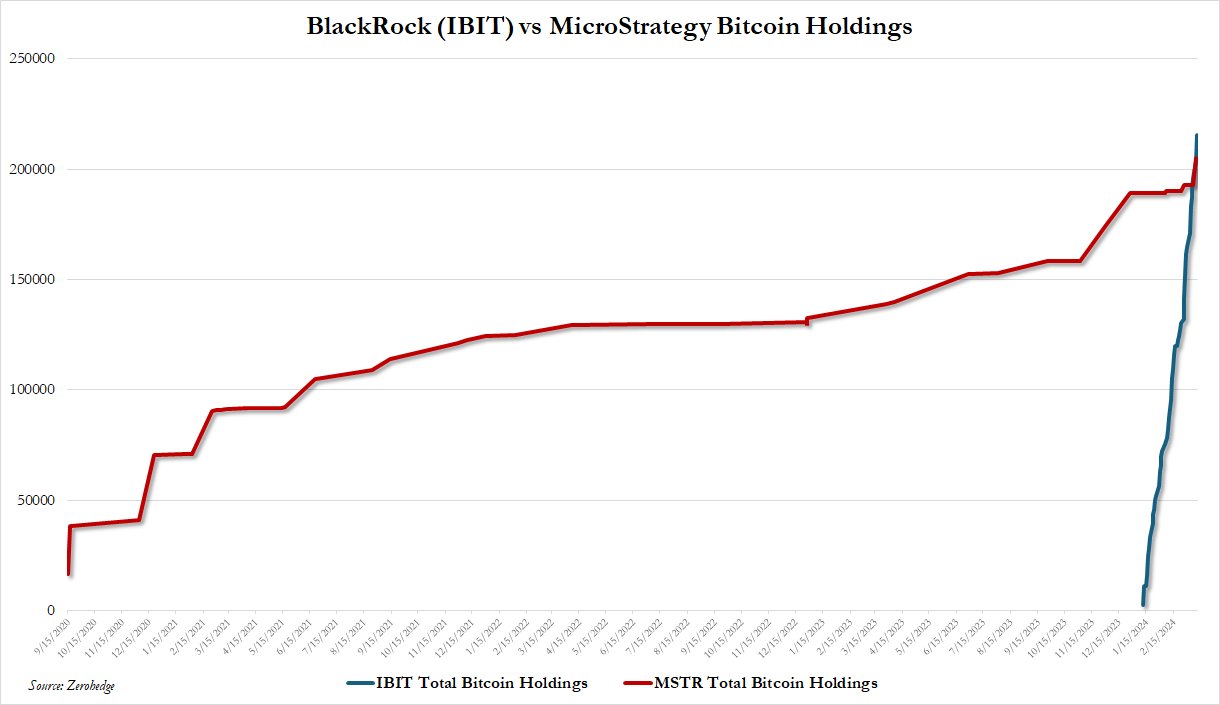 Click for larger graphic h/t @zerohedge
The next largest spot bitcoin ETF among the 11 launched in January is the Fidelity Wise Origin Bitcoin ETF (FBTC) at $7.6 billion. Bank of America’s Merrill division and Wells Fargo recently allowed their wealth management clients to buy the ETFs. IBIT is a Buy for the 2024 and 2028 halvings.
Primary Risk:Bitcoin falls due to over-regulation or is surpassed by another cryptocurrency.
Commodities
Oil – $81.08
Oil closed over $80 for the first time since November 6 as demand remained strong, noticeably dropping product storage.
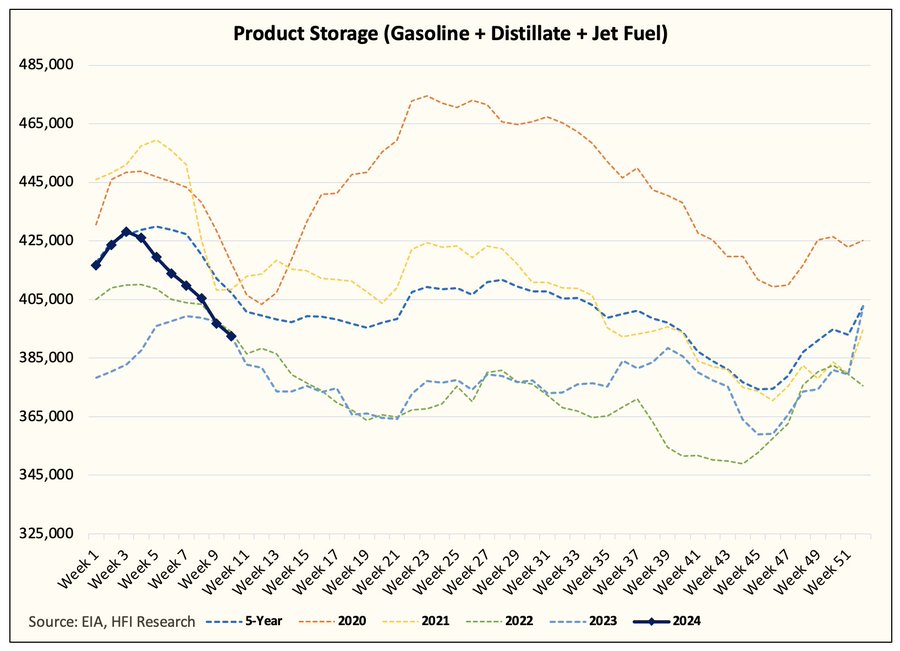 Click for larger graphic h/t @HFI_Research
The July 2026 Crude Oil Futures (CLN26.NYM – $68.88) are a Buy under $70 for a $200+ target. Only buy futures for all cash; do not use margin.
The United States 12 Month Oil Fund, LP (USL – $38.86) is a Buy under $40 for a $100+ target.
EQT (EQT – $33.78) is acquiring Equitrans Midstream (ETRN), an operator of dry gas gathering systems, over 2,000 miles of interstate pipelines including the Mountain Valley Pipeline that overlap EQT’s core upstream operations, and storage systems serving the Appalachian Basin. Management called it a “transformative” acquisition that creates America’s only large-scale, vertically integrated natural gas company. It is a $5.5 billion all-stock transaction with a combined company enterprise value over $35 billion.
The deal reduces EQT’s long-term corporate free cash flow breakeven to less than $2 per million British thermal units (MMBtu), giving them robust free cash flow generation through all parts of the commodity cycle. The cost structure integration will materially improve the economics of EQT’s remaining ~4,000 drilling locations. And they see immediate annual savings of $250 million with identified upside to more than $425 million.
Equitrans Midstream has a lot of debt that EQT will focus on paying down, so Wall Street knocked the stock down because the free cash flow will go first to debt reduction in the near-term. I have learned that a dollar of debt reduction is as good for shareholders as a dollar of stock buybacks, so I like the deal. CEO Toby Rice said the integration of contractual volume commitments eliminates over $11 billion of future liabilities, which is well in excess of the assumed debt. In addition, they have identified a low-risk path to more than $5.0 billion of near-term debt repayment via $3.5 billion of asset sales and organic free cash flow. Their long-term debt target is $7.5 billion and all three credit rating agencies have reviewed the pro forma balance sheet and will maintain EQT’s investment grade credit rating.
On the conference call (AUDIO HERE and SLIDES HERE), management pointed to the substantial upside for EQT shareholders:
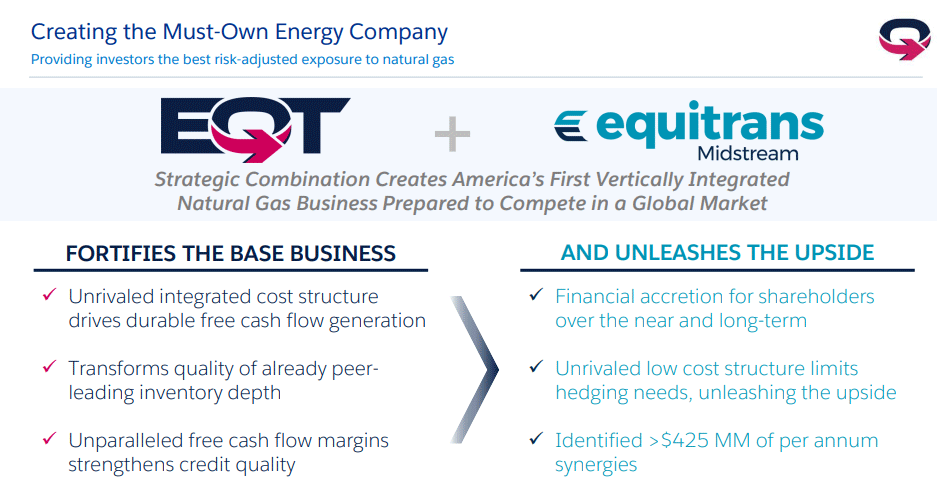 Click for larger graphic
They have downside protection to low natural gas prices because they are the low-cost producer. And because this deal minimizes the need to hedge, they get the full benefit of gas price increases. EQT is a buy under $35 for a first target of $70 and a long-term hold for much higher prices.
Primary Risk:Natural gas prices fall.
Energy Fuels (UUUU – $5.89) will benefit as uranium prices increase to feed the 68 reactors under construction and somewhere between 110 and 150 reactors in the planning and permitting phase.
The uranium spot price dropped from $89 to $81, panicking some, but 20% to 30% drops have been the norm in this uptrend.
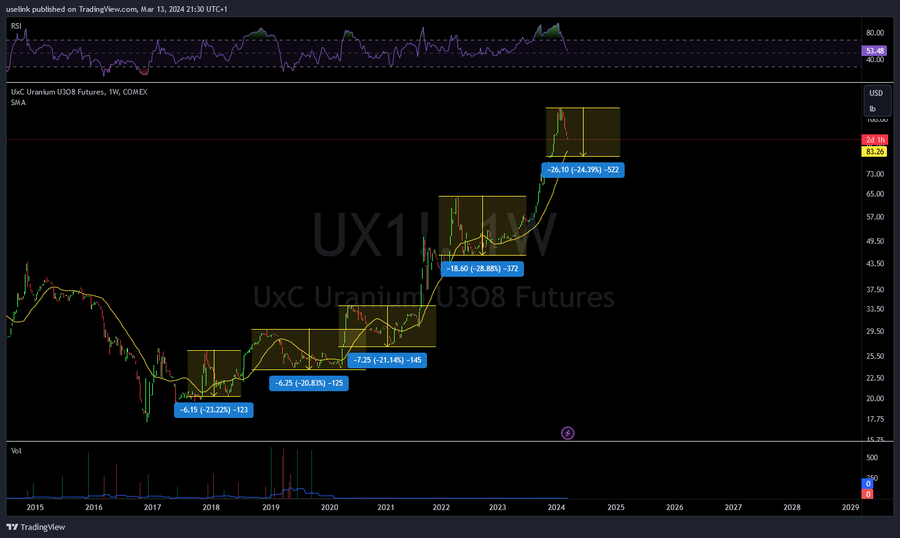 Click for larger graphic h/t @uselinkinv
UUUU is a buy under $8 for a $30 target.
Primary Risk: Uranium prices fall.
Freeport McMoRan (FCX – $43.32) moved up as copper futures jumped +3.10% to their highest in more than seven months after top Chinese copper smelters agreed to reduce production at unprofitable facilities due to raw material shortages. FCX is a buy under $44 for a $65 target within two years.
Primary Risk: Copper prices fall.
International & Other Recommendations
Acreage Holdings (ACRDF – $0.21) started adult-use sales at the first cannabis storefront in Vernon, Connecticut. ACRDF is a buy under $2 for a hold for the Canopy Growth merger and beyond.
Primary Risk: Canopy Growth does not acquire the company.
* * * * *
Each color shows $1 trillion getting added to the national debt.
Not that long ago, it took six years to add a bar.
We’re now adding one every 90-120 days.
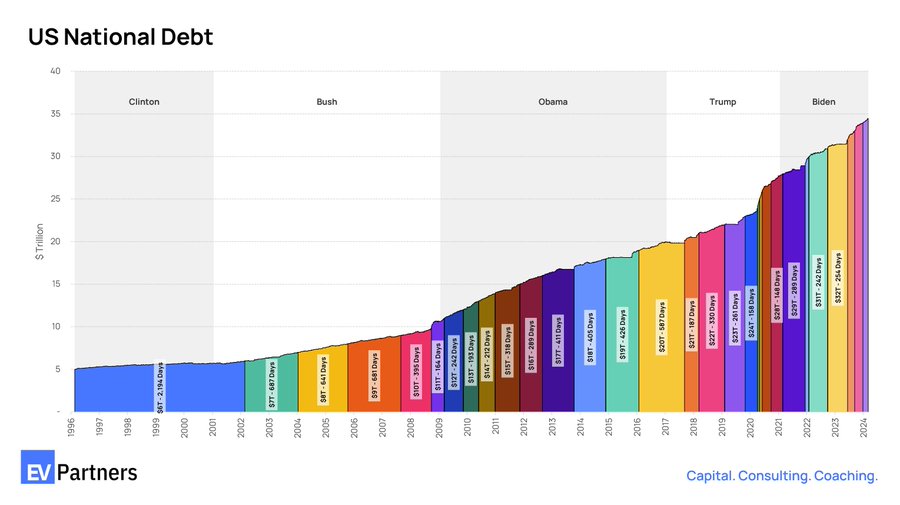 Click for larger graphic h/t @RobertMSterling
* * * * *
Click for larger graphic
* * * * *
Your getting ready for the crisis Editor,

Michael Murphy CFA
Founding Editor
New World Investor
All Recommendations
Priced 3/14/24. Check out the complete Portfolio page HERE.
Portfolio Protection
April 30 SPY $505 put (SPY240430P00505000 – $4.75)
April 30 SPY $410 put (SPY240430P00410000 – $0.39)
Buys
These are the stocks everyone needs to own because transformative events are happening over the next year or two, and I expect to hold them long-term.
Tech Dominators
Apple Computer (AAPL – $173.00) – Buy under $150 for new iPhones
Corning (GLW – $32.53) – Buy under $33, target price $60
Gilead Sciences (GILD – $74.21) – Buy under $80, target price $120
Meta (META – $491.83) – Buy under $345, target price $400
SoftBank (SFTBY – $28.68) – Buy under $25, target price $50
Small Tech
Enovix (ENVX – $7.76) – Buy under $20; 4-year hold to $100+
First Trust NASDAQ Cybersecurity ETF (CIBR – $57.00) – Buy under $40; 3- to 5-year hold
Fastly (FSLY – $12.77) – Buy under $20; 2- to 5-year hold to $80+
PagerDuty (PD – $22.93) – Buy under $30; 2- to 5-year hold
QuickLogic (QUIK – $17.44) – Buy under $10, target price $40
Rocket Lab (RKLB – $4.17) – Buy under $13, target price $30+
Velo3D (VLD – $0.36) – Buy under $6, target price $50
$20-for-$1 Biotech
AbCellera Biologics (ABCL – $4.70) – Buy under $6, target $30+
Akebia Biotherapeutics (AKBA – $1.37) – Buy under $2, target $20
Aptose Biosciences (APTO – $1.40) – Buy under $10, ultimate target $300
Compass Pathways (CMPS – $9.80) – Buy under $20, hold a long time for a 10x return
Inovio (INO – $10.81) – Buy under $14, hold a long time
Medicenna (MDNAF – $1.16) – Buy under $3, first target $20, then maybe $40
ScyNexis (SCYX – $1.50) – Buy under $3, target price $20, then $50
TG Therapeutics (TGTX – $15.36) – Buy under $12 for buyout at $30+
Inflation
A Short-Sale or REO House – ($415,400) – Hold
Bag of Junk Silver – ($25.02) – hold through silver bull market
Sprott Gold Miners ETF (SGDM – $23.81) – Buy under $28, target price $50
Sprott Junior Gold Miners ETF (SGDJ – $29.72) – Buy under $39, target price $100
Sprott Physical Gold and Silver Trust (CEF – $19.98) – Buy under $18, target price $30
Global X Silver Miners ETF (SIL – $26.06) – Buy under $30, target price $50
Coeur Mining (CDE – $3.17) – Buy under $5, target price $20
First Majestic Mining (AG – $5.40) – Buy under $11, next target price $23
Paramount Gold Nevada (PZG – $0.38) – Buy under $1, first target price $10
Sandstorm Gold (SAND – $4.89) – Buy under $10, target price $25
Sprott Inc. (SII – $35.80) – Buy under $40, target price $70
Cryptocurrencies
Bitcoin (BTC-USD – $70,793.30) – Buy
iShares Bitcoin Trust (IBIT – $39.51) – Buy
Ethereum (ETH-USD – $3,840.34) – Buy
Grayscale Ethereum Trust (ETHE – $29.40) – Buy
Commodities
Crude Oil Futures – July 2026 (CLN26.NYM – $68.88) – Buy under $70; $200+ target
United States 12 Month Oil Fund, LP (USL – $38.86) – Buy under $40; $100+ target
Vermilion Energy (VET – $11.40) – Buy under $11; $24 target
EQT (EQT – $33.78) – Buy under $35; $70 first target
Energy Fuels (UUUU – $5.89) – Buy under $8; $30 target
Freeport McMoRan (FCX – $43.32) – Buy under $44; $65 target within two years
International & Other Recommendations
EMQQ Emerging Markets Internet & Ecommerce ETF (EMQQ – $31.13) – Buy under $38 for a $66 target in 12 to 18 months
KraneShares Bosera MSCI China A Share Fund (KBA – $21.46) – Buy under $40 for a three- to five-year hold
Morgan Stanley China A-Shares Fund (CAF – $12.14) – Buy under $18 for a three- to five-year hold
KraneShares CSI China Internet ETF (KWEB – $26.44) – Buy under $40 for a double over the next three years
Acreage Holdings (ACRDF – $0.21) – Buy under $2 for the Canopy Growth merger
Mongolia Growth Group (MNGGF – $1.04) – Buy under $1.30; long-term hold
Holds
These are holds but not sells – yet. They could get moved back to one of the buy categories if their prices drop or outlook improves, or they could become sell recommendations in the future.
Arch Therapeutics (ARTH – $2.10) – Hold for buyout
Invitae (NVTAQ – $0.02) – Hold for April 17 auction
Publisher: GwynRose LLC, 5348 Vegas Drive, Suite 868, Las Vegas, NV 89108
New World Investor does not act as a personal investment adviser or advocate the purchase or sale of any security or investment for any specific individual. The recommendations and analysis presented to members are for the exclusive use of members. Members should be aware that investment markets have inherent risks and there can be no guarantee of future profits. Likewise, past performance does not assure future results. Recommendations are subject to change at any time. Nothing in this presentation should be considered personalized investment advice. No communication to you by Michael Murphy or any of our employees or contractors should be deemed as personalized investment advice.
Copyright ©GwynRoseLLC 2024
New World Investor Mastermind Group
1. Post unto others as you would have them post unto you.
2. Keep it clean, like a 1950s family television show. Your alter ego can run free on Twitter.
3. NO PERSONAL ATTACKS! If you don’t like the stock, don’t trash the person. Everyone is responsible for their own due diligence and investments.
4. Don’t post here about politics or religion – you aren’t going to change anyone’s mind. Again, NO PERSONAL ATTACKS!
5. The investment implications of something going on in politics or religion is OK.
6. Of course, there’s never a reason to slur someone based on race, religion, gender, sexual orientation, or country of national origin.
7. Please, no snark!
 Print This Post


Me..the Gary Guy!
About 25% of TGTX floating shares sold short. MM where I can find average price at which TGTX shares were sold short?
I don’t think that exists. Shortsqueeze.com would have it if it did.
Thank you.
I wonder if buying NVDTQ might be a great buy (though risky) at .02?
What risk is it at .02 ,it wasn’t risky buying it up to 10.00 a share the day before it filed ,before that buy up to 50.00 a share,your only going to waste a couple of dinners if you lose..nvta to the moon
I bought some. Most BKs wipe out the equity, so this is a speculative bet that the auction winner includes a % of the company for current shareholders to avoid litigation.
MM–on SCYX, please answer my question about why it is taking GSK so long to fix the manufacturing problem. The engineering task is simple. I suspect we are dealing with the usual obstructionist political FDA in approving the manufacturing proposal.
I bought 3500 VLD at @ .35 yesterday. Thanks for your help. Now holding 11k and change in shares.
Good move on VLD. Is this your first buy? My first buy was at $1.54, then 3x the number at 47.5 cents, then 3x at 29.5 cents, finally 7x at 24.5 cents, for an average cost of 44 cents. I have invested more $ in this stock than any other, but that amount is still only 3% of my total portfolio. VLD is an intelligent speculation, unlike NVTA which is akin to a lottery ticket even at 2 cents. VLD is a tech leader endorsed by Bechtel, a diversified global company in business for 125 years. VLD just made management mistakes like poor customer service, which has been corrected.
44 cents is a nice in for vld ,original recommendation was 10.00 a share,I did buy a few back at that price,took that loss a long time ,should have stayed away back then,oh well did buy a few of vld at .35 also have a great day
John / JGMD, do you believe VLD has significant move up left to go, any immediate catalysts to drive it, possible it will get back to its 52 wk high?
Today, the YMB for VLD was just as fiery as the stock action. You’ll recognize me sparring with many traders. There have been no PR’s from the company other than the Bechtel news last week. The only authentic catalyst for a SUSTAINED advance over 50 cents would be actual increased first quarter sales, which won’t be revealed for another 3 months, announcement of actual military contracts, not just speculations from the uber bull Z on YMB. I am looking for a pullback next week. The only way to invest in this stuff is when there is blood in the streets yet with reasonable hope for a turnaround. I am grateful to Lazerator who was bearish until fairly recently when he was the first to suggest a turnaround. As he continued to average down, he gave me the courage to plow more money into this than any previous stock. He got some more at 20 cents whereas my best entry was 24.5 cents. I have no idea of a target price. Analyst target average of $1.50 seems reasonable. If Bechtel worldwide business helps VLD, this is blue sky. Even MM’s ultimate target of $50 could happen.
Yes, I do. Primarily because my sources of advice are calling for continued updraft to the markets over the long term . Especially since this is an election year and there is about 8 trillion dollars on the sidelines in money market funds that are practically dead money when you consider that some of these stocks could go up 30 percent or more by year end. It’s just speculation on my part but I am feeling pretty confident that it will happen. It may be a bumpy ride and some serious pull back on the way but I am standing pat on my positions.
I can’t seem to find my costs of each buy. My average price is .60 . So worse than your’s. But still good, I am thinking. It took a pop up today. At least at this point in the day.
My Fidelity account easily shows my buy history, as well as my net cost, what percentage overall I am up or down. Zero commissions on trades. Fidelity probably makes plenty of $ on mutual fund fees, managed account fees.
I finally found it hiding under the tax lot tab. 10/5/21 bought 33@7.84 and 100@7.84 same day. 10/1/21 bought 186 @8.03, 5/9/22 bought 348@ 2.85, 2/2/2024 bought 900 @.25 and 3100 @.25 same day, 1/26/2024 bought 3125 @ .32 and finally 3/14/2024 bought 3500 @ .35.
Good. You dollar cost averaged about $1000 each time. 11,000 shares at 60 cents average. Highly likely you double your money this year. Reasonable chance of target in a few years of $10, maybe even MM’s target of $50 if the military engages in serious warfare. War is tragic, but the military industrial complex loves it.
Thanks for your input and analysis, JG. I would love to see it hit $10.
John, your timing is impeccable. What a gift!
I still think by June. If they don’t change the supplier and production process, they don’t need FDA approval. If GSK wants to start making it, FDA approval won’t take that long.
Thanks. But I think the production process would have to be changed to avoid the contamination problem. Good manufacturing practices (GMP) involve certain procedures/protocols, so I am getting concerned. The actual production process is straightforward, but what takes a long time is crapola FDA slow moving oversight.
MM–AKBA, my read of the twitter post is that this is mild sophisticated FUD. The author contradicts his conclusions with the data. First, vada is non-inferior to darpa, although not by a big margin. Second, there were fewer MACE events in vada than darpa, again not by a big margin. Third, the possible thrombotic issue is low probability and could be solved by a labeling procedure, just a requirement to monitor. Fourth, the liver toxicity is rare and would be solved by monitoring liver tests in the blood, which nephrologists do anyway. The author seems to think that nephrologists are negligent idiots. Maybe the FDA thinks the same way, and would act like a nanny in not trusting the MD’s to do the lab tests. Fifth, the small print in the twitter post implies that it IS acceptable to use Japanese data of safety.
My overall feeling is that approval is not a slam dunk but more of a 75% likely situation, with the main risk from corrupt FDA politics that FDA reviewers don’t want to jeopardize their future job prospects with Amgen, the competitor to AKBA.
What do others think? Brent, zman, rich taylor, Chris, DonB, pharma_2005?
My guess is that he’s a short trying to scare people into selling, but I don’t know for sure.
What’s so ridiculous about this whole situation is that VAFSEO® (vadadustat) is approved for use in 34 countries. The FDA is so corrupt!!
That’s why I feel that the main risk is political corruption at the FDA. The negative twitter post did stop me from adding to my position. The stock is zooming today, so there is nothing for me to gain since my average cost is $1.71.
Also, the twitter post was Mar 5 when the stock was down to $1.30-1.45. What were the replies to this post on X? Look how it is considered a 3 min read. That shows how superficial twitter is. To understand and critique that post requires at least 20 min or more.
It seems unlikely to me that the FDA would provide Akebia a path to approval, including identifying how their initial rejection concerns could be addressed, and then, after considerable additional time, effort and money on the part of both parties reject it once again. That doesn’t make any sense, although I understand we’re dealing with the FDA here. I would think that in their discussions with the FDA that Akebia made as sure as possible that they had addressed all of the FDA’s concerns to get approval. I base this view on MM’s reports, snippets of which I’ve pasted in below.
6/15/23 Report
The FDA cited both an elevated risk of vascular access thrombosis and drug-induced liver injury as reasons they did not approve. Both of these are easily controlled with proper labeling, and there has never been a case of drug-induced liver injury in Japan.
6/1/23 Report
Akebia Therapeutics (AKBA- $1.09) said the FDA denied its appeal of the Complete Response Letter for vadadustat, but guided them on how to resubmit the New Drug Application without any new clinical trials for chronic kidney disease patients dependent on dialysis.
On a conference call (AUDIO HERE), management said the FDA staffers indicated that the risk of vascular access thrombosis (VAT), a reason for the higher risk of thromboembolic events, is not large and can be managed as a labeling issue.
The FDA said the risk of drug-induced liver injury appears modest in intensity and is potentially manageable with appropriate monitoring that is routine among dialysis patients. They said data from Japan would be important to assess this risk further. Based on the safety data Akebia has received from its partner in Japan, Mitsubishi Tanabe Pharma, there have been no reports of drug-induced liver injury in the more than two years that vadadustat has been on the market in Japan.
The regulators suggested that the company request a Type A meeting with the Office of New Drugs.
9/28/23 Report
“We are pleased to have resubmitted the NDA for vadadustat following multiple discussions with the FDA and clear direction from the agency…” said John P. Butler, Chief Executive Officer of Akebia.
JGMD, appreciate your medical take on the twitter post as I don’t have any kind of medical background. Curious what your thoughts are on the poster’s view that the “drug doesn’t work well” and it’s “commercial prospects appear rather bleak”.
AKBA just filed an 8-K indicating that the CFO will be transitioning out a week from now with the CEO taking over her role.
On March 15, 2024, Akebia Therapeutics, Inc. (the “Company”) and Ellen Snow mutually agreed that she would transition from her role as the Company’s Senior Vice President, Chief Financial Officer and Treasurer, effective March 22, 2024 (the “Transition Date”).
John Butler, the Company’s President and Chief Executive Officer, will act as interim principal financial officer from the Transition Date. Mr. Butler, age 59, has served as a member of the Company’s Board of Directors since July 2013 and was appointed as the President and Chief Executive Officer of the Company in September 2013.
https://ir.akebia.com/financial-and-filings/sec-filings
I don’t want to read too much into this, but could this be a sign of a buyout?
I am confused by tonight’s YMB post on this, saying that a buyout would be at the low price of today. MM recently said that on approval the stock might have only a small gain, but the bigger gain would occur in October when they could get an add-on TDAPA payment. They won’t sell the drug until they can get the extra payment. The TDAPA seems like a scam to me, but we’ll take it.
I probably misinterpreted tonight’s speculative post of Nanostylo on YMB–
“Unfortunately, the departure of Snow indicates nothing else than straight buyout, which is at the current price level not much satisfying for long term holders like me (from old KERX days). But it is what it is…”
Does he mean that the buyout price wouldn’t be much above the current closing price of $1.70, or maybe the entry price for KERX shareholders? I didn’t have many KERX shares years ago, and my converted AKBA cost was near $4. I loaded up on AKBA recently at $1.15, bringing my average cost down to $1.71. Then poster Maura says the buyout price would be for the value of the drug, which makes more sense.
Pure unadulterated hogwash FUD that “the drug doesn’t work well” and “its commercial prospects appear rather bleak.” He lies about VADA not passing the non-inferiority test vs Amgen’s darpapoetin. Amgen’s drug works well enough to be the market leader, and VADA is even a little superior to that, according to the data he presents. Amgen’s drug does well commercially, so why not VADA? The AKBA management team sucks, so the company needs a buyout from a Big Pharma to challenge Amgen’s marketing. Isn’t VADA doing well in the many countries it is selling in?
They will soft-launch vadadustat after approval for those who want it. The reason it will be commercially successful is after TDAPA approval, the dialysis suppliers can stop paying for Epogen AND get reimbursed for vadadustat in addition to the unchanged dialysis bundle payment. That’s too good to ignore.
Great point. Is the market aware of this?
A very Happy Saint Patrick’s Day to all, celebrating this weekend.
Is anyone on this board buying alt coins to play the crypto alt coin run that historically has followed Bitcoin surges? If so, share the coins and rationale. SOL looks primed.
Yes, holding XLM . Currently still up 11 percent. 17,493
ACXP–I’ve been grumbling recently about Luci’s failure to get a partner for phase 3. Plunge in AH to as low as $1.80, possibly suggesting a capital raise with big dilution will happen soon. Assuming that ACXP has enough money for phase 3, can they do it alone in an efficient manner with help of a CRO, contract research organization? Why isn’t any BP interested in what is likely the best drug for C diff?
Chris?
Trying to determine outstanding shares.They said they had 14.5 million shares outstanding on Dec 31. Of the 17 million atm they used 1.2 last year. Does that mean they can use 15.8 million more shares? What’s with the nip and tuck shit? Is that on top of all this? At 15.8 x heaven forbid 2.00 is over 30 million. I thought he said 15 to 18 million for phase 3.
Read the transcript of the CC. Click on Yahoo this AM. They established a shelf registration ATM for $17 million in late 2023. They used 1.1 million shares of that, so you can add that to the shares. We won’t know how much money is required for phase 3 until the April end of phase 2 FDA meeting. Read my YMB post from this AM, and see what you think. This looks like dead money or even more plunges while we wait.
Chris?
Yet, we get a price target update for $12. Doesn’t make sense.
HC Wainwright & Co. analyst Ed Arce maintains Acurx Pharmaceuticals (NASDAQ:ACXP) with a Buy and lowers the price target from $14 to $12.
Copyright © Benzinga. All rights reserved. Write to editorial@benzinga.com with any questions about this content. Benzinga does not provide investment advice.
I know I was poo poo’ed(pun intended) when I suggested this ealier in the month, but you might take a look at Seres Therapeutics (MCRB). At that time the price was around $1.00 and it recently retreated to .73 due to ATM sales they were doing. The sales of VOWST for C diff have really taken off and I still think they are going to get bought out by their partner Nestle Health Science. Might be a good short term play until we hear more about ACXP.
I studied MCRB back then. Perhaps I posted on it, but I forgot my analysis. I recall that the product is a type of fecal transplant. The product is relatively inexpensive, and I didn’t see how the sales would ever be significant. Certainly ACXP’s Ibeza is more innovative. I don’t know why Big Pharma isn’t jumping on ACXP. Wainwright keeps reiterating their buy on it. They are an investment banker for these spec stocks. I take their opinion with a thimble of shit. But there are 4 analysts with a low target of $10.
Chris, please, your thoughts.
My thoughts? I interpret the small deal Luci did to top up the coffers as a negative for the prospects of a big deal in the near term. The low price of NervGen yesterday and the fact we’ll see results from them in Q3 prompted me to sell some of my ACXP and move funds into NervGen. Also bought more NAT as it went ex-div today and tanker rates remain amazingly high. I expect today’s 12 cent dividend to rise to 15 cents next Q.
Anyone wanting to ask Luci a question can do so at the upcoming Biopub webcast. Also upcoming on Biopub webcasts are ACHV, NGENF and MDNA.
Chris, thanks. I doubt any BP would have given a good buyout for ACXP at this early stage. They need to see results for many more patients. The best offer would be a partnership to fund the phase 3 trials. The first of the phase 3 won’t be reported for at least 2 years from now. That might get a partnership to fund the second phase 3, if the first phase 3 is successful. Without a partner, can ACXP do phase 3 just as fast as with a partner, utilizing a contract research organization? Would the FDA approve based on only the smaller first phase 3? We’ll find out in April. If the results are fabulous in early 2026, can the company petition the FDA to approve on that smaller phase 3?
NGENF–this has much more potential than ACXP, but much more risk if the results are mediocre. At least we know that there is a high probability that Ibeza works well. I am looking to add more NGENF in the summer at much lower prices of $1.20-1.50.
Do you own MDNA Chris? I still think Luci can find a buyer after fda meeting. Not probable but possible. It’s in his best interest. He has over a million shares.
But Luci’s buyer couldn’t give us a high price at that stage. It is near certain that phase 3 will be successful, and we would get a 2-4x higher price later. It will take until mid 2026 to get that, or even 2028 if the FDA insists on the full part 1 and part 2 of phase 3. We will be able to add many more shares at about $1 before 2026. It would be worth it to wait another 4 years, and particularly for Luci with his million shares. But obese Luci might have health problems, so he might want to cash out early.
I got back into MDNA in November. I hope Luci can find a buyer, but right now it looks like my decision to move some of my money out of ACXP and into NGENF and NAT was a good one.
The Biden administration has just given us an excellent buying opportunity in AAPL
Today, a Nervgen YMB poster linked an article by Guy Kawasaki. In that article, he linked an earlier video of Nov 2023 with an interview with Dr. Jerry Silver. It was an hour and 16 min, and riveting, telling the story of his life and development of the peptide. Silver is a courageous, no nonsense stalwart who believes in himself despite long periods of denial from colleagues. The peptide is safe and can be tried for a longer time to see what happens. I feel that if 3 months of observation is not enough to reveal significant improvements, the protocol with dosing and time will be modified to improve results.
Silver did his work at Case Western Reserve U starting in the 1980’s. When I was applying for medical internship in 1975, Case was considered a very prestigious medical center. It was interesting that GSK and Abbott respected Silver’s work, but both turned him down because the number of SCI patients is much smaller than for MS, Alzheimers. So Silver and his colleagues drove a hard deal with Nervgen. He likes management of Nervgen who is not just interested in money but is genuinely concerned about the patients. Little did GSK and Abbott realize that this work may be applicable to MS, Alzheimers, stroke and other conditions as well.
I heard the reason GSK and Abbott didn’t get it is because Case’s administration dropped the ball.
Silver said in the interview that both GSK and Abbott were going for conditions like MS or Alzheimers where the market is much larger than for SCI. So Silver got a tiny company called NGENF to do the work. Little did GSK and Abbott realize that Silver’s peptide would be applicable to MS, Alzheimers and many other conditions. But you could be right about Case’s administration. Maybe Case thought they could charge exorbitant license fees to big pharmas like GSK or Abbott. Then these BP refused to pay those fees. I am disgusted about present day policies of hospitals.
MM–please address my post. Thanks.
JGMD
March 15, 2024 7:54 am
MM–on SCYX, please answer my question about why it is taking GSK so long to fix the manufacturing problem. The engineering task is simple. I suspect we are dealing with the usual obstructionist political FDA in approving the manufacturing proposal.
Wow, what a surprise, Powell wasn’t a buzz kill with his speech on the economy. Now it is really overheated?
New World Investor for 3.21.24 is posted. New rec – PayPal.